
A claim rejection usually means a submission failed an intake check before adjudication. A claim denial is a payer decision on a claim or line it adjudicated. Read the acknowledgment or remittance before acting. Correct a verified intake error through the submission workflow. For a denial, check the reason and payer instructions to decide whether to correct the claim, ask a question or dispute the decision.

Start with the practical question
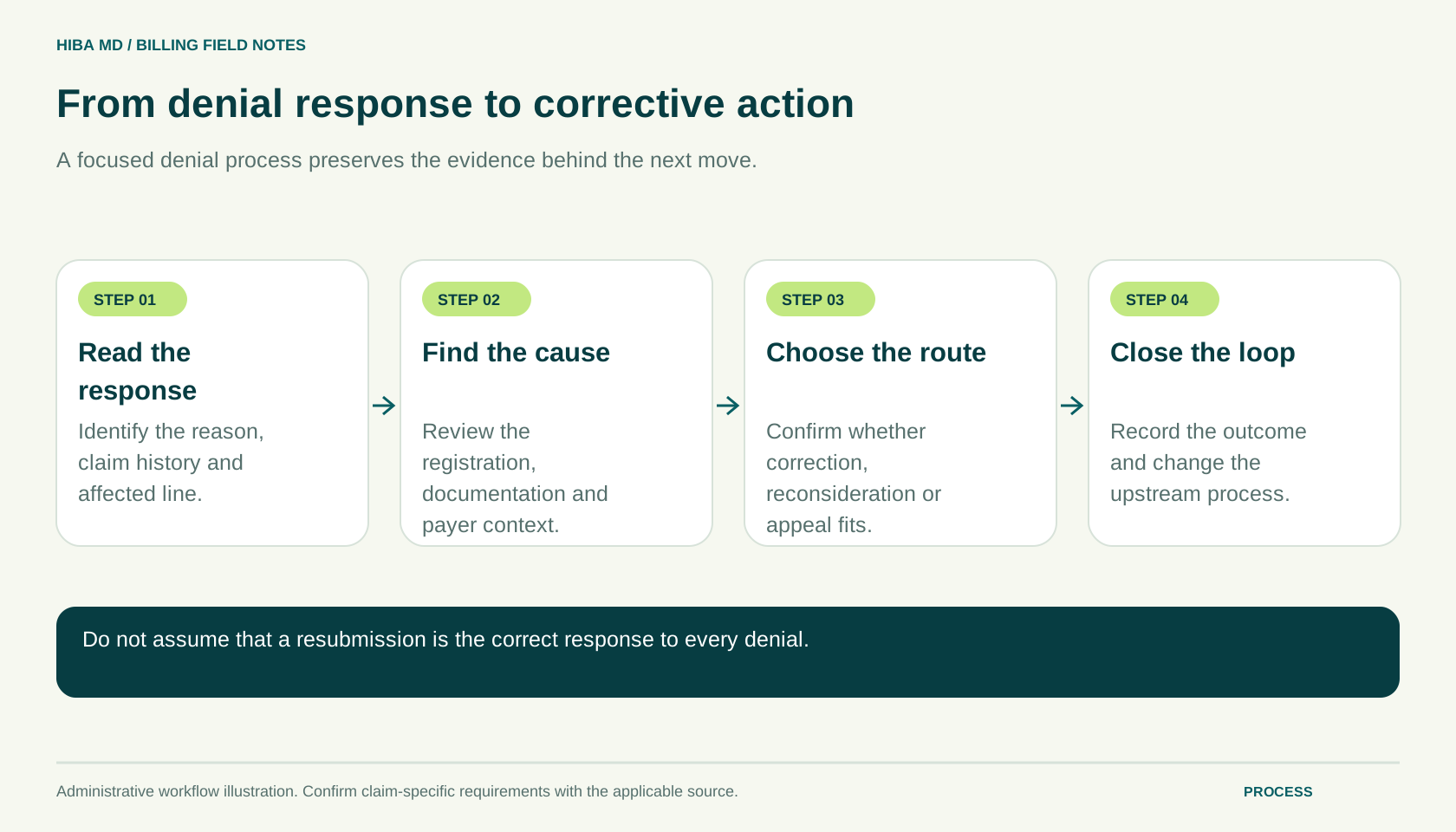
A rejection and a denial usually occur at different stages of the claim journey, so they should not automatically trigger the same response. A returned transaction may need correction before it can enter processing. An adjudicated denial may require investigation, a corrected claim, a payer inquiry or an appeal, depending on the actual determination. Read the response and identify the stage before choosing the route.
For practice administrators, the distinction matters because an undifferentiated denial queue hides different owners, evidence requirements and deadlines. This guide explains how to build a response-driven workflow, review recurring causes and measure progress without treating every unpaid account as the same problem. Worked examples are invented administrative scenarios, not payer instructions or Hiba MD performance results. Use the actual plan notice and current official references for a particular account.
Start with the response, not the dashboard label
Open the original acknowledgment, remittance or payer notice associated with the item. Record who issued it, what transaction or claim it refers to, the service dates and the stated status. A label imported into a practice dashboard can be useful for sorting, but it may compress several messages into one category. The underlying response is what tells you which question needs to be answered.
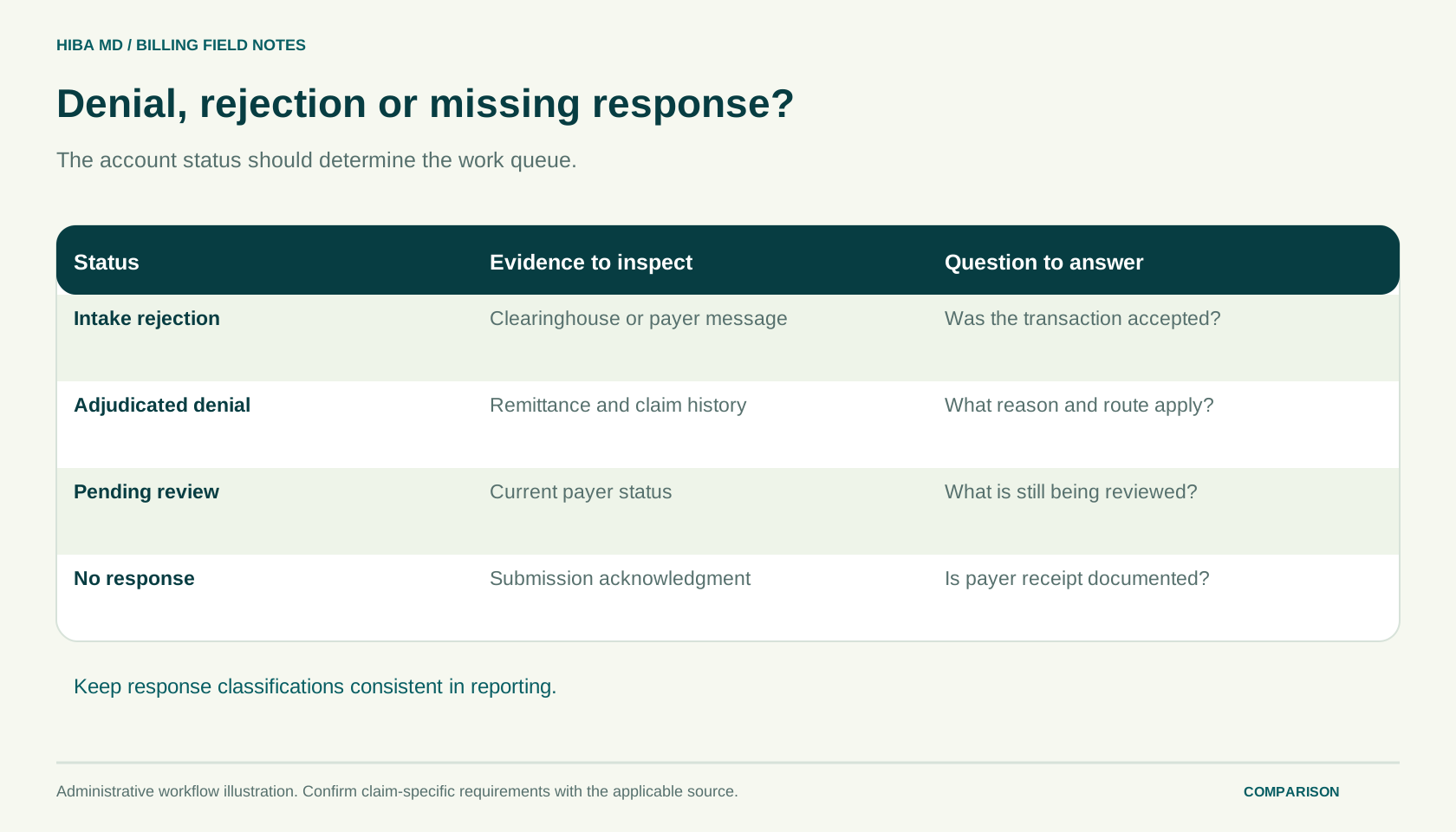
Ask whether the item has reached adjudication. A submission may fail a technical or administrative check before the payer makes a coverage or payment decision. Another claim may be accepted and subsequently adjudicated with an adverse determination. Those are distinct events even when the same front-end screen calls both of them denied. Your internal definitions should make that distinction reproducible for different staff members.
Keep the response reference with the work item in the approved practice system. When a second person takes over, they should not need to repeat the first investigation merely to find the notice. Record enough context to identify the relevant message and what remains unresolved, while avoiding unnecessary duplication of sensitive information in external spreadsheets or email chains.
Understand where a rejection can occur
A claim can pass through practice software, a clearinghouse and a payer-facing intake process. A negative response at one point may prevent it from advancing to the next. Your system's documentation and the relevant trading-partner instructions should explain the acknowledgments available at each stage. Do not assume that a successful file upload establishes acceptance of every claim in that file.
For example, a batch may transmit successfully while an individual record contains an invalid identifier. The appropriate task is to identify the exact field, confirm the source information and make the permitted correction through the established process. It is not necessarily an appeal of an adjudicated decision because the claim may not yet have reached that stage.
Create a separate unacknowledged-items view as well. An absent response does not prove either acceptance or rejection. Confirm the transmission reference and investigate through the correct technical or payer route. Tracking the expected response helps the practice find a stalled handoff before staff assume that an account is simply waiting for payment. The control is about locating evidence, not inventing a universal response timetable.
In a fictional batch, the clearinghouse accepts the file but reports that claim A failed an edit on the subscriber ID. Claim B appears on the payer remittance with a denied line. Check the registration record for claim A and verify that the corrected claim reaches the payer. For claim B, keep the payer claim reference and read the adjustment and remark together before choosing the next action. Keep the two records in separate queues so a batch receipt does not close either issue.
Read adjudication messages in full
CMS explains that Medicare remittance information communicates payment decisions and adjustments at different levels. Claim adjustment group codes, claim adjustment reason codes and remittance advice remark codes can contribute different pieces of that explanation. Read them together with the amounts, service lines and any associated notice. A single short description may not explain the entire decision.
The important operational question is what the response establishes and what still needs investigation. A contractual adjustment, an assigned patient amount, a denied line and a provider-level adjustment are not interchangeable categories. Avoid assigning financial responsibility solely because an unpaid amount remains on the account. Compare the actual response with the practice's approved policies, relevant contract information and current applicable requirements.
Suppose a remittance shows payment for one line and a different outcome for another. Treat the line-level issue precisely rather than calling the whole encounter unpaid. A useful work item identifies the affected line or amount and the evidence needed for review. That approach also improves reporting because the practice can distinguish partially paid claims from fully denied claims instead of losing the difference in one headline count.
Classify the cause and the required action separately
The reason an issue occurred is different from the task needed now. An eligibility mismatch might need registration clarification, while an authorization issue might need the actual response and service comparison. A documentation question may require a clinical or coding reviewer. A payment discrepancy may need a contract or fee-schedule reference. These causes should not all route to a generic resubmission instruction.
Use two fields in the queue: issue category and next action. Example issue categories include registration, participation, authorization, documentation, coding review, filing status and payment variance. Example actions include obtain missing information, check status, correct permitted data, request payer review and prepare an appeal. The exact vocabulary should fit your systems, but staff must understand what each selection means.
This separation helps a manager identify upstream patterns while keeping today's task clear. Ten accounts can share a registration cause but require different immediate actions depending on their current processing stage. Conversely, several different causes may all need a practice response before billing can proceed. A useful queue exposes both the pattern and the dependency instead of forcing one label to explain everything.
Investigate eligibility and payer-order questions
When the response points to coverage or payer order, review the service-date information rather than relying on what is active today. Confirm the patient and subscriber details, plan identity and any other coverage relevant to the encounter. Preserve the source and date checked. A card image can be useful supporting information, but it should not silently replace the actual plan response in the investigation.
CMS coordination-of-benefits resources explain that responsibility may need to be determined when more than one payer is involved. For a particular account, the team should confirm the appropriate route using the relevant program and plan information. Do not copy a rule from a different coverage arrangement merely because the payer names look similar. Medicare, Medicaid and commercial products can involve different administrative questions.
An illustrative account might have been submitted under an old employer plan even though the patient reported a change. The next step is to reconcile the recorded information and the relevant coverage evidence, then follow the actual correction or submission process. It is not enough to change the payer name and repeatedly send the claim without confirming the service-date arrangement and the status of prior submissions.
Compare authorization evidence with the completed service
An authorization reference number is only one part of the record. Review the response for the actual service scope, provider, location, dates and limits that matter to the arrangement. Compare those details with what was completed and documented. If the encounter changed after the request, identify the exact change and consult the appropriate current payer process.
Keep pending requests, submitted requests and recorded approvals distinct. A general system flag can hide a missing document or a mismatch between what was requested and what was reviewed. Staff should be able to locate the original response and understand who owns any unanswered question. A denial investigator needs that evidence before deciding whether the next step is clarification, correction or a request for review.
For a therapy example, the practice might see an adverse response after a visit count was tracked against the wrong period. Review the service dates, the authorization record and the actual plan instructions together. A remaining-units calculator can support arithmetic, but it cannot interpret the approval or establish coverage. The account needs a documented decision based on the controlling evidence, not an assumption derived from a green status badge.
Route documentation and coding questions to the right reviewer
Billing staff should describe the administrative issue precisely and request the relevant evidence through the approved practice process. They should not create missing clinical facts or modify the story of an encounter merely to overcome a response. A documentation query should identify the question and its context without directing a clinician to record an unsupported conclusion.
Coding edits also require the correct source and qualified review. CMS NCCI resources provide Medicare edit information and explain that modifier use must be supported by the circumstances and documentation. A returned or denied code combination is not a reason to append a modifier automatically. The appropriate reviewer needs the actual services, record, applicable edit and payer context before deciding what is supportable.
Keep the query, answer and resulting administrative action connected. If a claim is corrected after review, the history should explain why. If the original submission remains supported, identify the evidence and the appropriate dispute route. This allows a later reviewer to distinguish a genuine correction from a payer disagreement and reduces the chance that different staff send contradictory explanations about the same encounter.
Choose among correction, inquiry and appeal
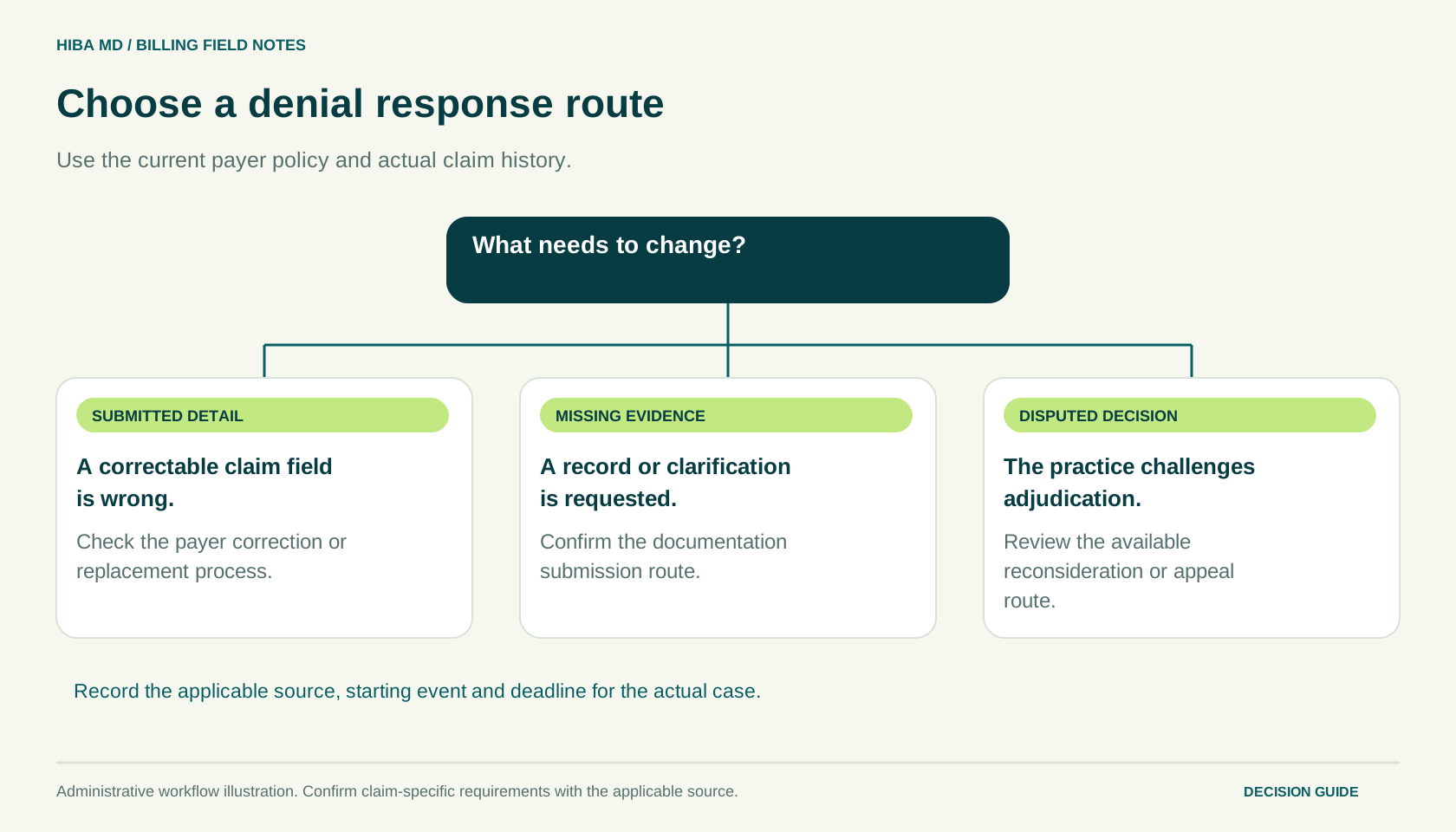
A corrected claim changes information through an allowed correction process. A status inquiry asks what has happened to a submitted item. An appeal challenges a determination through a specified review route. Those descriptions are useful starting points, but the actual payer instructions control which route is available and how to use it. A practice should not treat the terms as interchangeable buttons.
Before acting, ask what the team is trying to establish. If the payer has no record of the claim, find transmission and acknowledgment evidence. If accepted data are wrong, investigate the permitted correction route. If the data and documentation support the original position but the determination is adverse, review the appropriate appeal or reconsideration instructions. Record the reason for choosing the route.
CMS describes a multilevel appeal process for Original Medicare. That structure does not automatically apply to every commercial or managed-care claim. Use the actual program and notice, verify the current destination, and retain receipt evidence. Sending a persuasive letter to the wrong department can leave the underlying requirement unmet, so administrative accuracy matters alongside the substance of the explanation.

Track deadlines from the controlling source
For each time-sensitive item, record the source of the deadline, the event that starts the period, the required destination and what establishes timely receipt. The date a staff member opened an account may not be the date that controls. A reminder date used by the practice is also different from a filing or appeal deadline.
Use a calendar calculator only after the responsible reviewer has identified the applicable rule and inputs. It can add days to an entered date; it cannot decide whether the period uses calendar or business days, whether an exception applies, or whether a particular submission method establishes receipt. Keep the rule source with the result so another person can audit the arithmetic and the assumption separately.
Set an internal review date that leaves time for the real tasks: gathering evidence, obtaining an authorized review, completing the required form and transmitting through the appropriate route. If the team discovers a possible deadline problem, escalate it using the practice's process rather than quietly changing the date field. An accurate exception is more useful than a reassuring but unsupported due date.
Build a work queue that survives staff changes
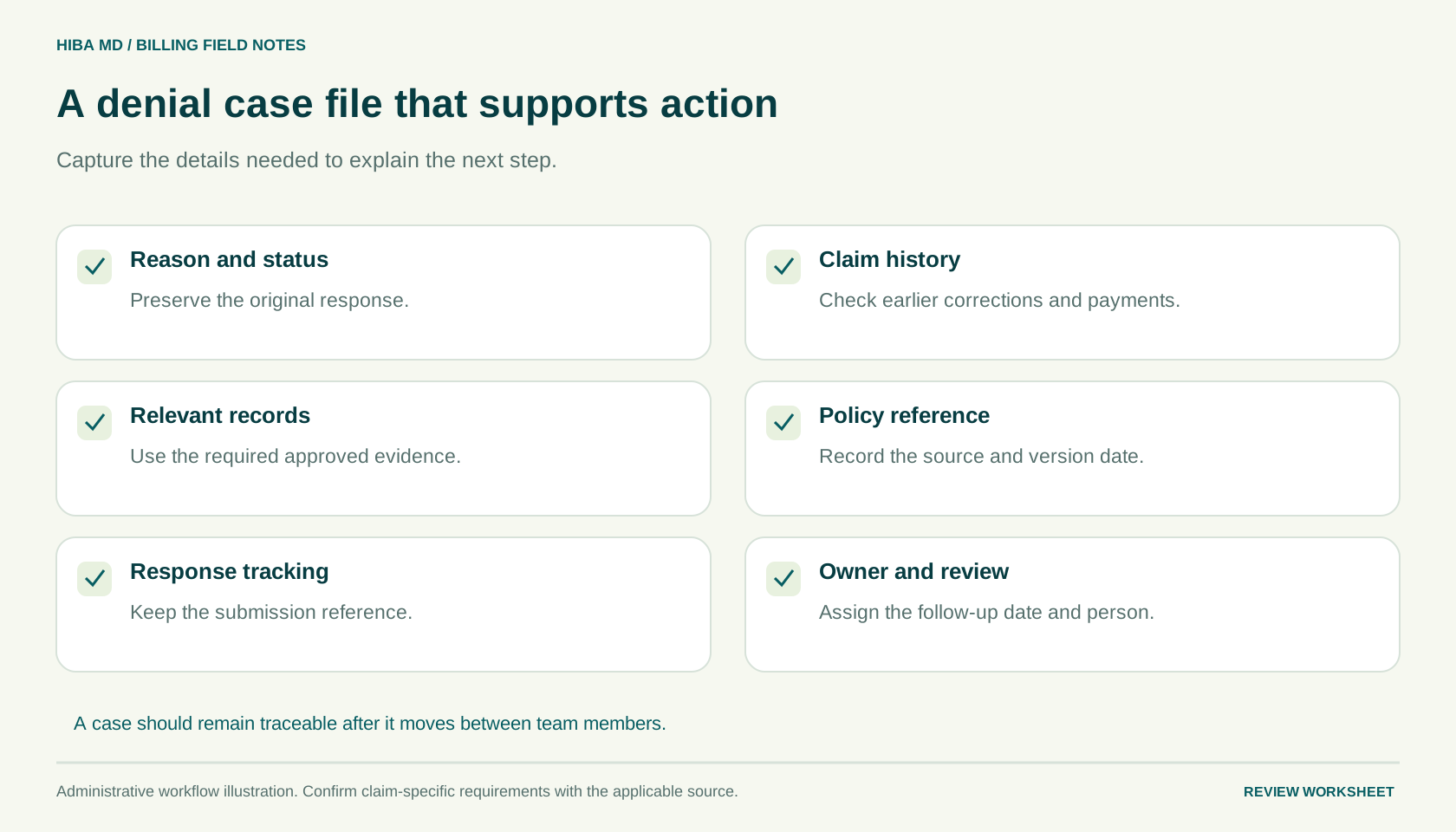
A workable queue records the account reference, response stage, issue, amount under review, evidence needed, next action, owner and next review date. Use links or references into the approved system rather than copying unnecessary patient details into a general management file. Someone taking over the item should be able to understand what has been established and what is still pending.
Document contacts meaningfully. Instead of called payer, record the question asked, the response, the reference and the agreed next step. If information was requested, note who is obtaining it and where it will be submitted. If no decision was available, record what status was confirmed and why the selected follow-up date makes sense for that particular situation.
Prioritize using more than balance age. Consider a verified deadline, availability of evidence, the amount at issue, recurring cause and whether a practice decision is blocking progress. A high-value item with no necessary record may need a documentation escalation, while a smaller complete appeal package may be ready for immediate action. The queue should help staff make that distinction visibly rather than relying on memory.
Measure denials with an explicit denominator
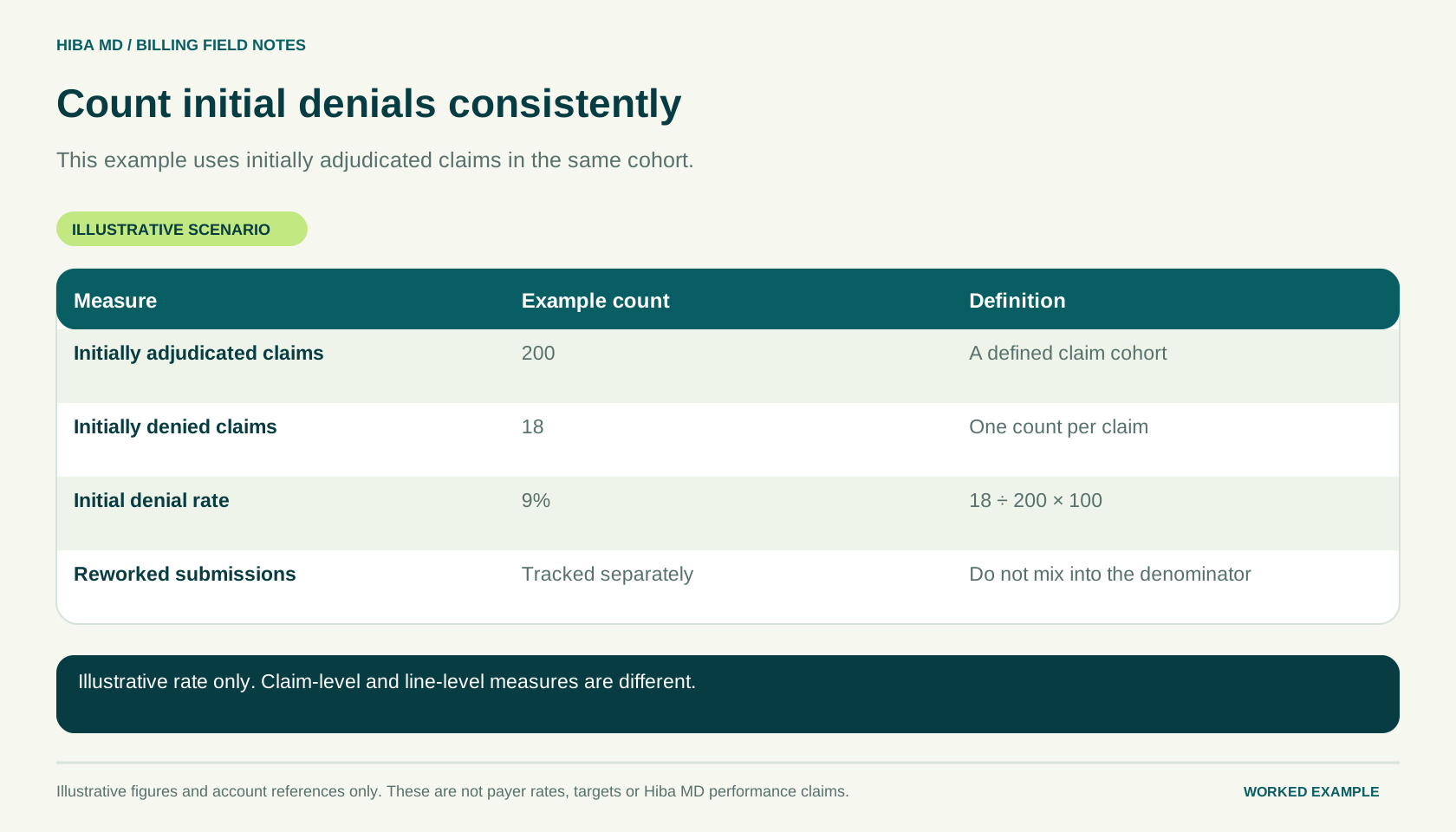
Decide whether the report counts claims, service lines or dollars. Then define the period and the stage included. A count of denied lines divided by a count of claims mixes units and can produce a misleading result. A measure that includes initial denials and later repeated responses may answer a different question from a first-adjudication measure.
For an invented example, 40 initially denied claims out of 800 adjudicated claims equals 5 percent under that specific definition. If those 40 claims contain 65 denied lines, a line-based measure will differ. Neither number alone explains recoverability, workload or the reason for the outcome. Keep the definitions next to the chart so the team can reproduce the calculation from the source population.
Combine the rate with an issue view and a status view. Ask which causes recur, which actions are pending, which items were resolved and what happened upstream. A falling rate can still conceal a growing unsubmitted queue if fewer claims reached adjudication. Reading adjacent stages together helps the practice avoid celebrating a metric that improved only because the underlying population changed.
Turn recurring responses into prevention work
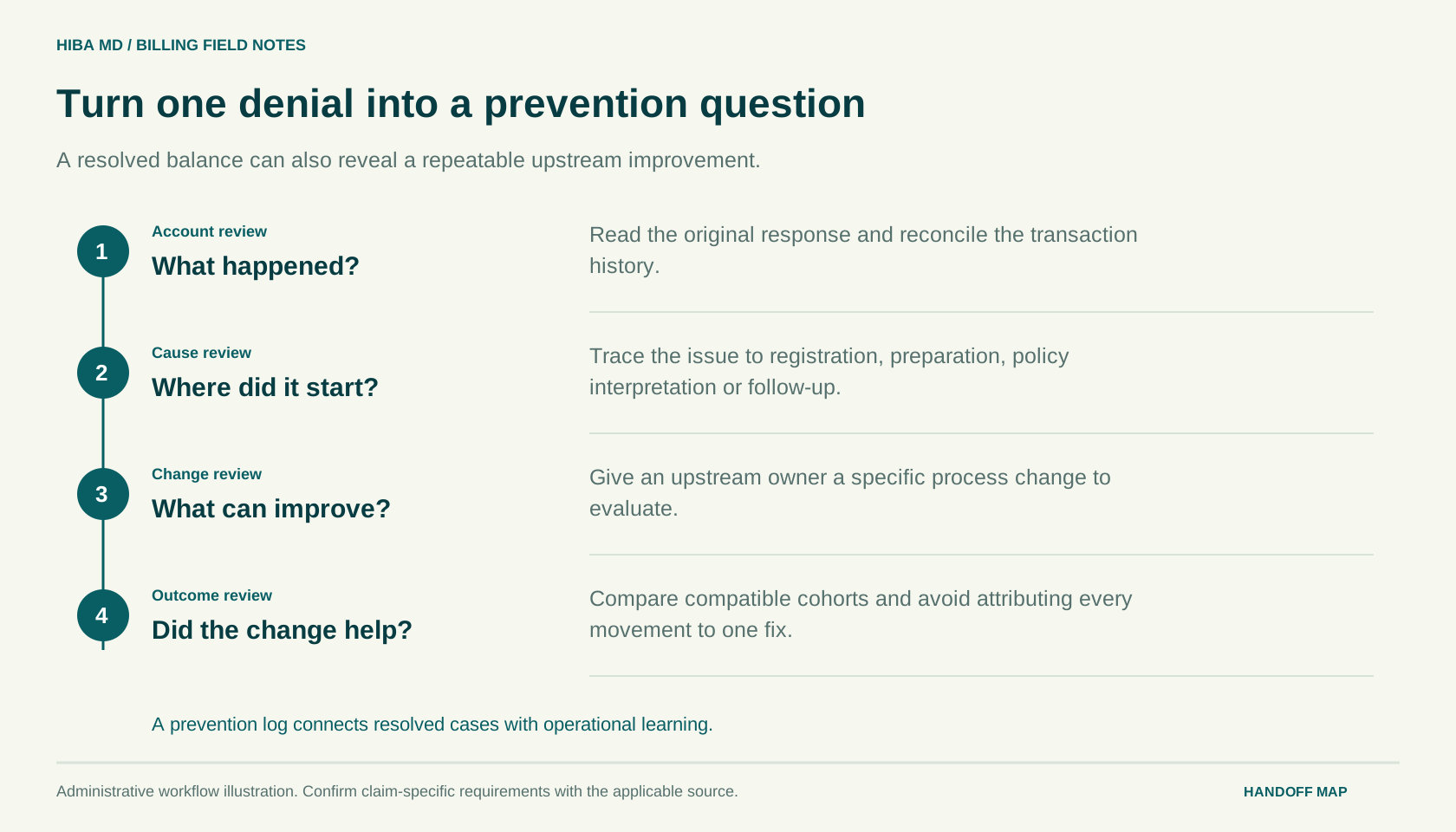
Choose one recurring cause and follow it backward through the workflow. If subscriber details are repeatedly wrong, inspect how the information is captured and confirmed. If documentation is consistently incomplete at charge release, inspect the readiness control. If a location mismatch recurs, compare scheduling, provider records and claim preparation. The goal is to identify a correctable handoff rather than assigning blame based on the final response.
Test the change on a defined population and review a later comparable period. Record what changed, who uses the new process and which exception it is meant to address. Keep other influences in view, such as a new payer mix or a reporting change. A local improvement should be evaluated with evidence rather than described as a guaranteed reduction across every specialty and plan.
Hiba MD can begin with a free audit discussion of your response queues and practice handoffs. One month of medical billing services is free, with no conditions. Bring an aggregate description of the issue, the systems involved and the current division of responsibilities. Any later record-level investigation should use the secure process agreed with the practice, with the actual payer evidence directing the next action.
Practice triage with six invented accounts
Build a training set that contains six different response situations: a technical return, an accepted claim awaiting adjudication, an adverse determination, a partially paid claim with a question, a paid claim awaiting posting and an account awaiting practice documentation. Give each item a source reference and a short history. Ask staff to identify the stage before choosing an action. The purpose is to expose how many different problems can be hidden behind the phrase unpaid claim. No actual patient information is needed for the exercise.
For the technical return, ask what evidence identifies the rejected field and who can confirm the correct value. For the pending claim, ask what status information is available and why another submission would or would not be appropriate. For the adverse determination, ask which notice and supporting records the reviewer needs. For the partial payment, ask what establishes the expected amount. The answers should describe an investigation and owner rather than a universal correction applied to every account.
For the paid-but-unposted account, route the issue to reconciliation and identify the source records needed. For the documentation dependency, identify the exact practice question and next review date. Then compare the six routes. If all six were placed in one appeal queue, which items would be delayed or sent to the wrong recipient? This tabletop review helps the team understand why precise stage definitions matter and why a useful queue needs more than an aging date and a broad denial label.
Audit the quality of the next-action record
Choose a defined sample of response work items and review the notes against a simple rubric. Can another person locate the original response, understand the issue, identify the evidence still needed and see who owns the next action? If the note includes a deadline, can the reviewer locate the controlling source and understand the starting event? The rubric tests continuity of the investigation. It does not judge whether a payer outcome was favorable or whether the worker made a large number of calls.
Record the findings by information gap. Missing response reference, unclear action, absent owner and unexplained follow-up date are different training questions. A note can be lengthy but still omit the one fact the next person needs. Conversely, a concise structured note can be highly usable. Share invented examples of a weak and improved note with the team, then revise the template to support the decisions staff actually make. Keep detailed account information inside the approved record system during the review.
After the template changes, review a later comparable sample. Ask whether the same information gaps remain and whether another staff member can continue the work without repeating the original contact. This is a practical process-quality check that the practice can control. It should not be described as proof that every denial will be overturned. The value is a better-supported investigation, clearer handoffs and fewer occasions when an account stalls because the next person cannot tell what happened or what is expected next.
Keep an evidence index for formal reviews
When a matter requires a formal payer review, create an index of the actual materials being submitted. Identify the determination, relevant claim reference, supporting record and explanation of the specific question. Use the current route and requirements for the actual arrangement. The index helps the responsible reviewer confirm that the package answers the issue raised rather than assembling a large collection of unrelated documents that obscures the important point.
Record which version was sent and retain the available submission or receipt evidence through the approved process. If additional material is requested later, connect it to the original reference and identify what changed. This supports continuity when a different staff member receives the next response. It also reduces the chance that two people send inconsistent explanations or assume that a document was included when it was only mentioned in an internal note.
After the response, update the account's current state and explain the disposition. Acknowledgment of receipt is different from a favorable decision. A partial outcome may leave another question unresolved. The work item should show what the latest evidence establishes and whether another supported step remains available. Treat the index as a practical organization tool, not a substitute for current requirements, authorized review or a judgment about whether the substantive position is supported by the actual record.
Review closed items as well as open ones
An open queue shows unresolved work, but a closed-item sample can reveal whether outcomes were recorded accurately. Select a defined group and ask what evidence supports the disposition. Was a payment received and reconciled, was a supported adjustment applied, was the question resolved another way, or was the item transferred to a continuing process? These outcomes should remain distinguishable so management understands what closed actually means.
Include items with apparently straightforward results. A favorable status in one screen may not show whether the ledger was updated or another line remains unresolved. The review should connect the final note with the actual response and account state. It does not need to repeat every investigation. It checks whether the evidence supports the recorded completion and whether another team still owns an outstanding dependency.
Use the findings to refine status definitions and training. If staff close an item after receiving an acknowledgment rather than a decision, clarify the distinction. If transfers lose ownership, improve the handoff field. A well-defined closed state gives the practice a more trustworthy view of the response cycle and makes a later recovery report easier to assess without relying on broad labels or unverified assumptions about the accounts.
Frequently asked questions
Does a rejection always mean the payer denied coverage?
No. A rejection may occur before adjudication because a transaction or claim did not pass an intake check. Read the actual response to identify the stage and required action. An internal label is not enough to establish that a coverage decision has been made or that an appeal is the appropriate next step.
Should every denied claim be resubmitted?
No. Repeated submission without understanding the response can create duplicate or conflicting work. The next step may be a permitted correction, a missing-information request, a status inquiry or an appeal. Review the original determination, the actual record and the current payer process before choosing the route.
Can we use the same appeal deadline for every payer?
No. The relevant period and its starting event depend on the applicable program, notice, contract and current requirements. Record the controlling source and verify receipt instructions. A general date calculator can support arithmetic once those inputs are established; it cannot select the rule or interpret an exception.
What is the difference between denial prevention and recovery?
Recovery addresses an existing adverse response or payment question. Prevention examines recurring causes and improves the earlier handoff that generated them. A practical program needs both: a well-owned response queue and a separate process for testing whether registration, authorization, documentation or submission changes reduce a specific recurring issue.
What can we discuss in a free Hiba MD audit?
Describe the types of responses your practice sees, the affected specialties and systems, and the parts of the work queue that need clearer ownership. Aggregate information is enough for the first conversation. Do not send patient records through the public website; agree a secure process before any detailed account review.
Sources and editorial notes
Written by the Hiba MD editorial team. Reviewed 2026-11-18. Worked examples use illustrative figures, not client results or performance benchmarks. This guide explains administrative workflows; check current payer requirements for claim-specific decisions.
