
Credentialing, payer enrollment and network participation are related administrative processes, but they do not mean the same thing. A complete provider profile is not the same as a confirmed participation arrangement, and an NPI is not evidence that a particular payer will process a particular provider's claim as intended. A useful workflow tracks the actual provider, entity, location, plan and effective dates separately.

Start with the practical question
This guide helps practice administrators organize the records, questions and handoffs involved when a clinician joins, a location changes or payer information needs updating. It is an operational planning guide rather than a promise about approval, processing time or payment. Use the relevant payer's current instructions and official program resources for an actual application. Examples are illustrative and do not describe Hiba MD clients or guaranteed enrollment outcomes.
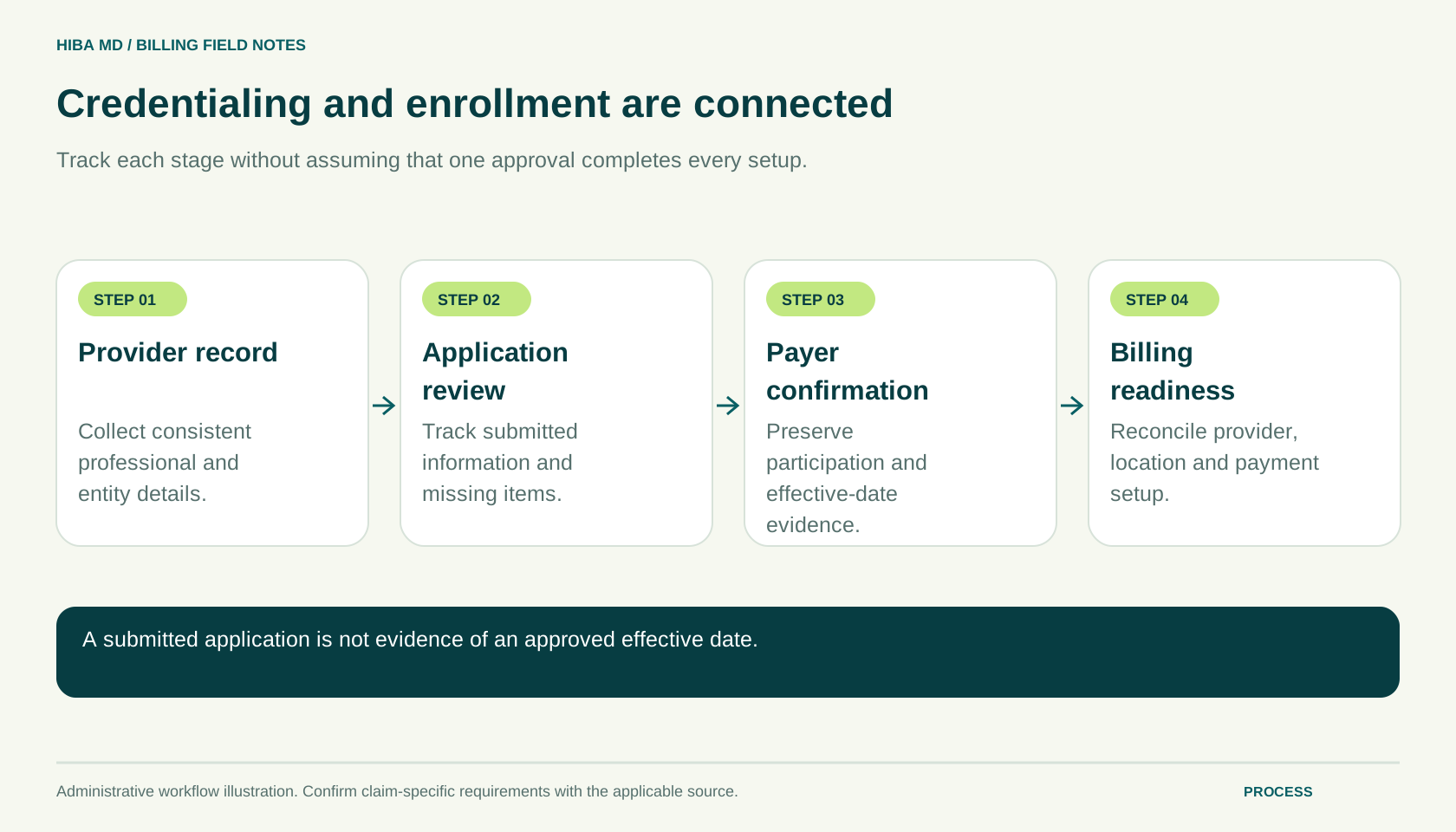
Separate the decisions you are trying to confirm
Begin by naming the administrative question. Credentialing generally concerns the review of a professional's qualifications and related information. Enrollment establishes information within a payer or program's administrative process. Contracting and network participation concern another set of arrangements. The precise terminology varies, so confirm what the organization actually means when it marks an application complete or approved.
Create separate status fields rather than a single credentialed checkbox. Track the source record, application, missing information, review outcome, participation details and effective-date confirmation as appropriate. If the practice uses a credentialing service, ask which of these tasks are included and which decisions still belong to the payer, clinician or practice. A service provider can coordinate a process without controlling the decision.
For a new clinician, the manager should be able to answer a concrete question: which arrangements have been confirmed for this individual at this entity and location? That is more useful than a general statement that the practice accepts a payer. Record unresolved questions visibly so scheduling, administration and billing do not infer a broader approval from a narrower completed step.
Build a reliable provider and location record
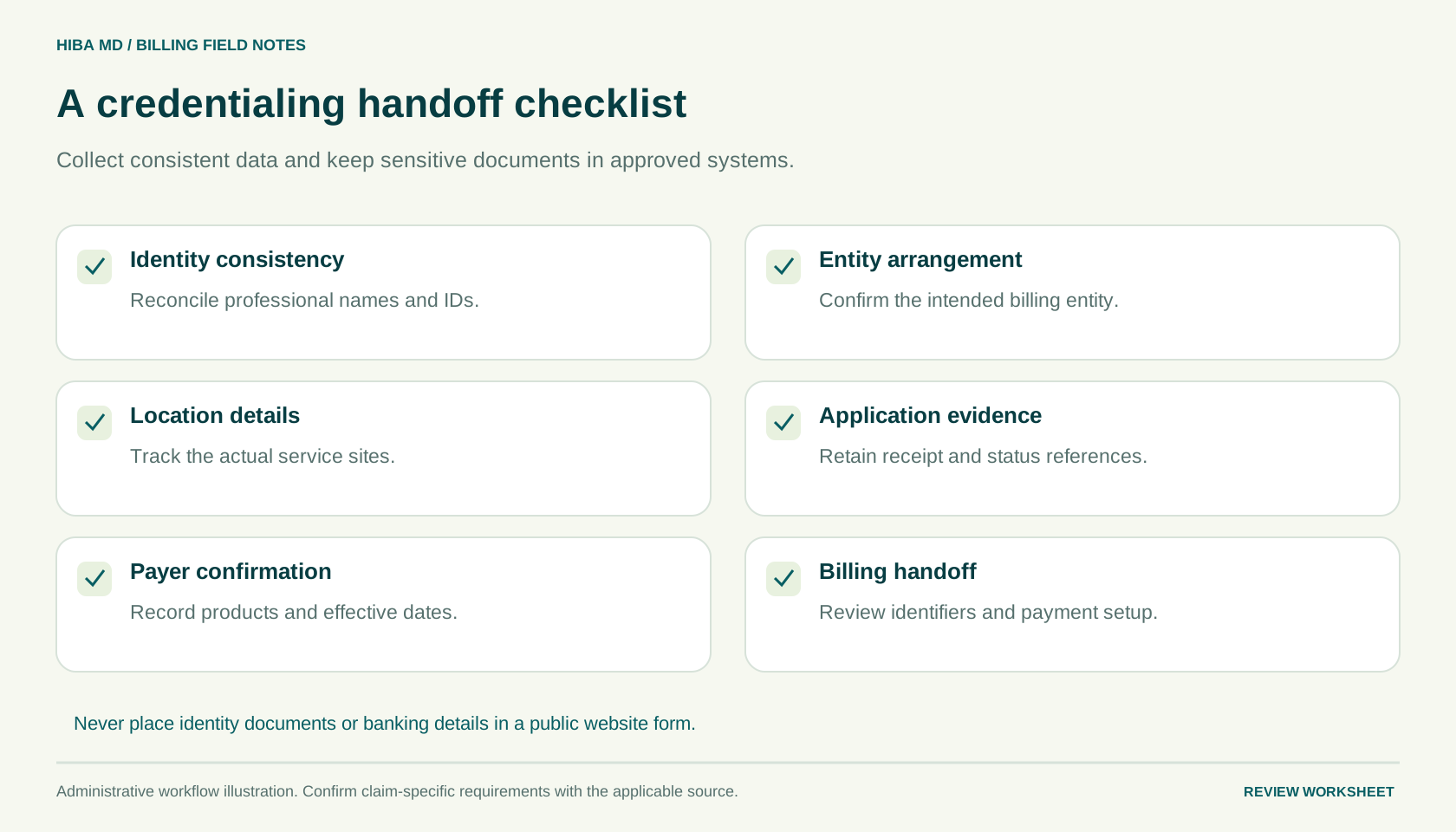
Collect the information the actual process requires and organize it under the correct person or entity. Professional identifiers, contact information, practice locations, education and training records, licensure and liability documentation may appear in different parts of the workflow. Use a controlled source so staff do not repeatedly copy inconsistent details from old applications or email signatures.
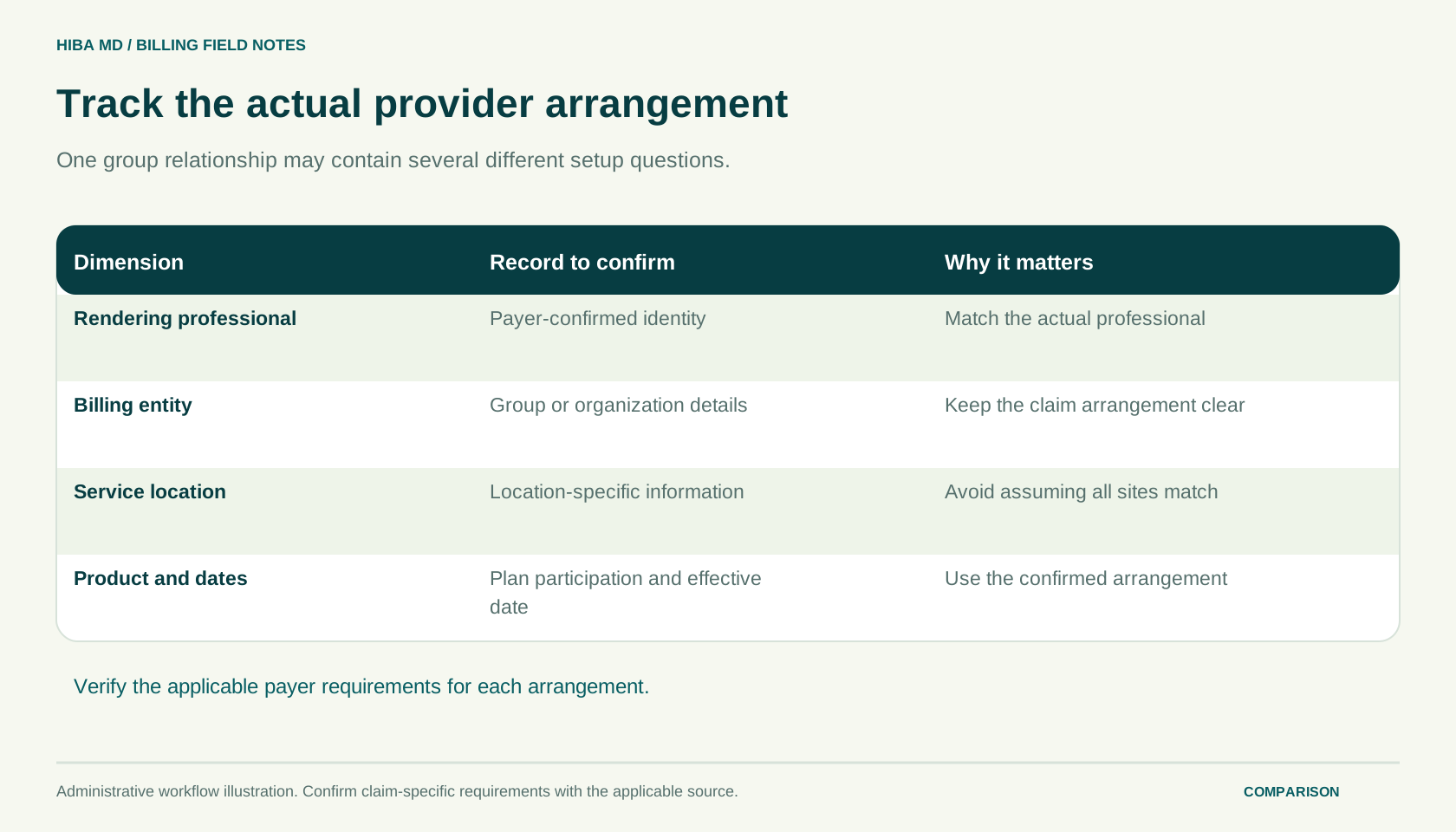
Distinguish an individual clinician from an organizational billing entity. Also distinguish a mailing address, a service location and another administrative address when the application does so. An apparently small mismatch can create additional questions if different forms describe the same arrangement differently. The goal is consistent, supportable information, not making every field identical when the underlying facts are actually different.
Assign a record owner who coordinates changes and identifies the relevant authoritative source. That person need not make every decision, but they should know where the current record is kept and how a correction is approved. Keep sensitive identifiers and supporting documents in the practice's approved system. A public lead form or general shared checklist should not become a repository for credentialing files or account passwords.
Understand the role and limits of an NPI
CMS identifies the National Provider Identifier as part of the provider enrollment sequence. The NPI identifies a provider within the relevant administrative framework; obtaining or validating one does not establish that a payer application is approved, a network arrangement is active or every service is covered. Keep identity validation separate from participation and claim-specific questions.
The practice should confirm the identifier against its source record and the actual provider arrangement being used. When a clinician's information changes, determine which records need attention rather than assuming an update in one system automatically changes all others. NPPES information, Medicare enrollment information and a commercial payer's records can involve distinct workflows.
An NPI checksum tool has an even narrower purpose: it tests whether an entered number has the expected mathematical structure. A passing checksum is not a registry lookup, proof of ownership, license verification or enrollment confirmation. Hiba MD's free validator should be used with that limit in mind. It is useful for identifying a possible entry error, while actual provider verification belongs with the relevant official source and practice process.
Use the correct Medicare enrollment route
CMS provides provider and supplier enrollment resources and describes PECOS as the online Medicare enrollment system. Begin with the resource appropriate to the actual provider or supplier type. The requirements for an individual professional, an organization and a supplier arrangement should not be inferred from a generic checklist intended for another category.
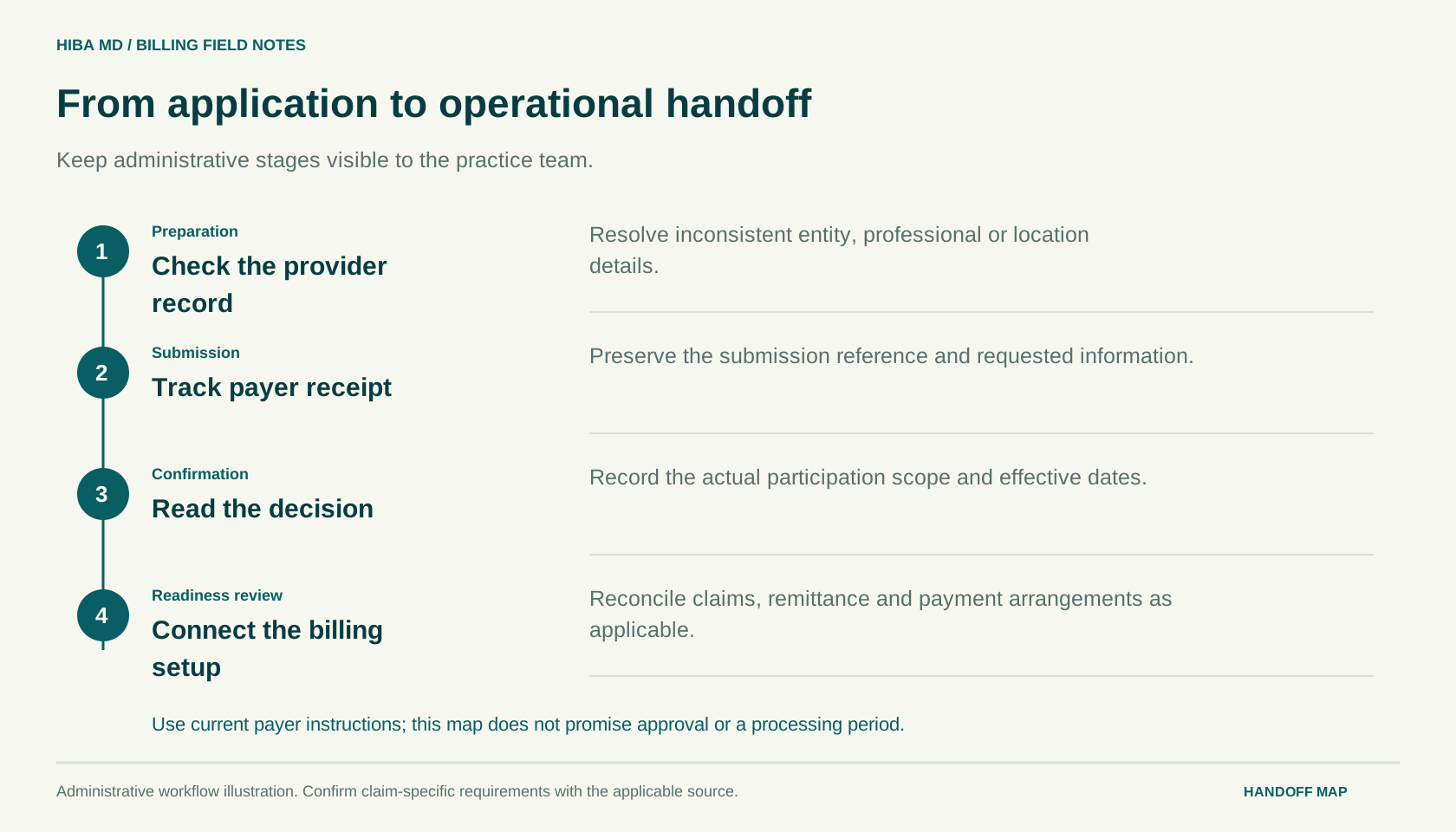
Record which application or update is being prepared, who is authorized to review it and what information remains outstanding. Keep the application reference and current status in the practice's tracking system. If clarification is requested, attach the request to the task and assign the response to the person who can supply accurate information. Avoid repeatedly resubmitting without understanding why the previous submission needs attention.
For claim-routing and enrollment questions, use the relevant CMS and Medicare Administrative Contractor resources. Confirm the actual jurisdiction and arrangement rather than selecting a contact based only on the practice's preferred office address. The website can help a reader find official starting points, but it should not substitute for a current program determination about a specific enrollment record or effective date.
Track the plan, product and participation details
A payer name can include different products and administrative arrangements. Record the specific plan or network relevant to the practice question and preserve the source of confirmation. If a clinician works in more than one location or under more than one entity, identify which combination the confirmation covers. A group-level summary should not hide differences that matter to actual scheduling and claim preparation.
Ask what the confirmation means in operational terms. Does it identify the professional, entity, location and relevant effective date? Are any steps still pending? Is there a separate system update or routing question to resolve? The answers should come from the actual payer or program process. Staff should not fill a gap with assumptions based on how another plan handled a similar application.
For an illustrative example, a clinician may be confirmed at an established office while a new location is still under review. A single active label would conceal that difference. A location-specific record helps the practice identify the unresolved question before the relevant appointments and claims are handled using an arrangement that has not actually been confirmed.
Keep effective dates separate from application dates
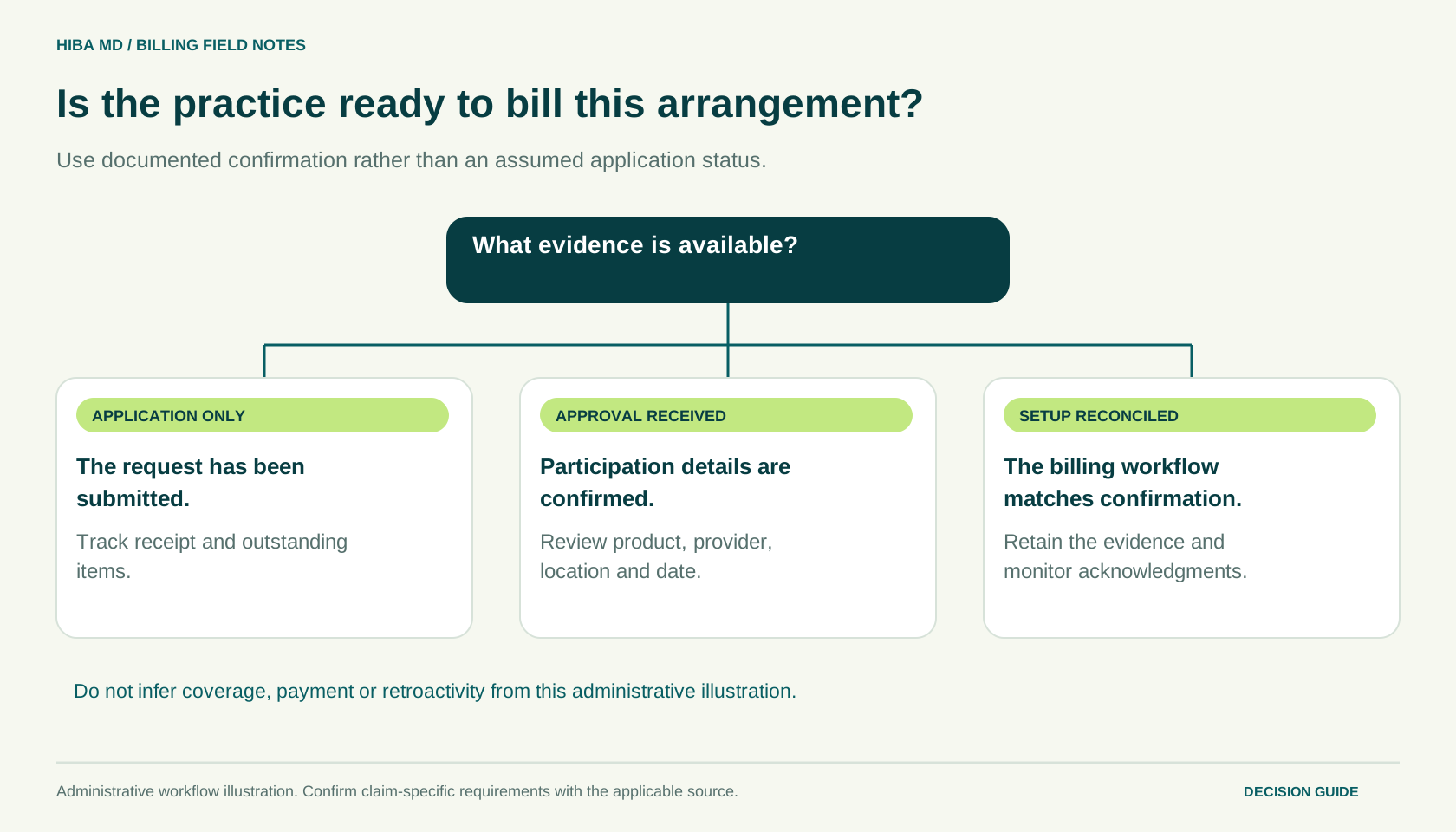
The date an application was submitted, the date a profile was updated and the date a participation arrangement is effective are different facts. Track them in separate fields. If a payer issues a confirmation, retain the actual document and record the effective date it states for the relevant arrangement. Do not infer retroactivity or prospective approval without supporting evidence.
Share confirmed information with the people who need it for their role. Scheduling may need to know what has been established for a planned appointment. Billing needs the relevant service-date arrangement and any unresolved routing question. Management needs a clear status view. Each team should receive the decision and its scope rather than a vague message that everything is done.
If an effective-date question remains unresolved, assign it to an owner and identify the source being consulted. The practice may need to make a separate operational decision about scheduling or financial communication. A tracking worksheet can highlight the question, but it cannot make that decision or promise how a payer will adjudicate a service delivered during an uncertain period.
Respond to missing-information requests precisely
When a payer or program requests clarification, read the complete request and identify the exact record or explanation needed. Note the response route, reference and any applicable current requirement. Send the request to the person who can supply accurate information rather than asking several staff members to produce different versions of the same document.
Use a controlled response checklist: requested item, source owner, date received, review status, submission method and confirmation. This is especially helpful when several clinicians are being onboarded at once. A request for one provider should not be marked complete because a similar document was supplied for another. The tracking record should distinguish the individual application and its current outstanding items.
After responding, retain receipt evidence where the system provides it and record what the team expects next. A document upload is not necessarily the final review outcome. If no response is available, follow the appropriate inquiry route with the application reference. The purpose is to establish the application's actual state, not to generate a succession of duplicate submissions that make the history harder to understand.

Maintain changes after the initial approval
Provider information can change when a clinician moves, adds a location, changes an entity relationship or updates professional documentation. Create a change-intake process so the relevant administrative owner learns about the change in time to identify affected records. A correct initial application can become an unreliable reference if nobody owns maintenance afterward.
List the systems and organizations that may require separate review. Do not assume that updating a shared provider profile, an NPI record or one payer automatically updates every other record. Confirm the actual requirements and retain the relevant confirmations. The maintenance log should show what changed, which arrangements were reviewed and which questions remain pending.
An illustrative practice expansion may involve a new office, a new scheduling template and a clinician splitting time between sites. Those operational changes should trigger a review of the provider and location record used by billing. The aim is to identify the administrative consequences before inconsistent addresses or participation assumptions begin appearing across appointments, claims and payer inquiries.
Connect enrollment status with the first claims
When a confirmed arrangement becomes operational, review the first relevant claims and responses deliberately. Confirm that the practice is using the intended provider, entity, location and destination. If a response raises a participation or identifier question, compare it with the actual confirmation and source records rather than changing claim details until a submission happens to pass.
Keep enrollment investigation separate from coding or coverage review. An adverse response mentioning provider information may require a record or system clarification, while another response may concern the service itself. The team needs the exact message and context to choose the right route. A general credentialing-complete status cannot answer every claim-level question that occurs after onboarding.
Use the findings to improve the handoff. If billing did not receive the effective-date confirmation, establish where that record will be stored and who announces future changes. If the confirmation was ambiguous, identify the specific question to ask the payer. This creates a feedback loop between enrollment administration and billing without pretending that either team can guarantee a payer's final claim decision.
Protect documents and role-appropriate access
Credentialing and enrollment work can involve sensitive personal and professional information. Agree where documents are stored, who can view them and how they are shared with authorized recipients. Use the access mechanisms provided by the relevant systems and the practice's approved procedures. Avoid putting credentials, identity documents or confidential records into a general inquiry form.
When an outside service handles information involving protected health information on behalf of a covered entity, HHS business-associate guidance may be relevant to the arrangement. The actual access and data flows should be reviewed appropriately. A website should not replace that assessment with a broad badge or a statement that a simple checklist proves compliance.
Include access changes in onboarding and offboarding. Identify who removes a former staff member's access and how current owners continue the work. The status record should remain understandable even when the individual who prepared an application is no longer available. Clear ownership, documented references and approved access together make the process less dependent on one person's inbox or memory.
Build a management view of readiness
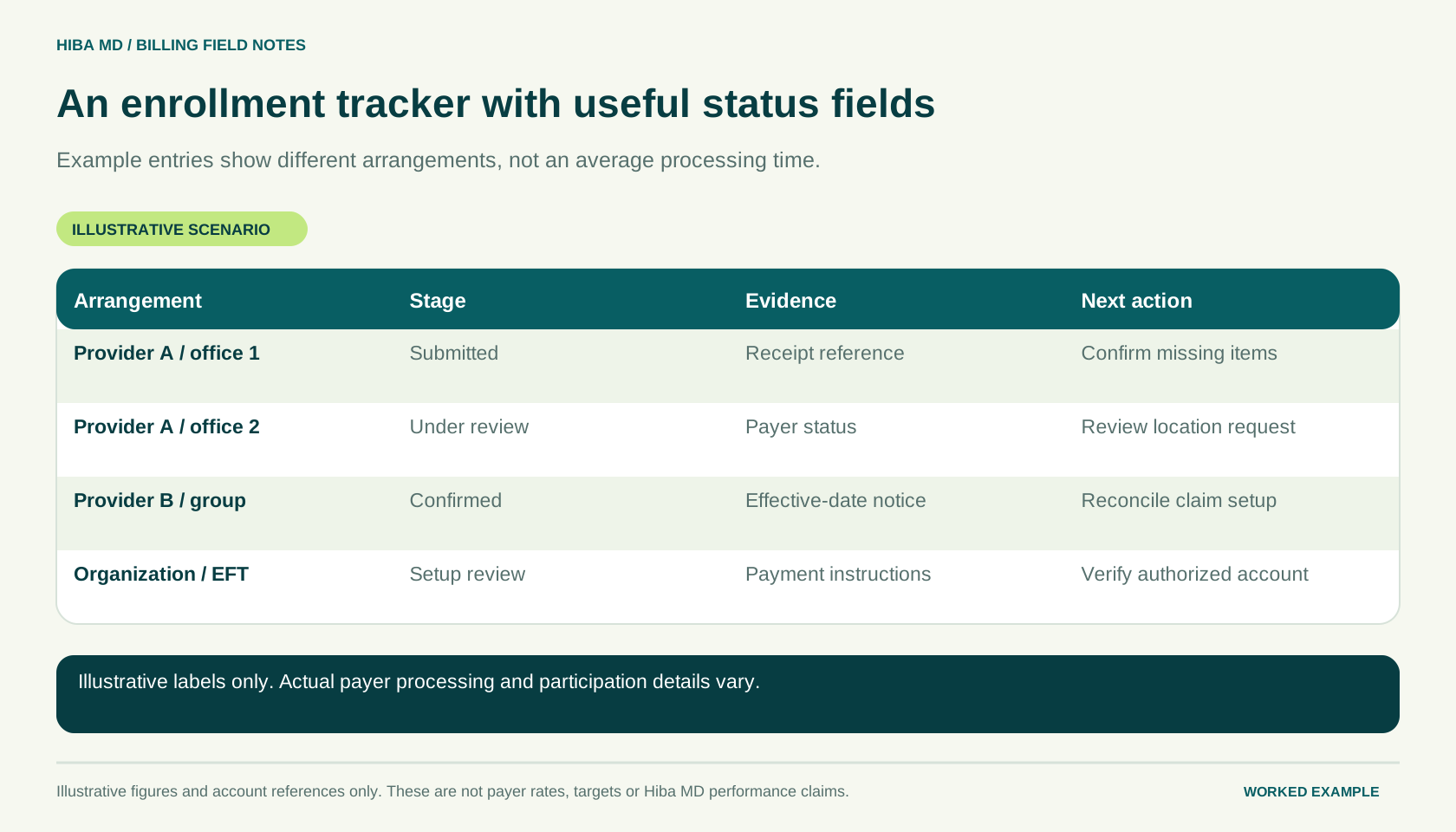
Organize the tracking view around actual arrangements rather than a list of provider names alone. Useful fields include provider, entity, location, plan or program, application type, current stage, missing information, owner, source confirmation and effective date where established. Keep sensitive details in the underlying approved system and use an aggregate summary for routine management discussion.
Measure the work you can define. Count applications awaiting a practice document separately from applications under payer review. Track changes in those categories over a stated period. An average turnaround number can be misleading when it mixes different application types, incomplete submissions and different starting events. Define the measure before using it to judge staff or compare service proposals.
For a practical weekly review, ask which arrangements need a decision before the next scheduling or billing milestone. Resolve one dependency at a time: obtain a current record, clarify an address, confirm the effective date or investigate a payer request. The meeting should produce a named next action. A long list of pending applications without those distinctions offers very little help to the people doing the work.
Compare credentialing support by scope and evidence
When evaluating outside help, ask which tasks are included: source-data collection, profile maintenance, application preparation, missing-information follow-up, payer communication, status reporting and change management. Identify what the clinician or practice must still review or authorize. A proposal that mentions enrollment support may cover fewer steps than the practice expects, so compare the work rather than the label.
Ask how the service documents confirmations and unresolved questions. The practice should be able to see the actual stage and locate the relevant source. Be cautious about a universal processing-time promise across different programs and arrangements. An administrative partner can coordinate follow-up and improve visibility, but the reviewing organization controls its own decision and may request additional information.
Hiba MD offers a free audit conversation and one month of medical billing services free, with no conditions. Use the discussion to connect provider readiness with the billing workflow you actually need. Bring an aggregate description of upcoming providers, locations and payer questions. Detailed professional records and any later account-level information should move only through the secure process agreed with the practice.
Test readiness with a provider-location matrix
Create an invented example with two clinicians, two service locations and three payer arrangements. A simple grid exposes up to 12 combinations that may need a defined status, although the actual requirements must come from the relevant payer or program. Do not assume that every cell requires the same application. The point is to ask what has been confirmed for each arrangement and where the evidence is stored. A broad provider-active label can hide differences that the grid makes visible.
For each relevant cell, record the source confirmation, scope, effective date where established and any unresolved question. One clinician may be confirmed at the original location while a new location remains under review. Another may have a current shared profile but no final payer confirmation. Use different statuses for those situations. The exercise helps scheduling and billing understand why profile completion, application submission and confirmed participation should not be merged into one checkbox simply to simplify the dashboard.
Review the grid with the people who use the information. Ask which fields they need before making an operational decision and which questions must be escalated. Keep the underlying professional documents in approved systems, with the grid serving as a reference rather than a duplicate sensitive record store. When the arrangement changes, update the affected cells and notify the relevant owners. That is a practical way to maintain clarity across a growing group without relying on a manager's memory of every application.
Run a controlled change-notification exercise
Use an invented location change to test the practice's process from beginning to end. Identify who learns about the change first, who coordinates the provider record and who reviews the affected payer or program arrangements. List the systems that may need separate attention without assuming that one update propagates everywhere. The exercise should reveal the actual notification path and the point where an owner confirms which requirements apply. A task list is useful only if the people named know they are responsible.
Next, ask how the change reaches scheduling and billing. What information establishes the current arrangement, and what should staff do while a question is unresolved? The practice needs a clear status message that does not overstate approval. If the team only sends an email saying new address, important details may be lost. A structured notice can identify the provider, entity, location, relevant source and pending questions while leaving sensitive supporting documents inside the approved system.
Finally, examine the first relevant claims and responses after the change through the practice's review process. The aim is to confirm that the administrative handoff worked, not to assume that any later payer issue has the same cause. Record discrepancies precisely and route them to the owner who can investigate the actual source. This closes the loop between a management change, maintained provider information and the billing workflow, giving the practice a repeatable method for future additions or moves.
Review the application record before closing the task
Define what completed means for each task type. Preparing an application, submitting it, answering a request and receiving a final confirmation are separate accomplishments. A task can be complete while the broader arrangement remains under review. Closing the task should not remove the unresolved arrangement from management visibility. Keep the next responsible owner and source reference connected so the process continues after an individual activity is finished.
Before closing a confirmation task, ask whether the scope and effective-date information were recorded, the source was retained and relevant scheduling or billing owners were notified. If the confirmation leaves a question unanswered, create that question as a separate owned item. This is more reliable than leaving an ambiguous comment on an otherwise completed record and hoping that the person who needs the answer will notice it later.
Use a periodic sample review to check whether closed tasks remain understandable to someone who did not perform them. Can the reviewer locate the actual confirmation and tell which provider, entity, location and arrangement it covers? If not, improve the record template or handoff. The review does not need to duplicate the payer's decision. It checks whether the practice preserved the evidence and communicated its actual scope, which are the parts of the process the practice can manage directly.
Prepare a useful status update for leadership
Summarize the arrangements needing a decision, the current dependency and the owner of the next action. Leadership usually does not need copies of every professional document to understand the readiness question. An aggregate status can identify a location confirmation still pending, an application awaiting practice information or an effective-date clarification. Keep sensitive supporting material inside the approved system and provide the reference needed by authorized reviewers.
Avoid an overall completion percentage unless its population and meaning are clear. Ten completed profile updates are not equivalent to ten confirmed payer arrangements. A useful summary separates the task stages so a manager can see what is actually ready and what remains uncertain. If scheduling or billing needs a decision, identify the exact question and who is authorized to make it under the practice's process.
Date the summary and identify the source owner for current status. An application can change after the report is distributed, so readers need to know whether they are viewing a snapshot or a live record. This supports accurate communication across teams and reduces the chance that an old management attachment is later treated as current evidence of participation for an encounter it never described.
Frequently asked questions
Does having an NPI mean a provider is enrolled with a payer?
No. An NPI identifies the provider within the relevant administrative system. It does not confirm a particular enrollment, network arrangement, effective date or service coverage. Verify those matters with the applicable program or payer and retain the actual confirmation for the provider, entity and location involved.
Is a completed CAQH profile the same as payer approval?
No. A shared provider-data profile supports information collection and authorized sharing. A payer may still need its own application, review, clarification or participation confirmation. Keep profile completion, access authorization, payer review and confirmed effective dates as distinct statuses so the practice does not infer a broader approval.
Can one provider record cover every practice location?
That depends on the actual program and payer arrangement. The practical approach is to identify each relevant clinician, entity and location combination, then confirm what the source documentation covers. Do not assume that an established office's confirmation automatically resolves questions about a new service location or different entity relationship.
Should we promise a fixed enrollment completion date?
An internal planning milestone can be useful, but it is different from the reviewing organization's final decision. Track the application stage, missing information and dependencies, and communicate uncertainty clearly. Use actual confirmations for effective-date decisions rather than treating a target date or submission receipt as evidence of approval.
What information should we send through the Hiba MD website?
Send business contact information and an aggregate description of the administrative question. Do not upload identity documents, passwords, provider files or patient records through a public inquiry form. The initial conversation can establish the service scope and a secure process for any later detailed record exchange.
Sources and editorial notes
Written by the Hiba MD editorial team. Reviewed 2026-10-31. Worked examples use illustrative figures, not client results or performance benchmarks. This guide explains administrative workflows; check current payer requirements for claim-specific decisions.
