
The choice between in-house billing and an outside billing company should begin with the work your practice needs, not a headline percentage. Compare responsibilities, total operating cost, coverage when people are unavailable, access to information, specialty workflows and the transition plan. Either model needs clear practice ownership and supported documentation; an external partner does not remove those responsibilities.
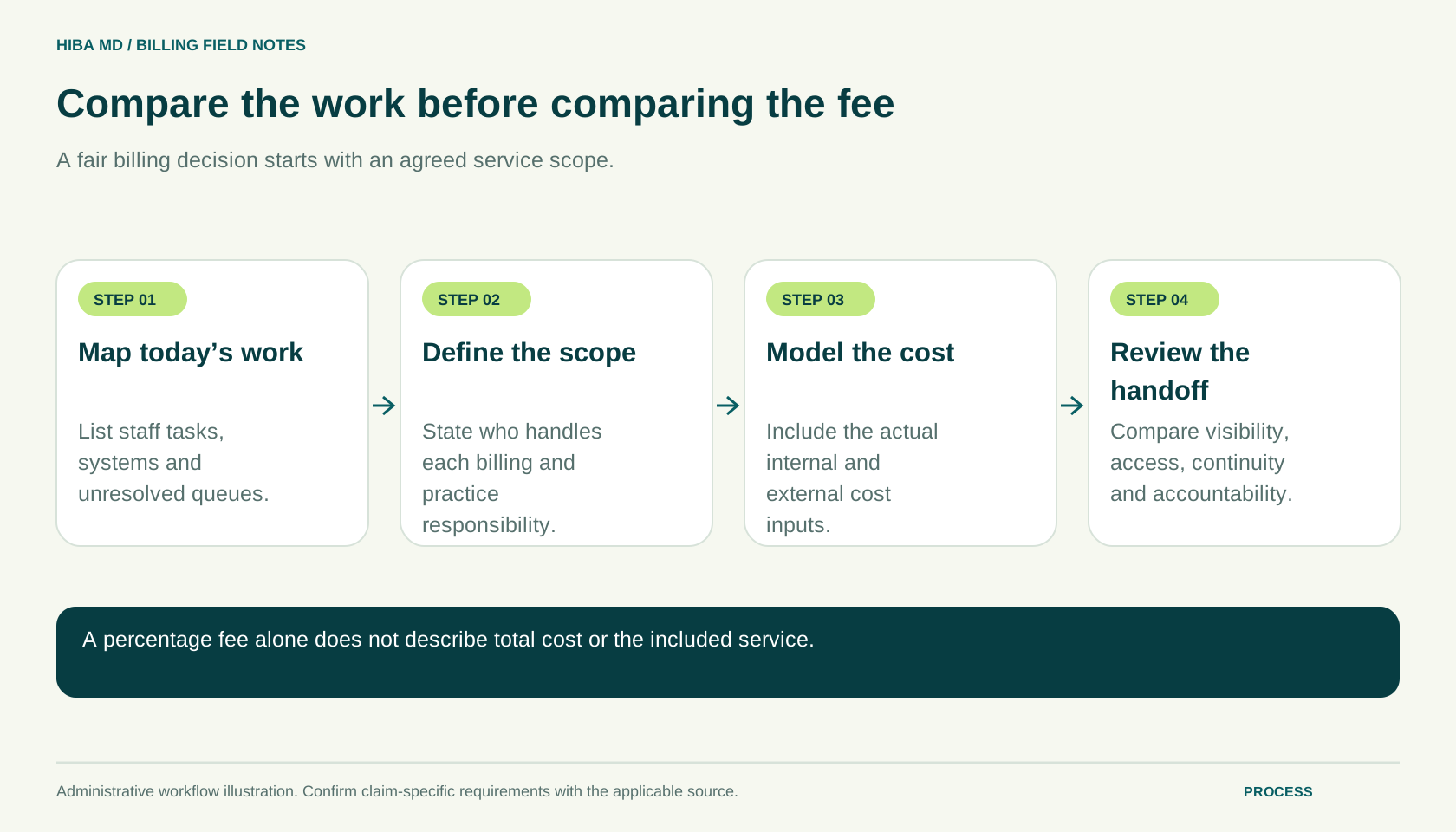
Start with the practical question
This guide provides a practical comparison for US practice administrators. The financial examples are invented arithmetic scenarios, not market prices, Hiba MD quotes or promised savings. Actual service scope and pricing must be discussed directly. The goal is to make competing options comparable and help you ask questions that reveal how the arrangement will work on an ordinary Tuesday, not only how it sounds in a proposal.
Define the billing work before comparing models
List the tasks currently performed from registration exceptions through final account review. Include claim preparation, submission responses, denials, payment posting, reconciliation, older A/R, patient questions and reporting. Identify which tasks are actually being considered for change. A proposal that covers claim submission alone is not comparable with a staffing plan that includes several additional responsibilities.
For each task, record the present owner, required system access, typical dependencies and the output management needs. A documentation query may depend on a clinician's response. A payment review may depend on remittance availability. Patient-account questions may require a practice decision. Naming these dependencies prevents the practice from assuming that changing the billing team automatically eliminates work elsewhere.
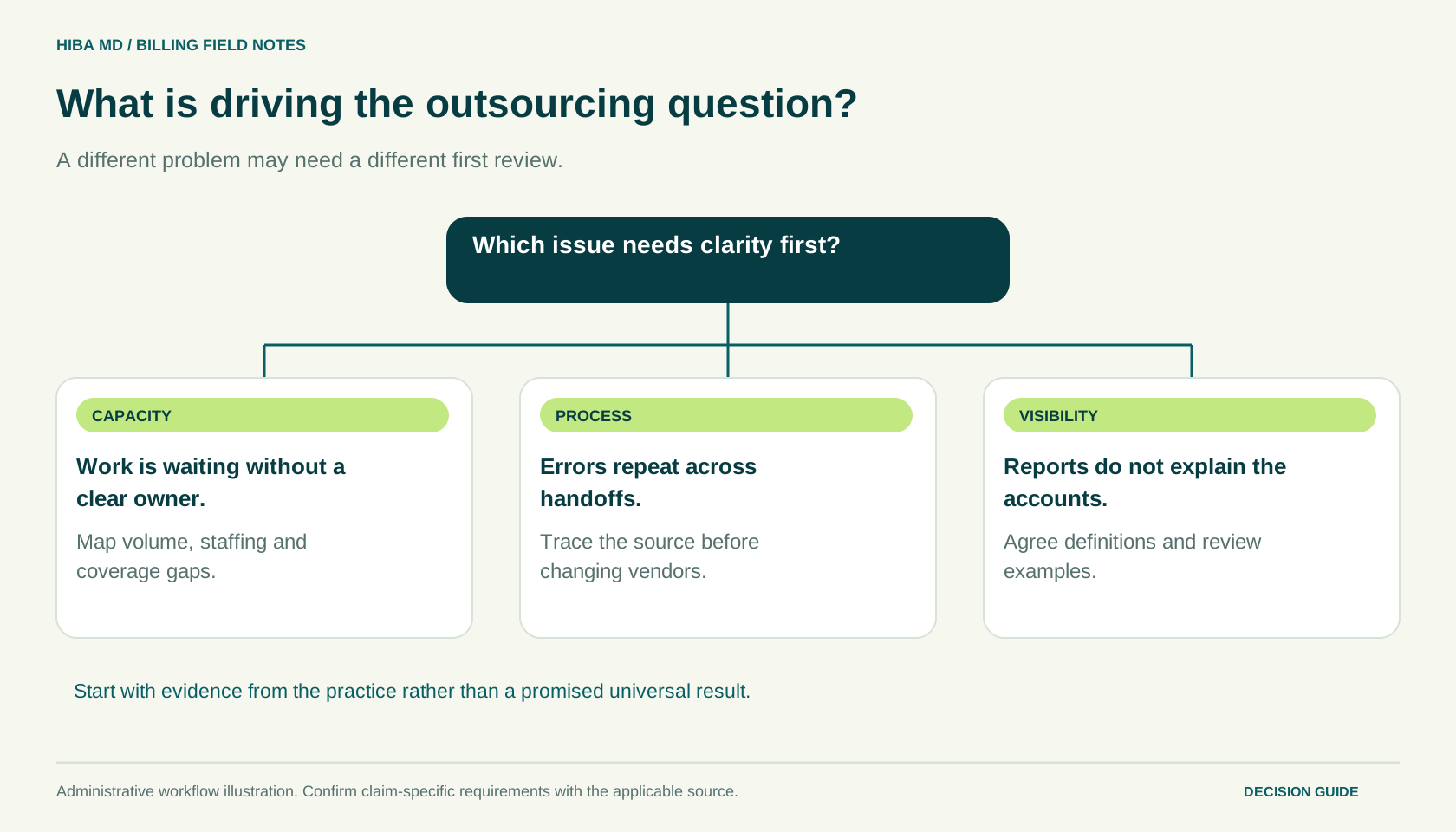
Then identify the reason for the comparison. Is the practice trying to address a backlog, reduce management burden, add specialist support, cover an absence or prepare for growth? Different goals require different evidence. A lower arithmetic fee does not answer whether a provider can handle the actual workflow, and a familiar employee does not by itself establish whether the current process has adequate capacity.
Describe what stays inside the practice
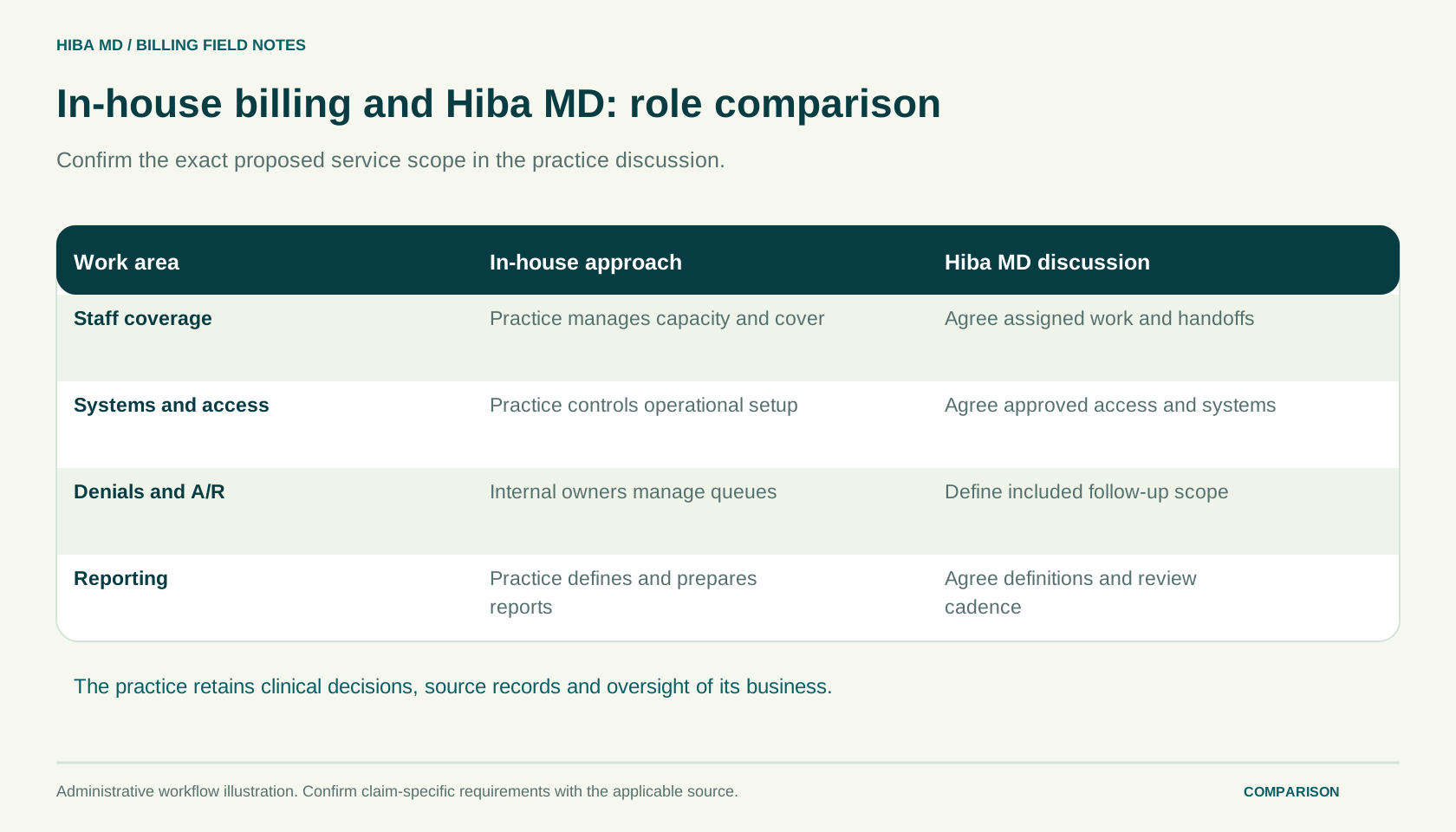
Some responsibilities remain with the practice regardless of who performs billing tasks. The practice supplies accurate source information, completes clinical documentation, makes relevant management decisions and coordinates authorized access. The precise division must be agreed, but an outside company cannot responsibly invent a missing service record or resolve every clinical question without practice participation.
Write down who answers documentation queries, confirms changes in providers or locations, reviews disputed adjustments and handles patient concerns that require a practice decision. Define an escalation contact and a backup. A small number of clear routes can be more valuable than a long promise that the partner handles everything, because staff know where a real exception will go.
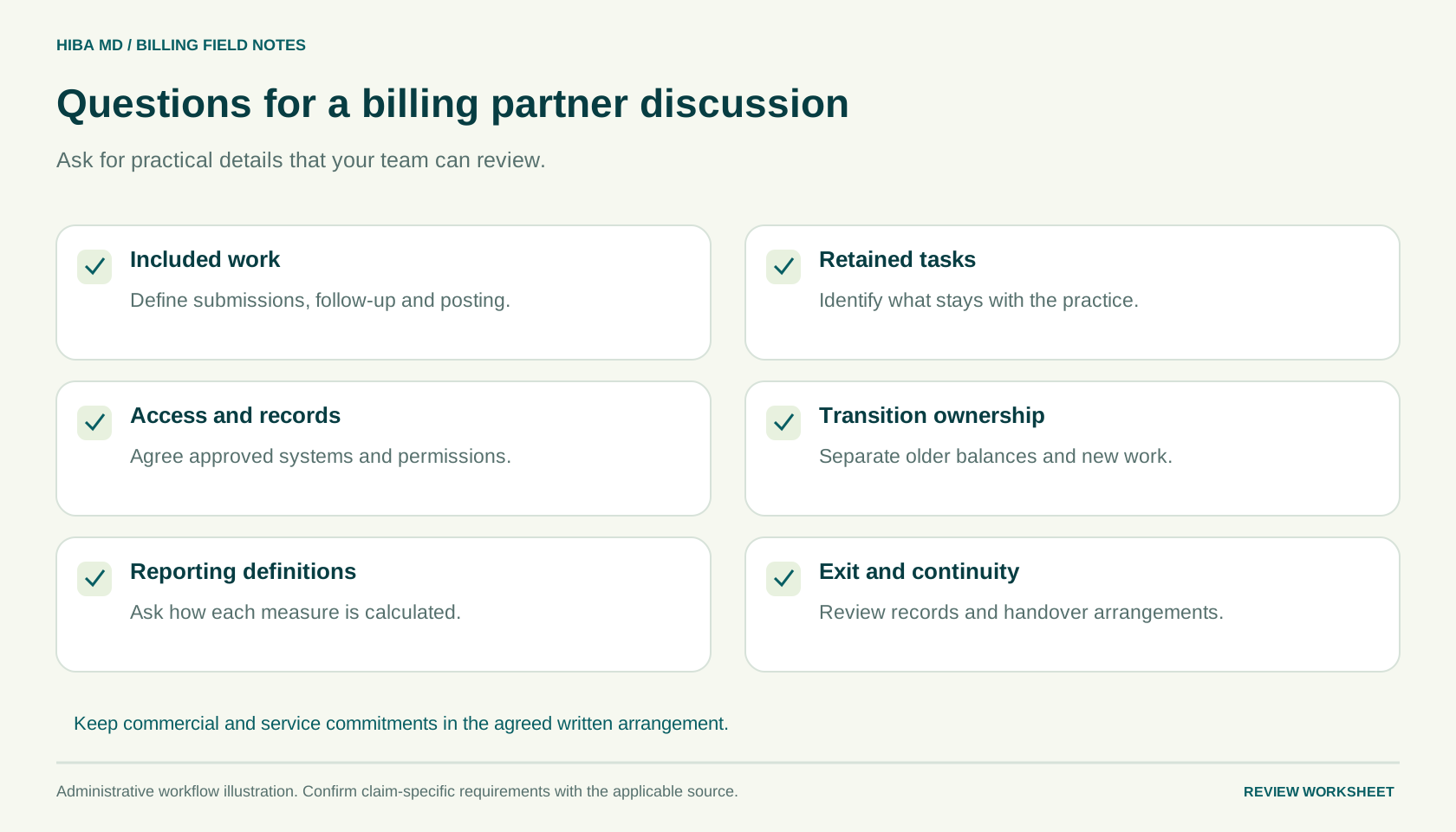
Use a responsibility matrix during the comparison. For each task, identify who performs it, who approves a decision where necessary and who receives the result. Review the matrix with the people who will do the work. If a proposal and the practice's expectations assign the same task to different teams, resolve that difference before the transition rather than discovering it after accounts begin waiting.
Calculate the included in-house operating cost
Start with the costs actually relevant to the chosen scope. Depending on your arrangement, those may include staff compensation, employer costs, benefits, software, clearinghouse services, training, recruitment, supervision and backup coverage. Some expenses may already be shared across the practice. Avoid counting the same cost twice or assuming every existing expense disappears if one task moves outside.
Separate fixed and variable costs where useful. A software subscription may remain because the practice still needs the system for other work. A staff member may move to another role rather than leave. Those situations affect a cash comparison differently from a theoretical replacement-cost model. Label the method so management understands whether the worksheet estimates current spending, avoidable spending or capacity required for a different scope.
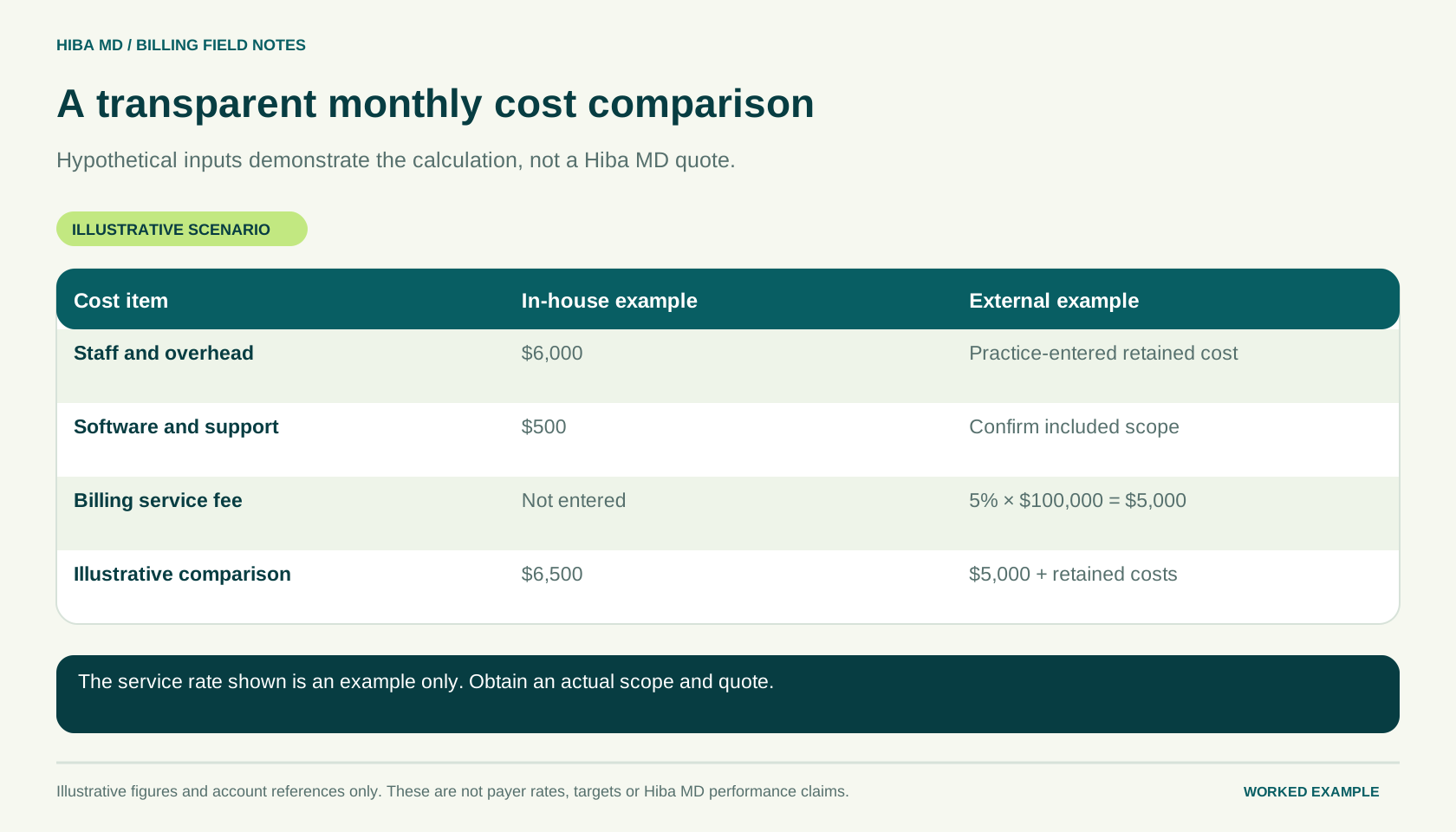
For an invented example, suppose included monthly staffing and related costs total $6,200, dedicated systems cost $500 and other included support costs total $300. The selected monthly total is $7,000. That number is a planning input, not a statement about the market. The useful next question is which of those costs would actually change under the option being considered.
Calculate outsourced costs using the actual fee basis
Read the proposal for the fee base, included services, exclusions and additional charges. A percentage may apply to a defined collection base, while another arrangement uses a different structure. The arithmetic is only comparable when both options cover the same work and the denominator is understood. Ask what happens with refunds, older accounts, patient payments and services outside the starting scope.
Using an invented 5 percent fee on an included monthly collection base of $100,000 produces $5,000. If another $400 of agreed recurring charges applies, the selected total becomes $5,400. Those figures illustrate the calculation; they are not Hiba MD pricing. The difference from an in-house input is only a scenario until the actual agreement, retained costs and transition expenses are included.
Keep ongoing pricing separate from any introductory offer. Hiba MD provides one month of medical billing services free, with no conditions. That can reduce the service fee for the first month under the offer, but it does not answer the ongoing scope and pricing questions. A responsible comparison shows the first month and continuing arrangement distinctly so the practice can assess both clearly.
Compare capacity and continuity
Ask how each model handles ordinary absences, unexpected volume changes and tasks that require specialized review. An in-house team may know the practice well and work closely with clinicians, but it needs a plan for leave and turnover. An outside team may offer a different staffing arrangement, but the practice should verify how work is assigned and who responds when an issue needs attention.
Use workload categories instead of a single account count. A simple status check and a complex documentation investigation require different effort. New claims, existing A/R and patient questions may also peak at different times. Ask how the proposed arrangement identifies growing queues and informs management before a backlog becomes visible only in aging totals.
Request a practical continuity explanation: where work history lives, how a different person takes over, who monitors unresolved dependencies and how access is changed when staff change. This is more informative than an unsupported promise that work will never be interrupted. Both models benefit from documented notes, clear owners and a queue that can be understood by someone other than the original worker.
Test specialty knowledge with actual workflow questions
Choose examples from the services your practice delivers. A therapy practice may ask how authorized periods and units stay connected with completed visits. A diagnostic practice may ask how component responsibility and interpretation handoffs are reviewed. A surgical practice may ask how operative records and facility coordination reach the billing queue. Keep the example administrative and use a secure process for any actual record review.
Ask the proposed team to describe the evidence it needs, the question it would ask and the person who owns the next action. A credible answer should acknowledge where documentation, coding or payer clarification requires additional review. Be cautious about a claim that one standard procedure solves every specialty issue or guarantees payment for every properly submitted account.
The comparison should also include change management. How does the team learn about a new service, provider or location? Who updates the administrative reference and verifies the relevant payer route? Specialty support is not only a list of conditions on a website. It is a repeatable way to connect the actual encounter details with supported claim preparation and follow-up.
Compare visibility and reporting access
Ask what the practice can see without waiting for a presentation. Can it identify pending documentation questions, returned submissions, payer-response issues, unreconciled amounts and older accounts by next action? Clarify which information is available in the existing system and what reports the team will provide. Visibility should support decisions, not just create more charts.
Define each proposed measure. Net collection rate, gross collection rate, first-pass measures and A/R days answer different questions. Ask for the reporting period, denominator, included population and treatment of adjustments. A number that cannot be reproduced from the source should not be treated as proof of quality simply because it is displayed in a polished dashboard.
Request an example management discussion using invented data. What would the team do if a documentation queue grew while the denial rate fell? That combination could reflect fewer claims reaching adjudication rather than an improvement in the whole cycle. The exercise reveals whether the proposed reporting connects adjacent stages and produces a next action instead of celebrating an isolated percentage.
Review security, information sharing and access
Map the actual information flows before deciding what access a billing arrangement needs. Identify the systems involved, the tasks performed and who receives information. HHS explains that billing activities involving protected health information on behalf of a covered entity can fall within business-associate arrangements. The practice should review the actual relationship and appropriate documentation rather than relying on a marketing badge.
Use role-appropriate access and the approved mechanisms provided by the systems. Do not share passwords through an introductory email or public website form. Agree how records are exchanged, how access changes when personnel change and who handles questions about an incident or inappropriate disclosure. An outside arrangement needs a practical process; an internal arrangement needs one as well.
Ask where the work history will remain if the arrangement changes. The practice should understand how it retains appropriate access to its records and how a handoff will be supported. These questions are operationally important even when everyone expects a long relationship. A well-described exit process is evidence that continuity has been considered, not an assumption that the service will fail.
Plan the transition as a separate project
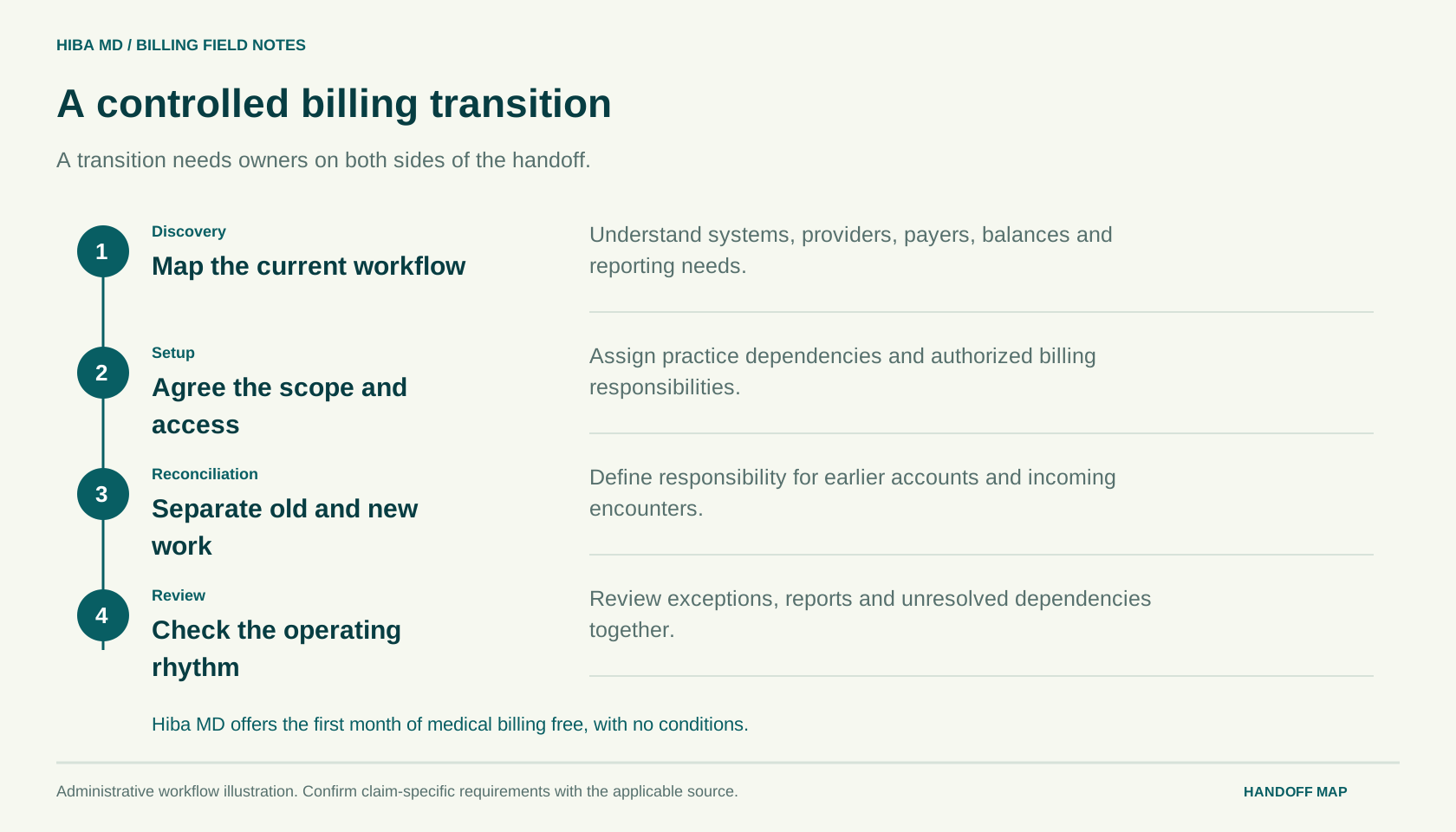
Define what changes on the starting date and what does not. New service activity, older A/R, payment posting, patient questions and reporting may need different handoff steps. Give the transition an owner and identify the source records that establish the opening position. Do not assume that moving a login or exporting an aging report transfers the knowledge behind every unresolved account.
For existing receivables, transfer the latest reliable response, current issue, outstanding evidence, deadline source where relevant and next action. Decide who continues payer contacts during the changeover. For payments, agree how remittances and deposits relating to earlier services will be reconciled. For patient questions, ensure staff know which contact owns the answer during the transition.
Use a short readiness review before the new process begins. Confirm approved access, initial reports, escalation contacts, documentation-query routes and the first management meeting. A free introductory month does not replace these steps. It is most useful when the practice and billing team use the period to establish a clear, reviewable workflow rather than expecting a new name to solve every inherited issue automatically.
Ask how exceptions are escalated
Every billing model encounters questions that cannot be resolved by routine processing. Ask how the team distinguishes a technical submission problem, a documentation query, an enrollment question, a payment variance and a potential compliance concern. Each needs an appropriate route and may involve a different practice owner. A single support email is not a complete explanation of responsibility.
Agree what information accompanies an escalation. The recipient needs the issue, relevant evidence, action already taken, decision required and any verified time-sensitive requirement. A vague request to fix billing forces the recipient to reconstruct the entire investigation. A clear request helps the practice respond and allows management to see whether a queue is waiting for information or for an external review.
Discuss what happens when the first route does not resolve the question. Who reviews a repeated pattern, contradictory responses or an unexplained adjustment? The answer should describe a supported decision process rather than automatic write-offs or repeated submissions. Clear escalation protects both efficiency and accuracy because the team knows when a routine task needs a different level of review.
Evaluate claims about results carefully
When a proposal includes a performance figure, ask what it measures, the population, the period and the evidence. A collection rate may use a different denominator from the one your practice uses. A result from another specialty or payer mix may not predict your experience. A percentage without context is a starting point for questions, not a guarantee about future revenue.
Separate process commitments from payer outcomes. A team can describe how it assigns work, documents follow-up and reports exceptions. A payer still controls its own adjudication under the relevant arrangement. Avoid treating statements such as every claim paid or no denials as reasonable evaluation criteria. They can encourage the wrong conversation about supported documentation and appropriate review.
Use a practical scorecard instead. Compare scope clarity, specialty workflow understanding, reporting definitions, secure access, continuity, transition planning and escalation quality. Record the evidence supporting each assessment. This gives management a defensible comparison even when the cheapest arithmetic option is not the one that best addresses the practice's actual administrative problem.
Run a scenario worksheet before deciding
Create at least three scenarios using your own verified inputs: current volume, a lower-volume period and a higher-volume period. Keep the scope constant and label any cost that changes with volume. Include retained practice costs and explain whether the comparison measures cash spending or replacement capacity. Do not turn a spreadsheet difference into a guaranteed saving before the assumptions are reviewed.
For an invented base case, an included in-house cost of $7,000 and an outsourced scenario of $5,400 produce a $1,600 monthly difference. Annualizing that unchanged difference gives $19,200. If a retained system expense or additional service changes, recalculate. The arithmetic is simple; the value lies in deciding which inputs belong in each column and whether both columns cover the same work.
Hiba MD's free billing savings and fee-comparison tools can help organize those inputs. They calculate scenarios from the values entered in your browser. They do not provide a binding quote, verify service quality or predict collection improvements. Use the result to prepare a discussion about the actual scope and ongoing terms, then compare the written arrangement with your worksheet.
Make the decision with the people who own the handoffs
Include practice management, the relevant clinical documentation owner, patient-account staff and whoever oversees finance or reporting. Each can identify a dependency that may be invisible in a proposal. Review the responsibility matrix and one sample encounter from scheduling through response handling. Ask where the work goes when information is missing and how the practice will know that it is waiting.
Document why the selected model fits the goal. If the goal is continuity, describe the backup process. If it is better A/R visibility, describe the required report and decision cadence. If it is a transition, describe the opening scope and first review. A decision with explicit reasons is easier to evaluate later than a broad hope that outsourcing or hiring will improve everything.
Hiba MD offers a free billing audit and one month of medical billing services free, with no conditions. The initial conversation can clarify your current workflow, retained responsibilities and starting priorities. Share aggregate operational information first and agree a secure process for detailed review. The next step should be concrete enough that your team can understand how the proposed arrangement will work in practice.
Test the comparison against a normal workday
Use an invented day with a missing subscriber detail, an unfinished note, a returned submission, an unexplained payment and a patient question. Ask how each proposed model handles every item. Who identifies it, where is it recorded, who supplies the missing evidence and how does the practice see the current status? The exercise turns a broad service list into a practical description of work. A proposal may sound comprehensive while leaving several of those handoffs undefined.
Include a question that requires a practice decision. An outside partner should be able to explain the escalation route and what information accompanies the request. An internal staffing plan should explain the same dependency. This avoids evaluating the options as though one removes the need for management while the other requires it. Both need a clear way to obtain accurate information and authorized decisions.
Record the answers in the same format for each option. If an answer is unclear, mark it as a clarification question rather than assigning an optimistic assumption. The comparison becomes reviewable when management can see the evidence behind each conclusion. It also gives the selected team a useful starting document for implementation because the ordinary exceptions have already been discussed.
Separate price sensitivity from performance assumptions
Create a volume worksheet that changes only the financial inputs you intend to test. For a percentage-fee scenario, change the included collection base while retaining the actual fee definition. For an internal-cost scenario, identify which costs remain fixed and which genuinely change. Label retained software or management expenses explicitly. A worksheet that removes every internal expense after outsourcing can overstate the cash difference.
Keep hypothetical collection improvement in a separate scenario if management wants to discuss it. Do not quietly assume that changing the billing model increases revenue by a chosen percentage and then describe the resulting difference as a saving. That combines an arithmetic cost comparison with an unverified performance forecast. Management should be able to evaluate the current-input comparison without first accepting a claim about a future payer outcome.
Document the source and date of your actual inputs. If compensation, system charges or proposal terms change, update the relevant field and retain the earlier version for context. The method should be understandable enough that another manager can reproduce it. Precision in the final dollar amount is useful only when the scope and assumptions feeding the calculation are equally clear.
Review the sample report as a decision tool
Ask each option to show how it would present a growing documentation queue and a stable overall collection rate. The report should make the earlier-stage dependency visible rather than relying on the favorable collection figure to describe the whole cycle. Ask what management must decide and which practice owner receives the question. This tests whether reporting supports intervention before a downstream balance becomes older.
Then ask how the report would explain a reduced A/R balance after payments, adjustments and transfers. Those dispositions should remain distinguishable. A reduced total by itself does not show cash recovery, and a presentation should not blur the difference. The same standard should apply to an internal team and a vendor; the comparison concerns usable information, not which report has more charts.
Keep the agreed report definitions with the service scope. A sample presentation is less useful if the actual ongoing report uses different populations or omits the queue that mattered to the decision. Identify who can answer a source question and how changes in the method will be communicated. That gives the practice a realistic expectation of the visibility it is selecting.
Agree the first review before the start date
Set a first review that asks whether the handoffs are functioning as agreed. Check approved access, documentation queries, response handling, posting reconciliation and visibility of existing balances. The purpose is to find implementation gaps early. It should not require a premature claim that the new arrangement has already changed every financial outcome, especially when payments may relate to earlier service periods.
Bring a short decision log to the review. Record each issue, the evidence, the responsible owner and the next step. If the practice discovers that a task was omitted from the written scope, discuss it explicitly rather than allowing both teams to assume the other will absorb it. Clarifying a genuine gap is more useful than leaving an unresolved item in a general pending queue.
Use the outcome to refine the operating agreement and the next review agenda. A successful start is a process the people involved can understand and continue, with accurate source information and clear responsibility. The free first month can provide time to establish those foundations. Ongoing evaluation should then use compatible periods, reconciled reports and the actual service scope rather than a single introductory impression.
Keep a copy of the assumptions that led to the decision. If the practice grows, adds a service line or changes systems, revisit the relevant scope and cost fields rather than treating the original comparison as permanent. A model that fit one workload may need a different staffing or service arrangement later. The same comparison method remains useful: define the work, identify retained responsibilities, reconcile costs and ask how ordinary exceptions will be handled. This lets management review the arrangement on its actual merits without relying on the introductory offer, a familiar job title or an unsupported promise that one model is always best.
Frequently asked questions
Is outsourcing always cheaper than in-house billing?
No. The answer depends on scope, actual fees, retained practice costs, volume and the method used to compare expenses. A percentage alone does not establish the total. Build a like-for-like worksheet and separate introductory offers from ongoing pricing before deciding what the arithmetic means for your practice.
Does outsourcing mean the practice has no billing responsibilities?
No. The practice still supplies accurate information, completes source documentation, coordinates appropriate access and makes relevant operational decisions. The exact division should be documented. A useful partner explains dependencies and escalation routes rather than suggesting it can resolve every issue without practice participation.
What is the most useful question to ask a billing company?
Ask it to explain a real administrative workflow from your specialty: what evidence it needs, what it does when information is missing, who owns the next action and how you see the status. The answer reveals more about the operating model than a broad claim about experience or a headline performance percentage.
How should we compare a free first month with ongoing pricing?
Show the introductory month separately, then calculate the continuing arrangement using the actual agreed scope and fee basis. Hiba MD's first month of medical billing services is free, with no conditions. Ongoing service scope and pricing are discussed directly so the practice can compare the complete arrangement.
What should we prepare before changing billing arrangements?
Define new and existing account ownership, approved access, opening reports, payment reconciliation, patient-question routing and escalation contacts. Transfer the current state of unresolved work, not only an aging total. A clear transition plan helps the receiving team continue the investigation without duplicate submissions or conflicting communications.
Sources and editorial notes
Written by the Hiba MD editorial team. Reviewed 2026-10-31. Worked examples use illustrative figures, not client results or performance benchmarks. This guide explains administrative workflows; check current payer requirements for claim-specific decisions.
