
A clean-claim workflow is a repeatable way to prepare supported information, identify exceptions and review submission responses. It is not a promise that every claim will be paid or a generic list that replaces current payer instructions. The useful question is whether the practice can show what was checked, which evidence supported the submission and who owns anything still unresolved.

Start with the practical question
This guide follows the administrative steps before and immediately after claim submission. It is written for practice administrators coordinating registration, documentation and billing teams. It does not select codes or establish coverage for an individual encounter. Use current official resources, the actual payer arrangement and appropriate qualified review for claim-specific decisions. Examples describe invented workflows rather than Hiba MD client outcomes or universal payer requirements.
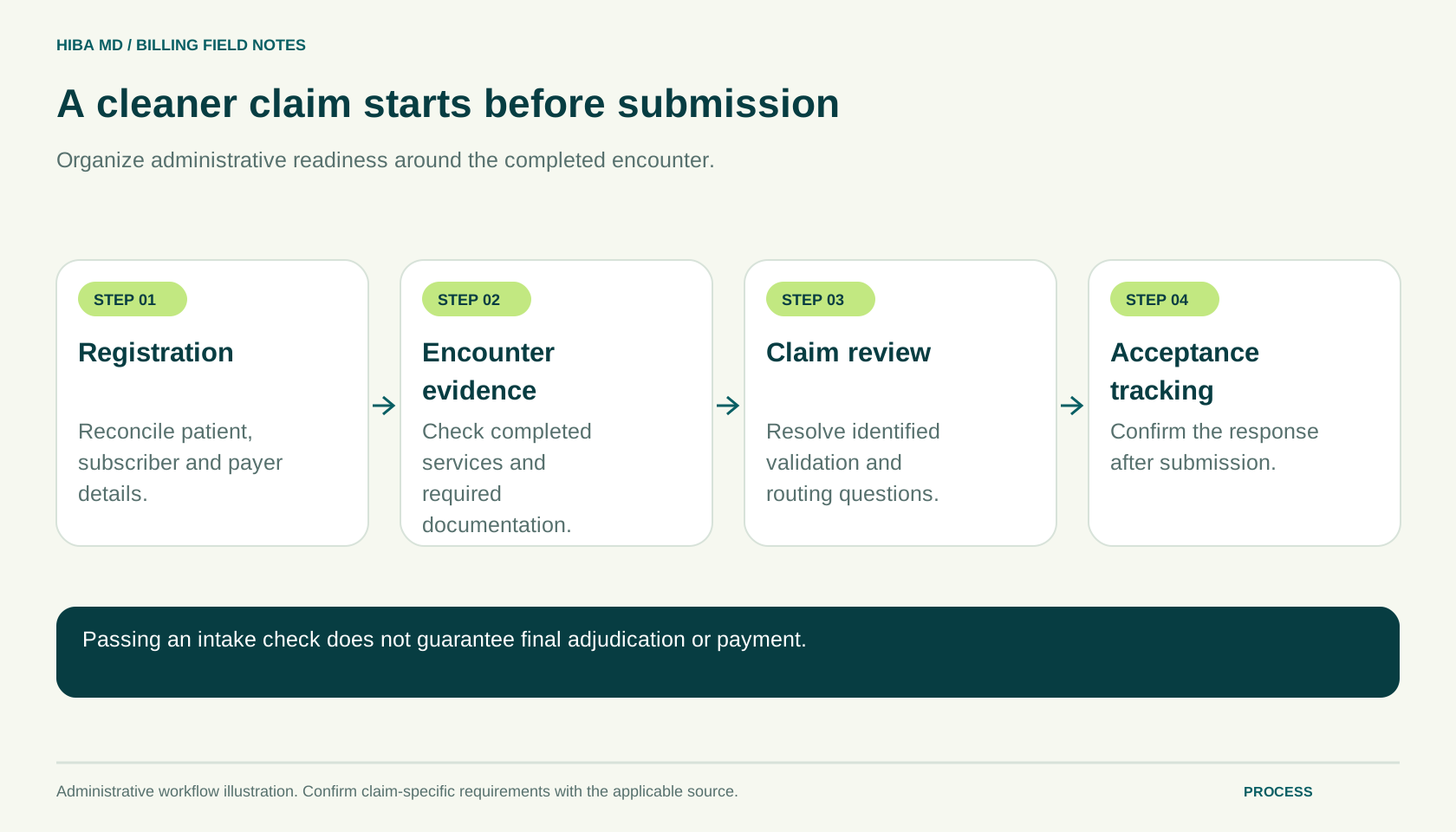
Define what your team means by clean claim
Begin with a written operational definition. Does the term describe a claim that passed an internal checklist, a transaction accepted at a particular intake stage or an adjudicated claim requiring no further action? Those are different events. If two departments use the same term for different stages, a dashboard can appear consistent while staff are discussing entirely different populations.
Name the stage your checklist controls. For example, an internal pre-submission review can confirm required administrative information and documented readiness under the practice's process. It cannot guarantee the payer's later adjudication. Keeping that limit clear helps the team use the checklist as a quality control rather than a reassuring label that hides unresolved coverage or documentation questions.
Also define an exception. An item may be incomplete, inconsistent, awaiting a source record or ready for qualified review. Those statuses need different actions. The checklist should explain where each exception goes, who is responsible and how it returns to claim preparation after clarification. A form with many boxes but no exception route can create the appearance of control without helping staff resolve the actual work.
Match the encounter to the right claim type
Confirm the services and billing arrangement involved before applying a template. CMS educational materials describe the professional CMS-1500/837P workflow, while other resources cover different claim types and settings. An office professional claim, an institutional facility claim and another supplier arrangement should not be treated as identical simply because all are requests for payment.
Keep a source reference for the actual transaction and relevant payer route. Staff should know where to find current implementation information and whom to ask when a system field is unclear. A software label can differ from the terminology used in an official guide, so the practice may need an internal mapping that explains how the source information reaches the transaction.
For a multispecialty organization, identify whether the checklist needs branches for different service settings or entities. A single high-level process can coordinate the work while preserving those distinctions. The aim is consistency in evidence and ownership, not forcing genuinely different arrangements into one form that omits the details needed to prepare an accurate claim.
Reconcile registration information with the service date
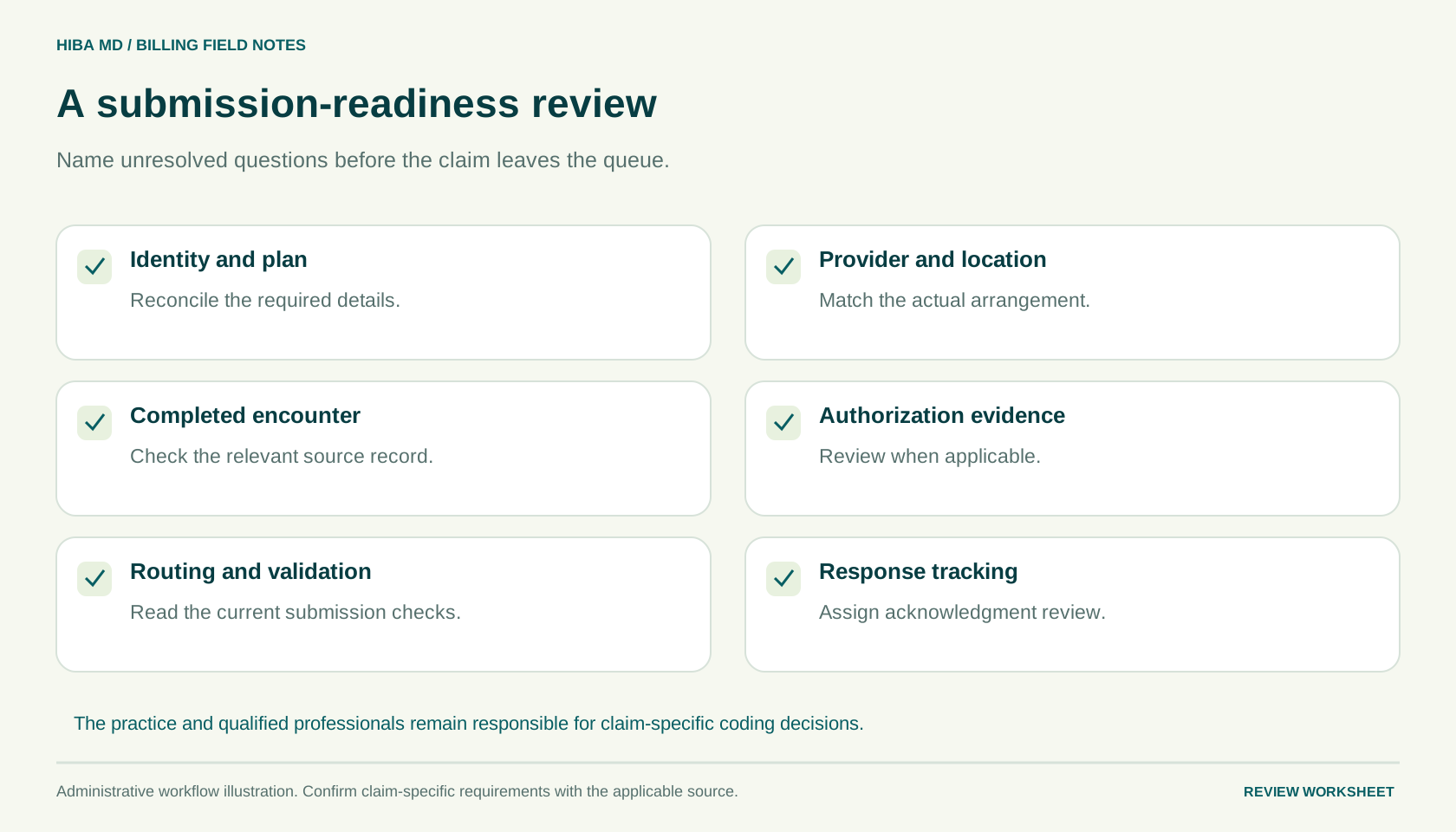
Review patient and subscriber details using the practice's approved sources. Confirm the relevant identifiers, plan or product and service-date information. When the record contains a recent coverage change, determine which encounter it affects. Do not assume that an active payer listed today establishes the arrangement for every earlier service in the account history.
Keep the evidence distinguishable. A scanned card, an electronic eligibility response and a patient-reported update can provide different information. The team should be able to identify what was confirmed and when. If a discrepancy remains, route the specific question to the registration or coverage owner rather than choosing whichever value allows the system to release the claim.
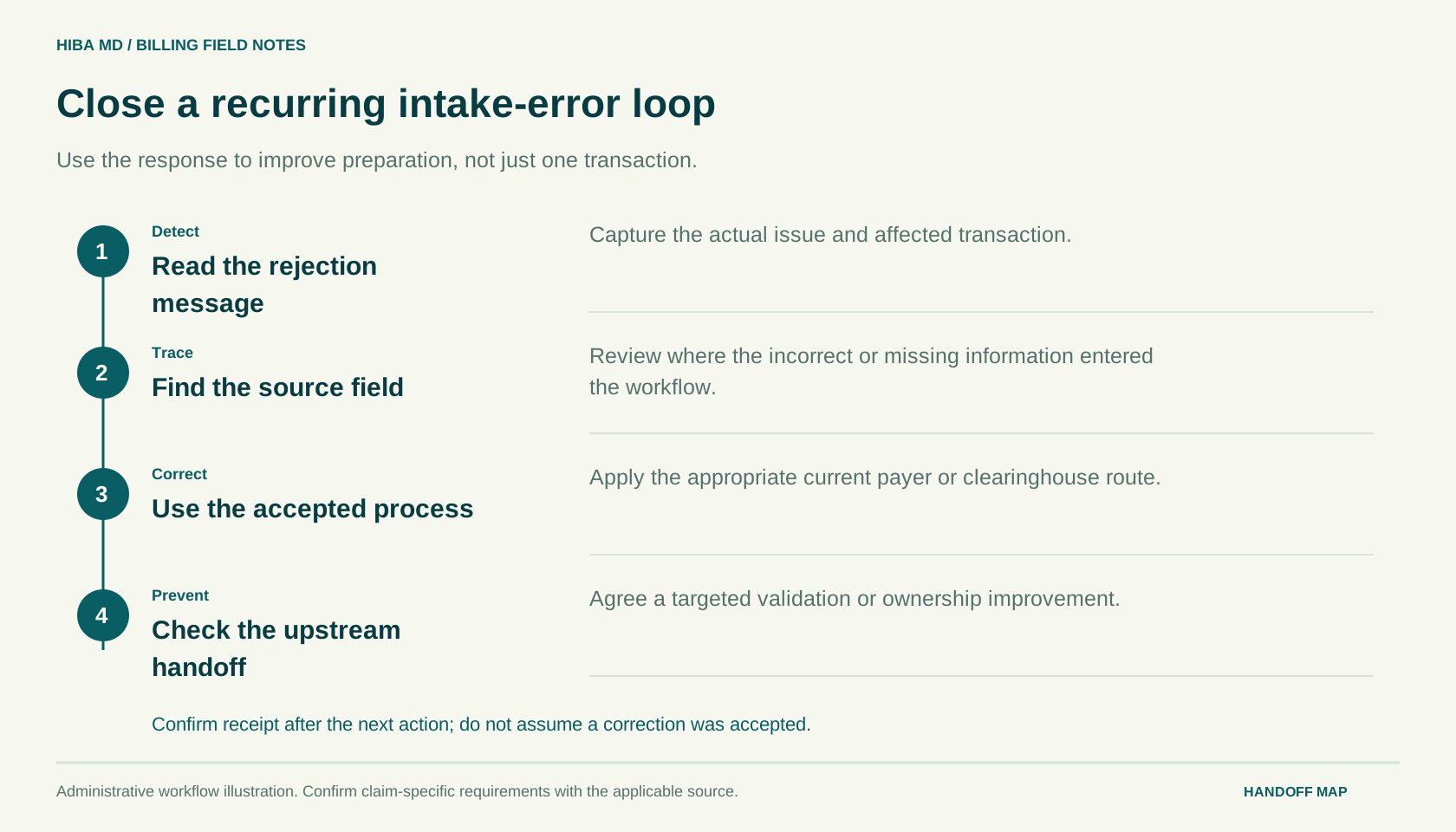
An illustrative recurring problem is a subscriber identifier copied incorrectly during registration. A pre-submission control can identify the inconsistency and obtain a supported correction. The long-term improvement may be a better collection or review step upstream. Record both the immediate correction and the recurring cause so the practice can address the pattern rather than fixing the same field repeatedly at the end of the cycle.
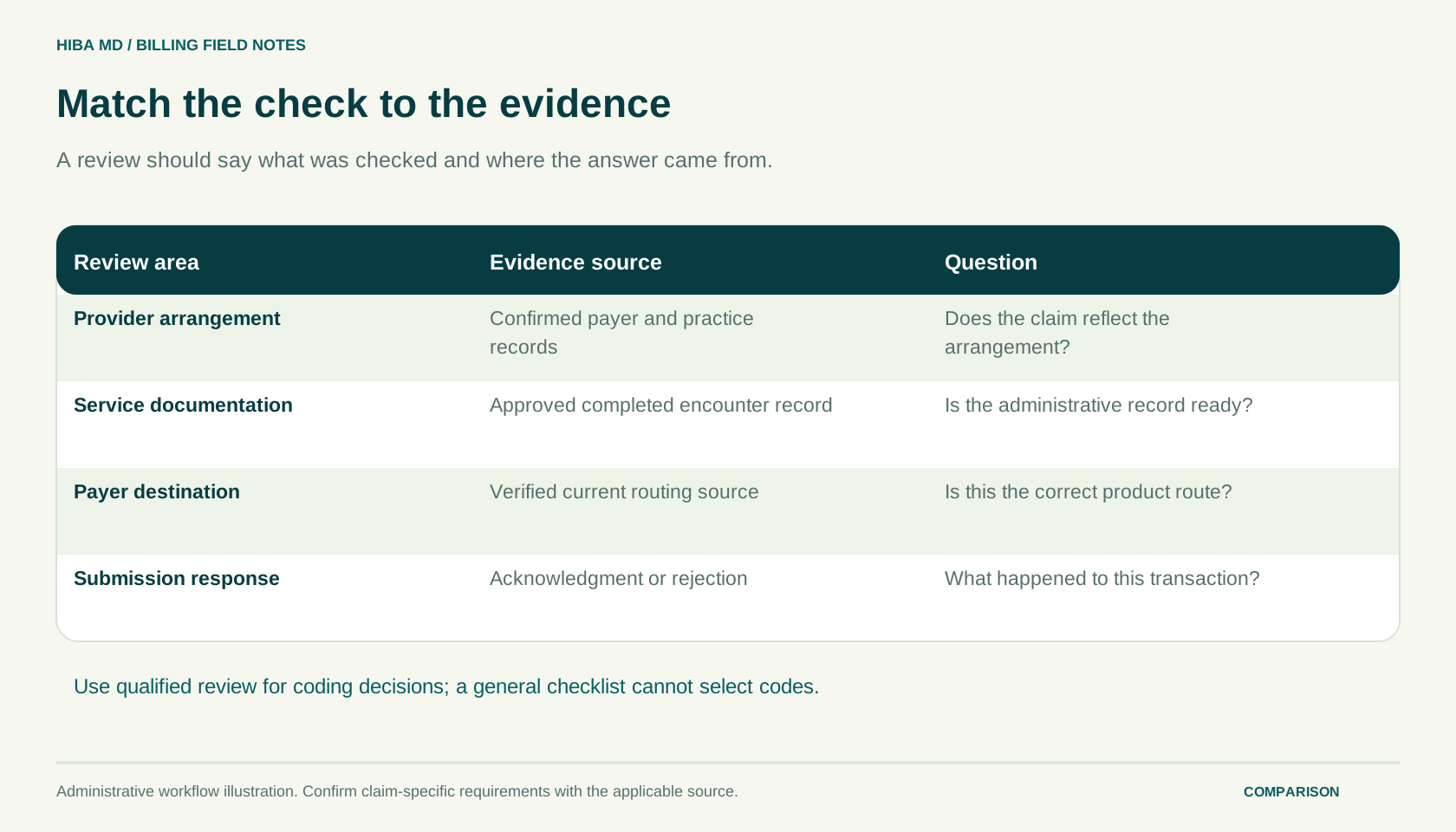
Confirm provider, entity and location details
The claim needs to reflect the actual administrative arrangement for the encounter. Review the relevant billing entity, rendering professional and service location information. A practice with several clinicians or offices should not assume that the same participation or routing reference applies to every combination. Keep the actual confirmation and any unresolved enrollment question available to the responsible team.
An NPI check can identify a possible structural entry error, but it cannot establish that the provider is enrolled, licensed or participating in the relevant arrangement. Use the appropriate official and payer sources for those questions. If the provider record and the encounter disagree, investigate the underlying facts rather than changing an identifier merely to satisfy an edit.
When a new clinician or location is added, make the first claim handoff deliberate. Confirm that billing received the relevant administrative record and effective-date information where established. A provider can be ready for some arrangements while another remains unresolved. A location-aware review helps prevent an overly broad active label from becoming an unsupported assumption in claim preparation.
Check that documentation is ready for the task
Reconcile completed encounters with the documentation and charge-preparation queue. The schedule shows that an appointment occurred; it may not establish that the record needed for billing is complete. Define what readiness means under the practice's process and identify the owner of records that remain unfinished or unclear. Keep the query specific to the missing information.
Clinical documentation should describe the actual encounter. Billing staff should not invent a diagnosis, service detail or clinical rationale to move an account forward. When a question requires clinical or coding judgment, route it to the responsible qualified reviewer with the appropriate context. The administrative team can coordinate the query and track its status without supplying unsupported clinical facts.
A practical readiness report might distinguish incomplete records, unresolved provider attribution and missing administrative information. Those categories lead to different owners. Reporting only unbilled visits can hide the reason for the wait. Once clarified, record the resulting action and retain the evidence through the approved system so a later reviewer can understand why the claim was prepared as it was.
Compare authorization and referral evidence where relevant
If an authorization, referral or other administrative response is relevant, locate the actual evidence and compare it with the completed service. Review the scope, dates, provider, location and limits that matter to the arrangement. A reference number alone may not answer whether the encounter matches what the payer reviewed.
Changes deserve explicit attention. A different service date, location, professional or procedure can create a new question under the actual plan process. Keep the original request, response and changed encounter information distinguishable. Do not alter the source record to make it resemble an earlier authorization, and do not treat an authorization as a guarantee of the eventual claim outcome.
For an illustrative therapy workflow, the team may track approved units and completed units in separate systems. Before claim preparation, compare the records and route discrepancies to the appropriate owner. A remaining-units calculation can expose a numerical question, but the original response and actual service record determine what needs review. The checklist should point to that evidence rather than replacing it.
Give coding edits a supported review route
When a system flags a code combination, modifier or other coding question, identify the applicable source and the actual documentation. CMS NCCI resources provide Medicare edit information, but they are not a universal payer clean-claim engine. A software edit should lead to a qualified review, not an automatic change that lacks support in the record.
Do not append a modifier simply because a claim would otherwise return or deny. The relevant circumstances and documentation must support its use under the applicable rules. The reviewer needs the actual encounter and current source information. If the original coding remains supported but a payer question persists, the team may need clarification or the appropriate review route rather than repeated unsupported modifications.
Keep the decision traceable. Record what was reviewed, the source used and the action taken under the practice's process. A later investigator should be able to distinguish a corrected data error from a documented professional decision. This also helps management identify whether recurring edits reflect a training need, a system configuration question or a missing documentation handoff.
Verify the destination and submission readiness
Confirm the actual payer route and claim destination using the relevant current source. A payer name, a clearinghouse selection and a plan's administrative address are not necessarily interchangeable. Keep the internal routing reference dated and assign responsibility for reviewing it when a new product, provider arrangement or location is introduced.
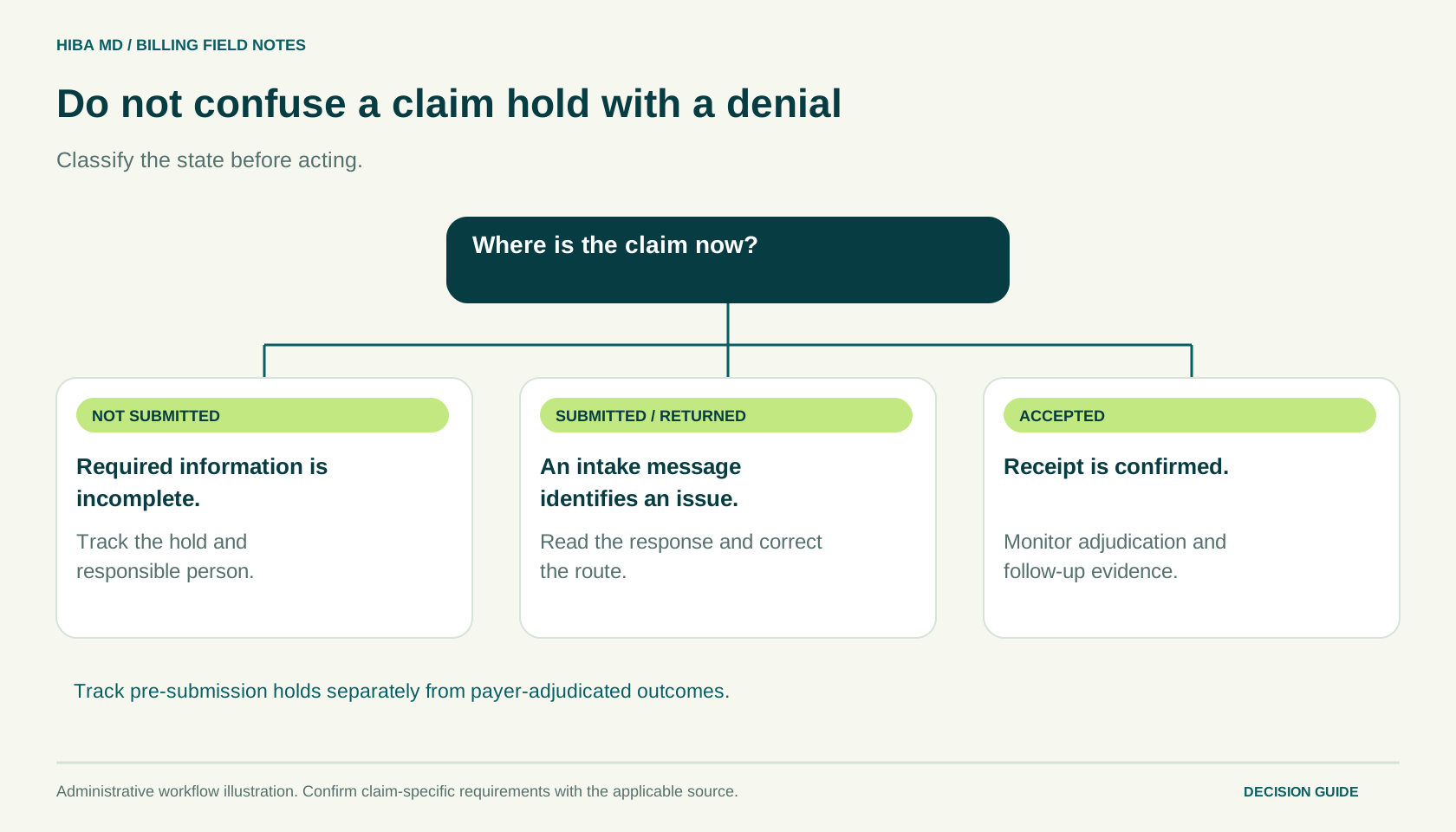
Check that the claim is ready for the intended transmission process. Identify what the system will send, how the submission is recorded and where acknowledgments will appear. If required information remains unresolved, use a visible hold category with an owner. Quietly placing a claim in a generic pending folder can cause a preventable delay because nobody knows what action will release it.
For an invented example, a practice discovers that a new plan product was mapped to an older destination in its internal reference. The immediate task is to verify the correct route and address the affected queue through the appropriate process. The upstream task is to define how new products are added and reviewed. Both matter; correcting one claim without updating the reference leaves the pattern in place.

Review acknowledgments after submission
Submission does not end the control. Establish which acknowledgments are expected and how negative or absent responses are investigated. A successful file transmission may not establish acceptance of each claim. Keep file-level, transaction-level and claim-level findings distinguishable where your system provides them, using the relevant technical and payer instructions.
Assign a regular review of returned items and unacknowledged submissions. The next action depends on the message. An identifier mismatch may require a supported data correction, a technical issue may need vendor support, and an accepted claim may need later status review. Do not repeatedly transmit the same item without understanding what happened to the earlier submission.
Retain references that help connect the response with the original claim. A useful note explains the stage, issue, evidence and next action. This makes the queue easier to transfer between staff and gives a later denial investigator a reliable history. It also prevents the practice from describing a claim as clean merely because it left the office system without an immediate visible warning.
Build exception categories around owners
Design the exception queue so that the category indicates the next responsible team. Registration questions go to the appropriate administrative owner. Documentation questions go through the practice's approved query process. Coding questions need qualified review. Provider-record questions need the person who can confirm the arrangement. Technical transaction questions may require system or clearinghouse support.
Avoid categories that describe concern without directing action, such as problem claim or needs attention. A useful item identifies what is missing, where the source should come from and who is expected to respond. Include a next review date so a pending dependency does not disappear from the workflow simply because the claim is not yet in an aging report.
Review repeated exceptions with the upstream team. If the same field is corrected on many claims, ask whether the capture or mapping process needs improvement. If a documentation query repeatedly arrives too late, examine the readiness handoff. The exception queue is more valuable when it generates a focused change than when it merely records how often staff had to repair the same problem.
Measure first-pass performance consistently
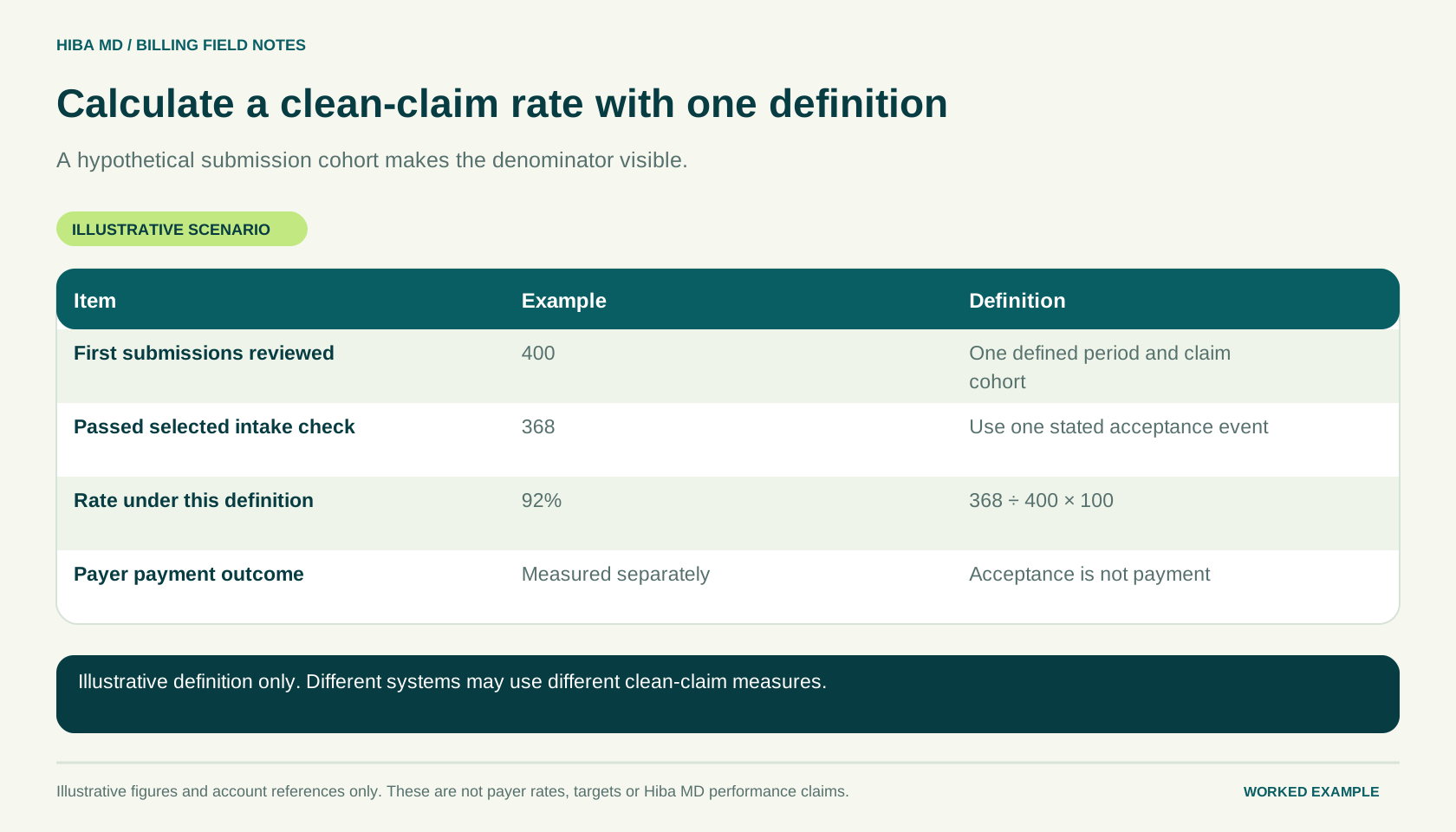
Define what the numerator and denominator count, and at which stage. An internal clean-claim rate might describe items passing a stated review, while a first-pass adjudication measure describes a different population and outcome. Do not compare those numbers as if they are interchangeable. Use matching units, such as claims with claims or lines with lines.
For an invented example, 475 claims passing a defined first review out of 500 reviewed claims equals 95 percent under that definition. The remaining 25 need issue categories and owners. That result does not establish that 95 percent will be paid, nor does it determine whether the review itself covers the right questions. The measure should accompany an explanation of the checklist and population.
Read adjacent queues alongside the percentage. A rising pass rate can coexist with a growing documentation hold queue if difficult items never reach the measured review stage. A complete management view shows what entered the process, what passed, what remains pending and why. This discourages a narrow focus on the percentage at the expense of actual encounter-to-response continuity.
Test an upstream improvement with a defined sample
Choose one recurring issue and describe the expected change. A registration prompt might clarify subscriber information. A location reference might make provider details easier to verify. A readiness report might identify unfinished records sooner. Assign an owner, explain the new step and record when it begins. The change should address a specific observed exception.
Review a later comparable sample using the same definition. Count the intended exception and inspect whether it moved elsewhere in the workflow. A lower submission-return count is less informative if more encounters are now waiting indefinitely before submission. Keep the evaluation connected to the whole handoff and explain changes in volume, service mix or reporting that affect interpretation.
Use the result as a learning step. If the change did not help, determine whether the cause was misunderstood, the step was unclear or another dependency remains. Avoid turning a local test into a universal performance claim. A practical quality process is willing to revise its checklist when the evidence shows that the old question was not the one staff actually needed to answer.
Keep the checklist current and easy to use
Give the checklist a responsible owner and a review process. Link it to the current source references used by the practice and identify when staff should request an update. A long form can become less useful if it repeats obvious steps while hiding the few specialty or payer questions that need attention. Use a consistent core with relevant branches rather than one unmanageable wall of boxes.
Train with an invented encounter and an exception example. Ask staff to identify the missing evidence, route the question and explain what would establish readiness. This tests whether the checklist works as an operating tool. It also reveals confusing labels before they create inconsistent handling across shifts, providers or locations. Keep the approved record system as the source for patient-level details.
Hiba MD offers a free billing audit and one month of medical billing services free, with no conditions. Use the discussion to identify where your claims lose information between registration, documentation and submission. Aggregate queue examples are enough to start. Any later detailed review should use the secure process agreed with the practice and the actual current payer evidence.
Build a core-and-branch review sheet
Start with a short core sheet that identifies the encounter, relevant registration source, provider arrangement, documentation readiness and intended submission route. Then create branches for the actual administrative questions your practice encounters. A therapy branch might point to dates and quantities in a relevant response. A diagnostic branch might point to interpretation completion. A surgical branch might identify the completed operative record and location clarification.
Each branch should name the source evidence and exception owner. Avoid adding a specialty name without changing the question or next action. The sheet is useful when it helps staff recognize what is missing and route it correctly. It is less useful when every branch repeats the same general instruction to verify information. Test the sheet with the people who will use it during ordinary work.
Keep the underlying patient record in the approved system and use the sheet as a workflow reference. A training version can use invented data. Give the reference an owner and identify the conditions that trigger review, such as a new service line, provider or location. The goal is a maintainable process rather than a checklist that becomes longer every time an exception appears.
Practice an encounter reconciliation
Use an invented group of 30 completed encounters. Twenty-two are ready for review, four await documentation, two await registration clarification and two await provider-record investigation. The total still equals 30. Ask the team to identify the owner and evidence required for each group. This makes unfinished work visible before it reaches the submission dashboard or becomes an unexplained gap between the schedule and charges.
Next, suppose 20 of the 22 ready items pass the defined review and two return to a documentation query. Record that movement without counting the same encounter twice. A clear population helps staff understand how an internal pass rate relates to the full encounter queue. A high rate among reviewed items cannot describe the readiness of encounters that never reached the review stage.
Repeat the reconciliation at a later cutoff and explain every movement. The purpose is not to force all items through submission regardless of evidence. It is to ensure that each item has an accurate state and an owned next step. Management can then identify the dependency that needs attention rather than issuing a general instruction to bill everything on the completed schedule.
Check whether the review catches the intended issue
A checklist can be completed consistently and still ask the wrong question. Select an observed recurring exception and identify which step is supposed to detect it. Then review a defined sample to see whether the step actually exposes the relevant mismatch. If a provider-location question is missed repeatedly, a generic identifier-present checkbox may be too narrow to address the real administrative issue.
Inspect both detected and missed exceptions. A step that flags many items may create unnecessary work if its wording is unclear or its source is outdated. A step that flags none may be effective, irrelevant or not understood. The sample review should examine the actual evidence rather than interpreting the count alone. Ask staff to explain what they did and which source supported the decision.
Revise the instruction with a practical example and a clear escalation route. Then test a later comparable group. Keep the old and new definitions identifiable so a change in the rate is not automatically presented as a change in claim quality. The evaluation should show whether the intended question became easier to answer and whether exceptions reached the person who could resolve them.
Maintain a source-and-change register
Create a small register for the references that support the practice's administrative checklist. Record the topic, official or payer source, owner, date reviewed and the part of the workflow affected. The register does not replace current claim-specific review. It helps staff find the right starting point and identify who should investigate when a source changes or an instruction no longer matches the system.
When a change is identified, explain what staff should do differently and which existing queue may need review. A new instruction that is merely placed in a folder may never reach the person preparing the claim. A short change notice with an example can be more useful than a lengthy announcement that leaves the action unclear. Retain the reference and relevant implementation date under the practice's process.
At a later review, check whether the change reached the intended users and whether the affected exception remains. If it does, investigate the handoff instead of simply sending the same notice again. A current reference, understandable instruction and owned exception route work together. None is sufficient alone, and a tidy checklist cannot compensate for a missing source record or an unresolved professional review question.
Also inspect how staff report an instruction that no longer appears to fit. They need a clear route to raise the question without silently working around the checklist or releasing an unsupported claim. Record the discrepancy, source and responsible reviewer, then communicate the reviewed answer to the affected users. A maintained process includes a way to challenge an outdated step. That makes the checklist more credible as the practice changes and helps management distinguish a genuine source update from an individual preference or an unverified shortcut copied from another payer arrangement.
Frequently asked questions
Does passing a clean-claim checklist guarantee payment?
No. A checklist supports a defined internal review. A later payer decision depends on the actual service, documentation, provider arrangement, benefits and adjudication. Keep internal readiness, transaction acceptance and payment outcomes as separate stages so staff and management understand what each status actually establishes.
Should we add modifiers whenever an edit appears?
No. A modifier must be supported by the actual circumstances, documentation and applicable requirements. Route the question to the responsible qualified reviewer using current source information. An edit is a reason to investigate, not permission to change coding merely to make the claim pass a system check.
What should happen to a claim with missing information?
Use a visible exception category that identifies the missing evidence, responsible owner and next review date. The appropriate action may be a registration clarification, documentation query, coding review or provider-record investigation. A generic pending status without an owner makes it harder for the practice to remove the dependency.
Is clearinghouse acceptance the same as payer adjudication?
No. Acceptance at one transmission or intake stage does not establish a final payment decision. Review the actual acknowledgment and follow the claim through the relevant next response. Your system and trading-partner instructions should explain the messages available and how exceptions are handled at each stage.
How can we use Hiba MD's free clean-claim checklist?
Use it to organize administrative questions and identify where evidence or ownership is missing. It is a workflow aid, not a code-selection engine or live payer verification service. Apply it alongside the practice's approved process, current authoritative references and qualified review for the actual encounter.
Sources and editorial notes
Written by the Hiba MD editorial team. Reviewed 2026-10-31. Worked examples use illustrative figures, not client results or performance benchmarks. This guide explains administrative workflows; check current payer requirements for claim-specific decisions.
