
Match the electronic funds transfer (EFT) to the electronic remittance advice (ERA) and the posted batch. Then use the applicable contract or payment schedule to check each unresolved line. Compare expected payer payment after valid patient responsibility and other applicable adjustments with the adjudicated payment on the same basis.

Start with the practical question
Payment posting records the payer's adjudication and related account activity. Underpayment review asks whether an actual payment differs from an appropriately established expected amount. Both depend on source reconciliation. A difference between charges and a deposit is not automatically an underpayment, and a remaining ledger balance does not automatically establish patient responsibility.
This guide helps practice administrators connect remittances, deposits, postings and follow-up decisions. The numerical examples are invented to illustrate arithmetic and investigative steps, not payer rates or Hiba MD client results. Claim-specific conclusions require the actual remittance, relevant contract or fee-schedule information, service details and applicable current requirements. A browser calculator can show a difference, but it cannot determine whether that difference is an amount the practice is entitled to receive.
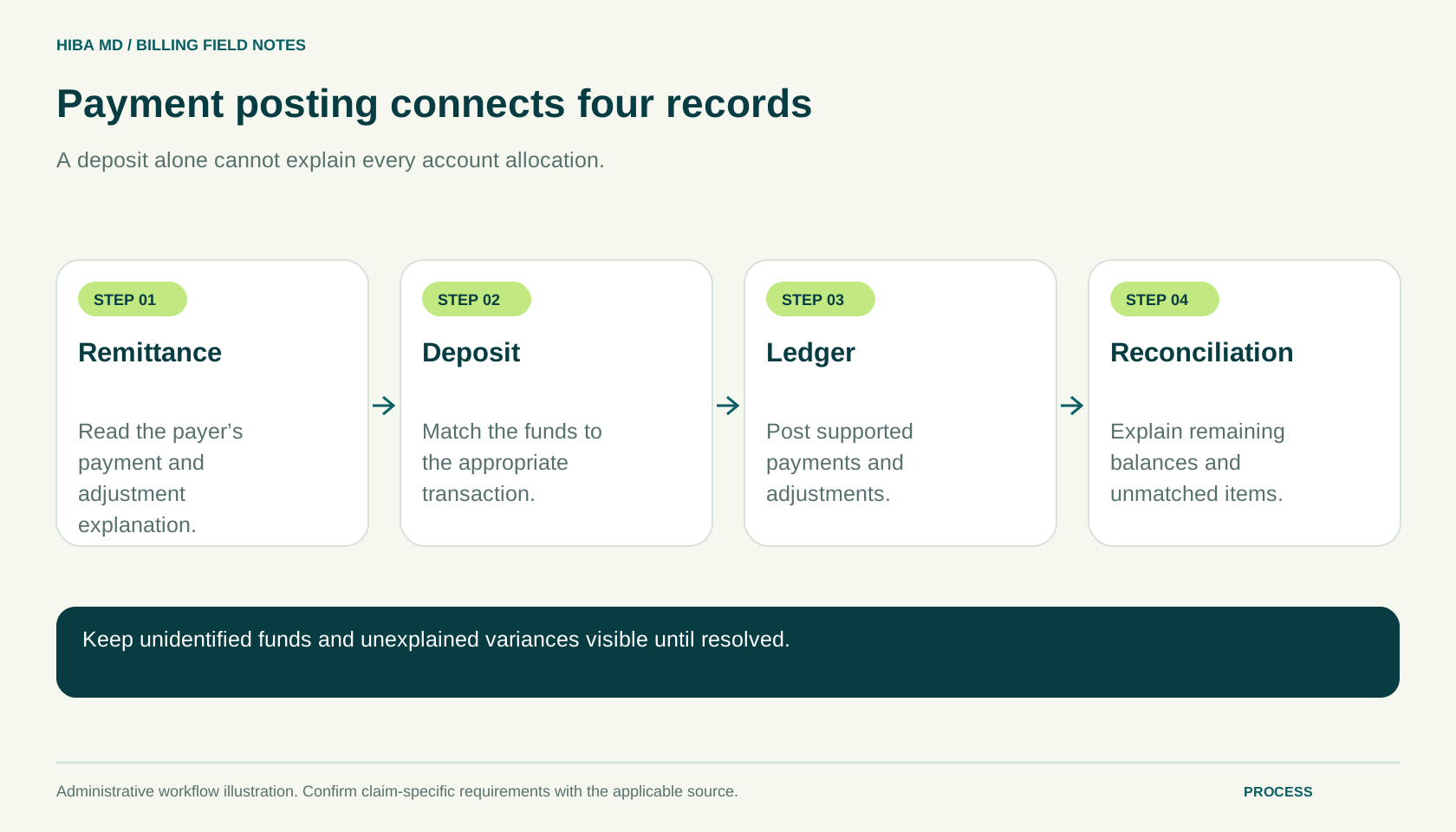
Distinguish the financial and adjudication records
A remittance communicates how claims were adjudicated. A deposit reflects funds received. The account ledger records how the practice applied payments, adjustments and remaining amounts. These records are connected, but they serve different purposes. Establish which team receives each source and who is responsible for reconciling them under the practice's process.
CMS describes Medicare electronic remittance advice as a source of final claim adjudication and payment information. One remittance can include multiple claims and adjustments at different levels. Staff need to connect the overall payment with the relevant claim and line details rather than treating the bank amount as a complete explanation of every account outcome.
Create a clear source path. The posting team should know where to find the original remittance, the corresponding payment reference and the ledger activity. A later investigator should be able to trace the posting back to those sources. If the practice relies on automated posting, the same principle applies: automation changes how information is entered, not the need to explain exceptions and reconcile the result.
Connect EFT, ERA and the posting batch
Identify the references your systems use to associate an electronic payment and remittance. Establish how staff handle a payment without a located remittance, a remittance without a matched receipt and a posting batch that does not reconcile. The correct technical details depend on the actual payer and system arrangement, so document the process your practice uses.
Do not resolve an unmatched item by guessing which accounts it belongs to. Record the reference, source amount, date and question requiring investigation. A temporary holding process may be appropriate under the practice's policy, but it should have an owner and next review date. Unapplied funds that remain invisible can create misleading A/R and unnecessary follow-up activity.
For an invented example, an $8,000 receipt is available while the posting batch totals $7,850. The $150 difference needs explanation. It may involve an unapplied amount, a posting issue or another documented adjustment. The discrepancy is not automatically an underpayment on a particular claim. Start with the batch and source records before contacting a payer or assigning responsibility to a patient.
Read adjustments at the correct level
CMS remittance resources explain that information can be reported at line, claim and provider levels. A payment difference at one level may not be explained by a single service-line label. Review the complete remittance and related source information before interpreting a net amount. Staff should know where their system displays each type of adjustment and how it reaches the ledger.
Claim adjustment group codes, reason codes and remark codes contribute different context. Read the applicable combination and amounts rather than relying on a short internal category. The purpose is to identify what the payer stated, what the practice recorded and what remains a question. A code description alone may not establish the correct final account treatment without the relevant arrangement and review.
When an automated rule maps a response to an adjustment, confirm that the mapping reflects the intended process. An exception should be visible when the source does not fit the rule. Automation can process routine items efficiently, but an unexplained mismatch still needs investigation. A system that silently clears differences can make the ledger look tidy while leaving the underlying question unresolved.
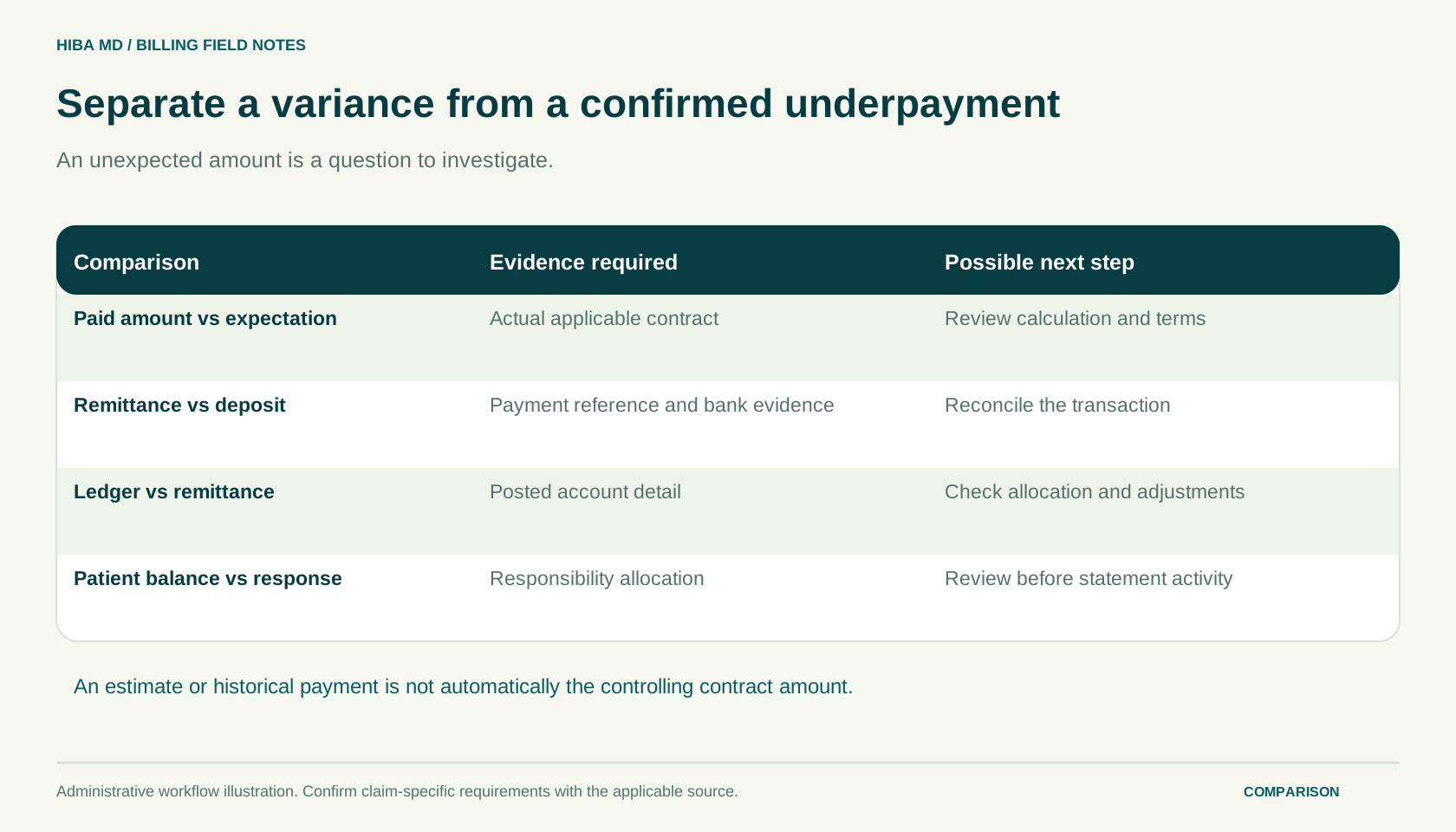
Reconcile the batch before reviewing individual variances
Begin with source totals and explain how they connect. Compare the remittance payment amount, receipt amount and posted activity under the chosen cutoff. Identify whether provider-level adjustments, reversals or other documented transactions affect the reconciliation. Use the actual system's reports and retain enough context for another person to reproduce the conclusion.
Separate a batch discrepancy from a claim-specific variance. If the total does not reconcile, determine whether a missing or duplicated posting is involved before launching multiple underpayment investigations. Conversely, a perfectly balanced batch does not prove that every claim paid as expected. Reconciliation and expected-payment review are complementary controls, not substitutes for one another.
Give unreconciled items their own queue. Record the amount, source references, issue, owner and next action. Avoid burying them in a general denial list or allowing a balance to age without a clear explanation. A well-owned exception queue helps management see whether the problem is missing evidence, a system mapping question or a financial record requiring a different review route.
Establish the expected amount from the right source
An underpayment review needs a defensible expected-payment basis. Depending on the arrangement, that may involve the relevant contract, fee schedule, service details, effective period and other applicable factors. Gross charges are not automatically the expected allowed amount. A public Medicare amount is not automatically the contracted amount for a different payer or product.
Record the source and assumptions used. Identify the service date, relevant provider and location arrangement, and whether the comparison is at line or claim level. If the source is unclear, label the item as needing expected-amount clarification rather than immediately asserting that the payer underpaid. This makes the investigation more precise and avoids building a dispute around an unsupported starting number.
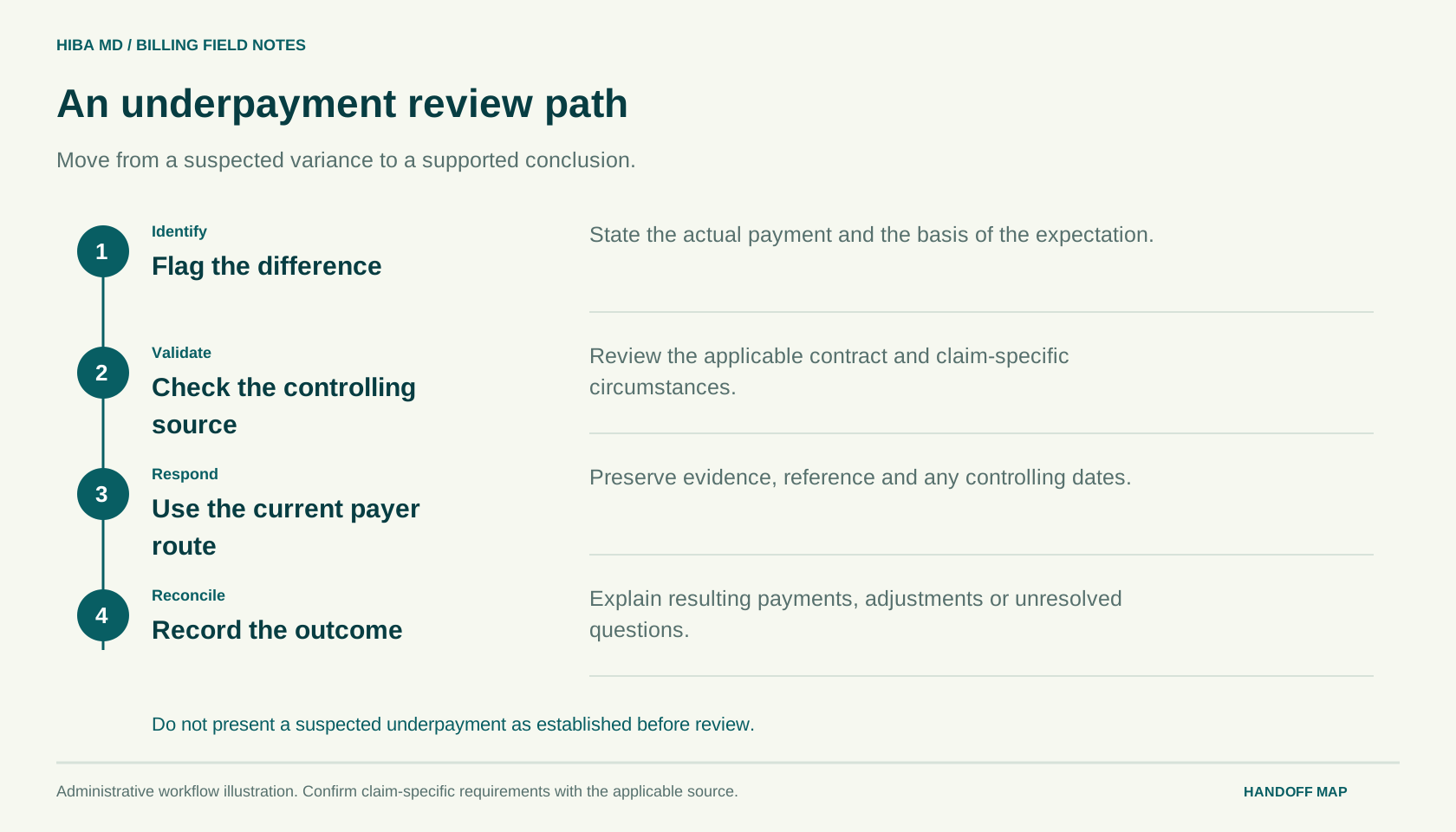
For an invented example, an expected amount of $140 and an actual payment of $120 produce a $20 arithmetic difference before other relevant account factors are considered. That is a flag for review. The investigator still needs to determine whether the expected basis is appropriate, how the payer adjudicated the service and whether adjustments or responsibilities explain the difference.
Consider a fictional $100 contractual allowed amount and $20 in valid patient responsibility. If no other adjustment applies, expected payer payment is $80. The ERA shows a $65 payer payment. The $15 difference belongs in the variance queue while the biller checks the rate and the remittance. If the ledger shows $60 even though the ERA says $65, investigate that $5 posting discrepancy separately. This keeps a ledger error out of the payer underpayment calculation.
Calculate the difference between an expected and actual payer payment
Review patient responsibility with care
The unpaid portion of a billed charge is not automatically patient due. Review the actual adjudication, relevant coverage arrangement, practice policy and applicable requirements before assigning or transferring a balance. Keep unresolved payer questions separate from a confirmed patient-account workflow. A ledger transfer should reflect a supported decision rather than an attempt to remove an old insurance balance.
If another payer may be responsible for part of the amount, confirm the coordination route. CMS provides Medicare coordination-of-benefits resources, and other programs and plans provide their own applicable information. Use the actual service-date arrangement rather than an assumption based on the order of payer names in the software. Record the source used and the current status.
Patient-facing staff need a route to investigate questions about statements. A remittance issue, a missing secondary claim and a payment-plan question require different evidence. Ensure that the ledger explanation and the communication are consistent. A clear statement total is helpful only when the underlying account treatment has been reviewed and staff can explain what was established.
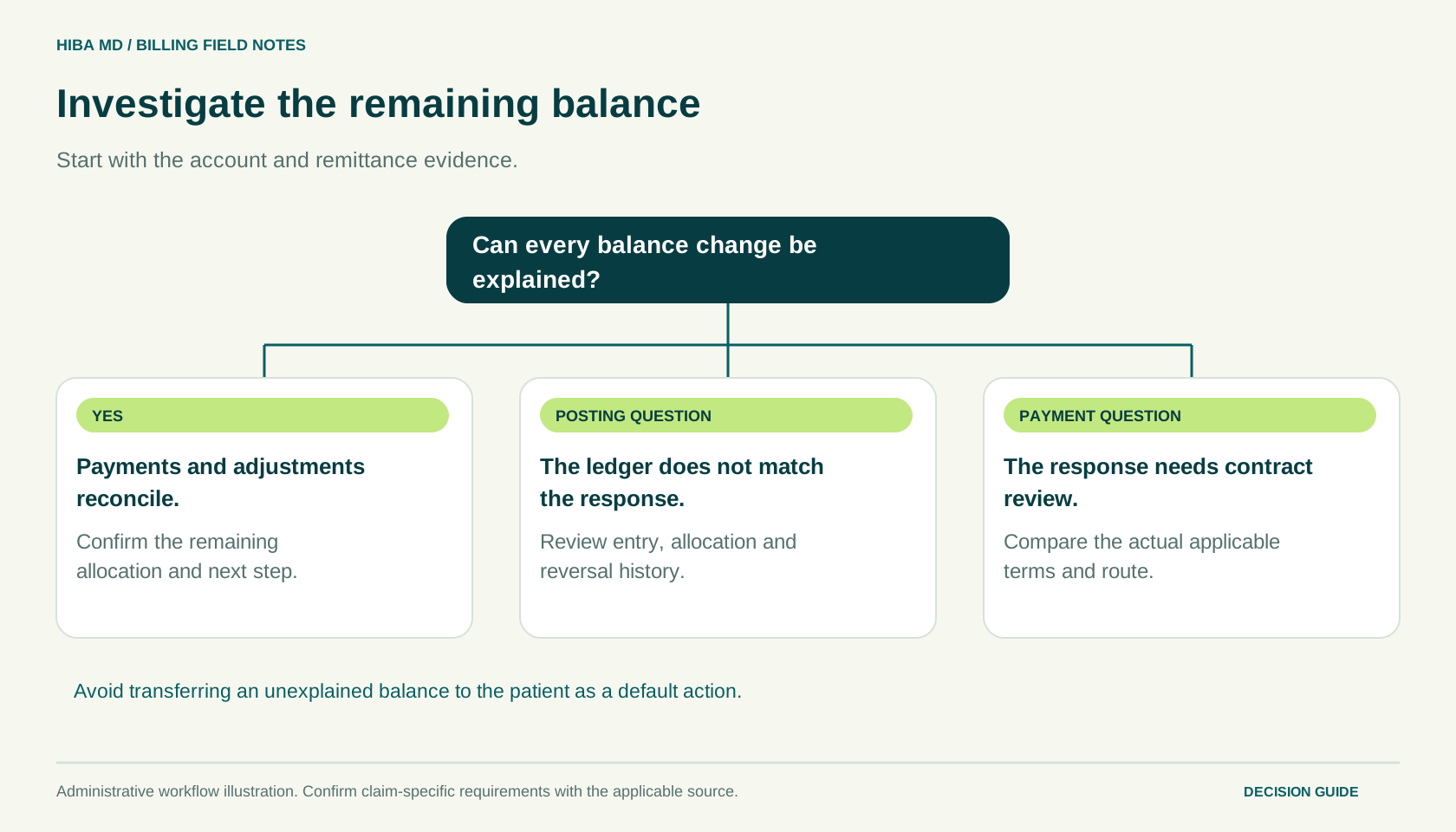
Separate denials from possible underpayments
A denied service and a partially paid service may require different investigations. Begin with the actual response and identify which amount or line is affected. Do not label every difference from billed charges as a denial or every low-looking payment as an underpayment. The categories should point toward the evidence needed for the next decision.
For a denial, the team may need documentation, coverage or administrative review and the appropriate correction or appeal route. For a possible underpayment, it may need the expected-payment basis and a comparison with the adjudication. Some accounts contain both. A precise line- or amount-level work item is more useful than one broad label applied to the entire encounter.
Keep the investigative routes connected where they overlap. A contract question may affect several similar payments, while a coding or documentation question may change how one service should be reviewed. The responsible qualified person should evaluate those issues using the actual record. Do not alter a claim merely to make the payment resemble a preferred amount without a supported basis for the change.
Investigate reversals and reprocessed claims
An account may receive a later reversal or reprocessed adjudication that changes the earlier posting context. Keep the sequence visible so staff can understand which decision is current and how the ledger reflects the change. A later payment or adjustment should not be treated as an unrelated new account event when it refers to an earlier transaction.
Use source references to connect the original and later activity. Confirm how the system handles reversals, replacement postings and any remaining difference. If an automated process creates an exception, route it to the person who can review the actual history. Avoid duplicating a payment or leaving an obsolete responsibility amount in place because only the latest screen was reviewed.
For an illustrative account, an original $200 payment may later be reversed and replaced by a $180 payment with a revised explanation. The net account effect is not understood by looking only at the second deposit. Trace the full sequence and determine what the current adjudication establishes. Any resulting follow-up should use the applicable response and current route, not the superseded decision alone.

Create a variance queue with a complete question
A useful variance record identifies the account reference in the approved system, affected service or amount, expected basis, actual response, difference, evidence needed, owner and next action. The queue should show whether the expected amount has been confirmed or is still an assumption. This prevents a list of arithmetic flags from being mistaken for a validated revenue opportunity.
Group similar items where doing so helps investigation, but retain claim-specific context. A repeated pattern may justify reviewing a payer mapping, contract reference or system rule. It does not establish that every account has the same cause. Sample the actual evidence and identify whether the apparent pattern remains when service dates, provider arrangements and response details are considered.
Prioritize with verified deadlines, evidence readiness, value and recurrence. A complete, time-sensitive inquiry may need immediate attention. A larger group with an unclear expected basis may first need a contract or source review. Clear priority definitions help the team direct effort toward a decision it can support rather than pursuing the largest displayed total without understanding what it represents.
Contact the payer with a focused evidence package
Before contacting the payer, define the question and gather the relevant references. Include the actual adjudication, the basis for the expected amount and the specific difference needing explanation. Use the current inquiry or review route appropriate to the arrangement. A general request to pay more is less useful than a precise question that the recipient can investigate.
Record the response and next step. If the payer requests another document, identify its owner and the required destination. If the response explains the amount, review that explanation against the relevant source rather than accepting or rejecting it without evidence. If a formal dispute route is needed, verify its current requirements, deadline source and receipt instructions for the actual program or plan.
CMS describes an appeals framework for Original Medicare, but that is not a universal process for every payer product. Do not apply one notice, destination or deadline across unrelated arrangements. A calendar tool can support arithmetic once the controlling inputs are established. It cannot determine the applicable route or whether the substantive payment interpretation is correct.
Report actual outcomes separately from identified differences
An identified variance is a question, not cash received. Report flagged differences, confirmed issues, pending inquiries, supported payments and other dispositions separately. Management should understand how the starting population moved and what remains unresolved. A large total of calculator differences should not be presented as recovered revenue or a guaranteed future collection.
Use invented figures to illustrate the distinction. A review flags $5,000 of differences. Investigation confirms $2,000 for further payer review, explains $1,500 through supported account treatment and leaves $1,500 awaiting source clarification. If $800 is later received and reconciled, report that outcome distinctly. The stages tell a more accurate story than calling the original $5,000 an underpayment recovery.
Keep count and dollar views where useful. A small group of high-value items and a large group of small recurring differences create different workloads. Explain the period, cutoff and included population. If a system rule changes and creates fewer flags, confirm that the underlying issue improved rather than assuming a lower exception count proves a better payment outcome.
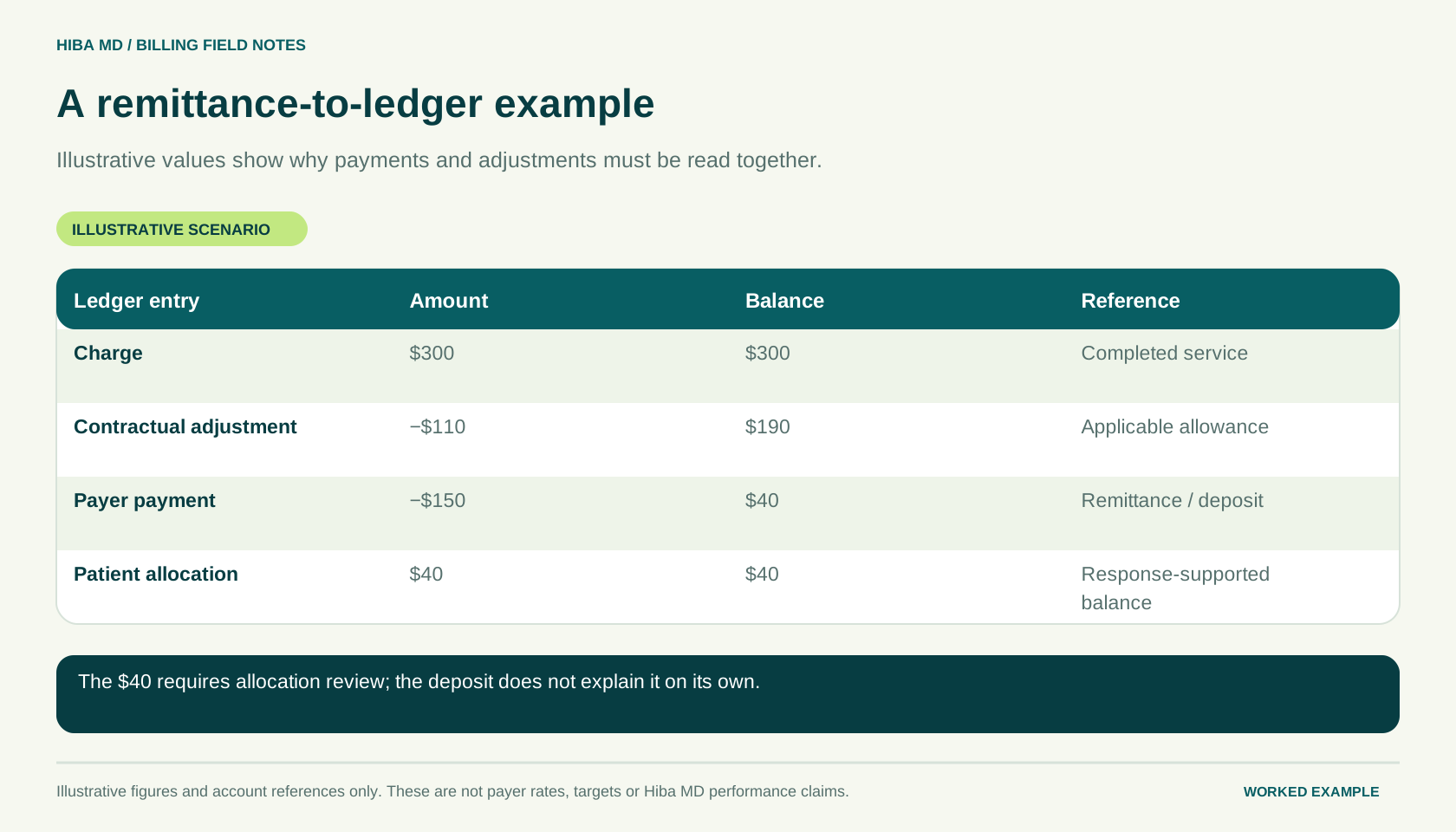
Review posting rules and training from real exceptions
Recurring exceptions can reveal a mapping, access or training question. Compare the source remittance with the ledger result and identify where the interpretation changed. A payer response may be correctly received but incorrectly categorized by the software, or a manual step may be applied inconsistently. The corrective action depends on the actual point of failure.
Test a proposed rule change on a defined sample before treating it as a general solution. Verify that it handles the intended routine items and exposes the exceptions that still need review. A rule that reduces manual work by silently clearing unexplained amounts can undermine the purpose of reconciliation. Document what the rule does, what source supports it and who reviews outcomes.
Train with an invented remittance scenario that includes a payment, an adjustment and a remaining question. Ask the team to identify which amount is established and which needs another source. This tests interpretation and escalation, not just data entry. The practice should retain a clear route for questions that exceed routine posting authority or involve a contract, coding or compliance concern.
Connect posting quality with the rest of the cycle
Posting affects A/R, patient statements, management reports and follow-up priorities. An incorrect adjustment can make a balance disappear; a missing payment can make it look overdue. That is why posting and follow-up teams need a shared exception route and management needs reconciled definitions. The quality of later decisions depends on the accuracy of the account state they receive.
Review a small set of controls regularly: unmatched receipts, remittances awaiting posting, batch differences, unapplied amounts and unresolved expected-payment questions. Assign owners and next actions rather than presenting only totals. A rising exception category should trigger a focused investigation into the source or handoff, with the actual evidence guiding the response.
Hiba MD offers a free audit discussion and one month of medical billing services free, with no conditions. Describe your payment sources, current posting workflow and the differences your team cannot explain. Aggregate information is enough to begin. Any detailed remittance or patient-account work should use the secure process agreed with your practice, and conclusions should remain tied to the relevant source records.
Trace one invented payment from source to ledger
Create a training payment of $1,000 associated with several adjudicated claims and a documented adjustment. Ask staff to locate the remittance total, identify the payment reference and explain the ledger postings. The exercise should use the system's actual source relationships without patient information. Every amount needs a supported explanation. If the total cannot be reproduced, the next step is source investigation rather than an arbitrary balancing adjustment.
Introduce a missing posting and ask how it appears in A/R. A follow-up worker may see an open balance even though a remittance exists. The correct route is to connect the evidence with the posting investigation. This shows why a current account state matters to downstream work and why posting exceptions should not be hidden in a general denial queue. The people reviewing the balance need a way to identify the source question.
Complete the exercise by having a different staff member trace the same payment using only the recorded references and notes. If they need the original worker to explain an undocumented step, improve the process description. A useful reconciliation trail supports continuity. It does not require a complicated new system, but it does require reliable references and a clear distinction between source evidence and an assumption.
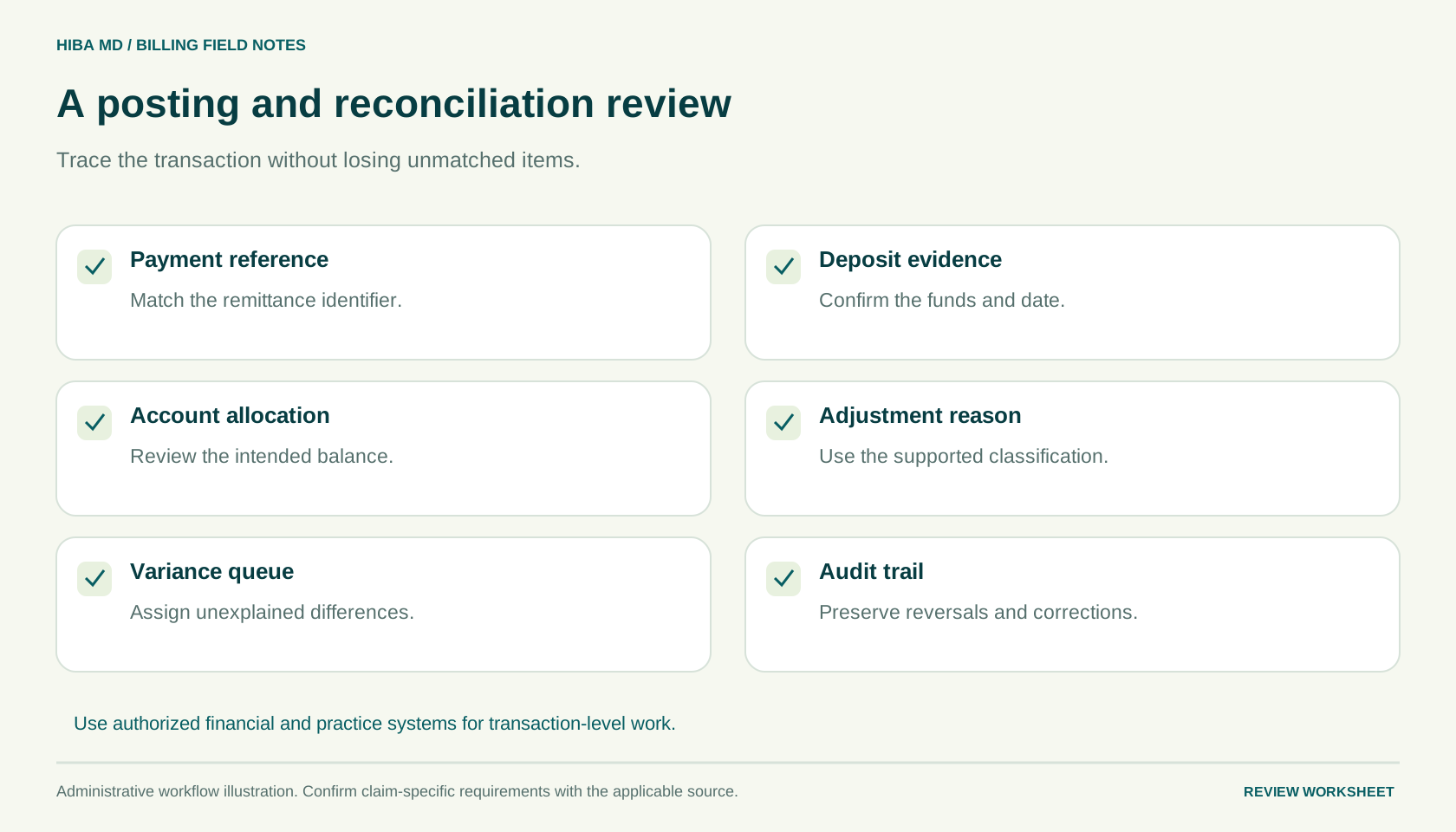
Validate a possible variance before aggregating it
Suppose a worksheet flags ten accounts with an entered expected amount of $150 and an actual payment of $130 each. The arithmetic difference is $200 in total. Before presenting that as an underpayment opportunity, confirm the expected basis for the actual service dates and arrangements, review the complete adjudication and identify any relevant account factors. A repeated input can create a repeated error as easily as it can reveal a repeated issue.
Review a defined sample and record whether the expected basis is confirmed, explained differently or still unresolved. If the same source assumption was used across the population, investigate it before sending ten similar inquiries. This can save unnecessary work while preserving genuine questions. The review should remain claim-aware; a pattern does not establish that every account has identical circumstances or should receive the same response.
Report the stages clearly. The initial $200 is a flagged arithmetic total under entered assumptions. A confirmed issue amount, a pending payer-review amount and a received payment are different results. Keeping those labels precise helps management understand what the team actually established and prevents a planning worksheet from being mistaken for a statement of cash recovered or guaranteed collectible revenue.
Review adjustment authority and exception ownership
Document which routine adjustments staff may apply under the practice's process and which questions require another review. The point is to make decision boundaries understandable, not to create a new rule for every account. An unexplained difference should have an escalation route. Staff should not feel compelled to clear it simply because a batch is expected to balance or a report is due.
Use an invented ambiguous response in training. Ask what evidence is available, what the system proposes to post and what remains uncertain. The appropriate answer may be to hold the exception for the responsible reviewer rather than choose a convenient adjustment category. A transparent unresolved item is more useful than a closed account whose disposition nobody can support when management later asks what happened.
Keep the review outcome with the source reference and the resulting ledger action. If a system rule is changed, identify what it will do to future items and whether existing exceptions need separate review. This prevents a configuration fix from being treated as automatic resolution of the older queue. A rule can improve processing, but each affected account still needs an accurate and explainable state.
Make payment questions visible in the monthly review
Report unmatched receipts, unposted remittances, unreconciled batches and expected-payment questions as distinct categories. Include the count or value relevant to the decision and the main dependency. A single payment-problem total makes it difficult to identify whether the practice needs a document, a source match, a system investigation or a contract interpretation. Clear categories direct management attention toward the owner who can act.
Explain movement from the previous review. New exceptions, resolved source matches, supported ledger corrections and received payments are different events. If an item moves to another queue, identify its continuing owner. A smaller total should not be celebrated without knowing whether the underlying question was resolved or merely reclassified. The review should preserve continuity of the work across teams and reporting periods.
Choose one recurring handoff to improve and define how the practice will test it. A missing remittance reference may call for a better intake process. A repeated mapping issue may call for a controlled system review. A delayed practice response may call for a clearer query. Use a later comparable sample to evaluate that specific change, while keeping payer outcomes and broader revenue claims separate from the process finding.
Preserve enough history to explain the result after the month closes. If a receipt was later matched, identify the source that resolved the question. If a posting was corrected, connect the correction with the reviewed evidence. If a variance remains under investigation, keep its current owner and expected next action visible. A management report should not become the only place where the story is recorded. The approved ledger and work history need to remain understandable to the next person who reviews the account, including someone investigating a later reversal or a patient question about the same service.
Frequently asked questions
Is the difference between charges and payment an underpayment?
Not automatically. Gross charges are not necessarily the expected amount under the relevant arrangement. Review the appropriate expected-payment source, actual adjudication, adjustments and responsibilities before reaching a conclusion. A simple subtraction can identify a question, but it cannot establish what the payer owes.
Is an ERA the same as a bank deposit?
No. The remittance communicates adjudication and related account information, while the deposit reflects funds received. They need to be connected and reconciled through the practice's process. One payment or remittance can involve multiple claims and other adjustments, so the overall amount does not explain every line by itself.
Can automated posting eliminate reconciliation?
No. Automation can enter routine information, but exceptions and source totals still need review. Confirm how the rules map responses to ledger activity and how unmatched or unusual items are exposed. A balanced batch also does not prove that each claim paid according to the appropriate expected basis.
Should an old payer balance be moved to the patient?
Age alone does not establish patient responsibility. Review the actual response, coverage arrangement, practice policy and applicable requirements. A pending payer question, secondary-coverage issue or posting difference needs its own investigation before an account is treated as ready for patient communication.
What does Hiba MD's underpayment analyzer calculate?
It compares the entered expected and actual amounts and shows the arithmetic difference. It does not validate the contract, retrieve a remittance or determine entitlement to payment. Use it to organize a review question, then confirm the basis and next action with the actual evidence and appropriate review.
Sources and editorial notes
Written by the Hiba MD editorial team. Reviewed 2026-11-18. Worked examples use illustrative figures, not client results or performance benchmarks. This guide explains administrative workflows; check current payer requirements for claim-specific decisions.
