
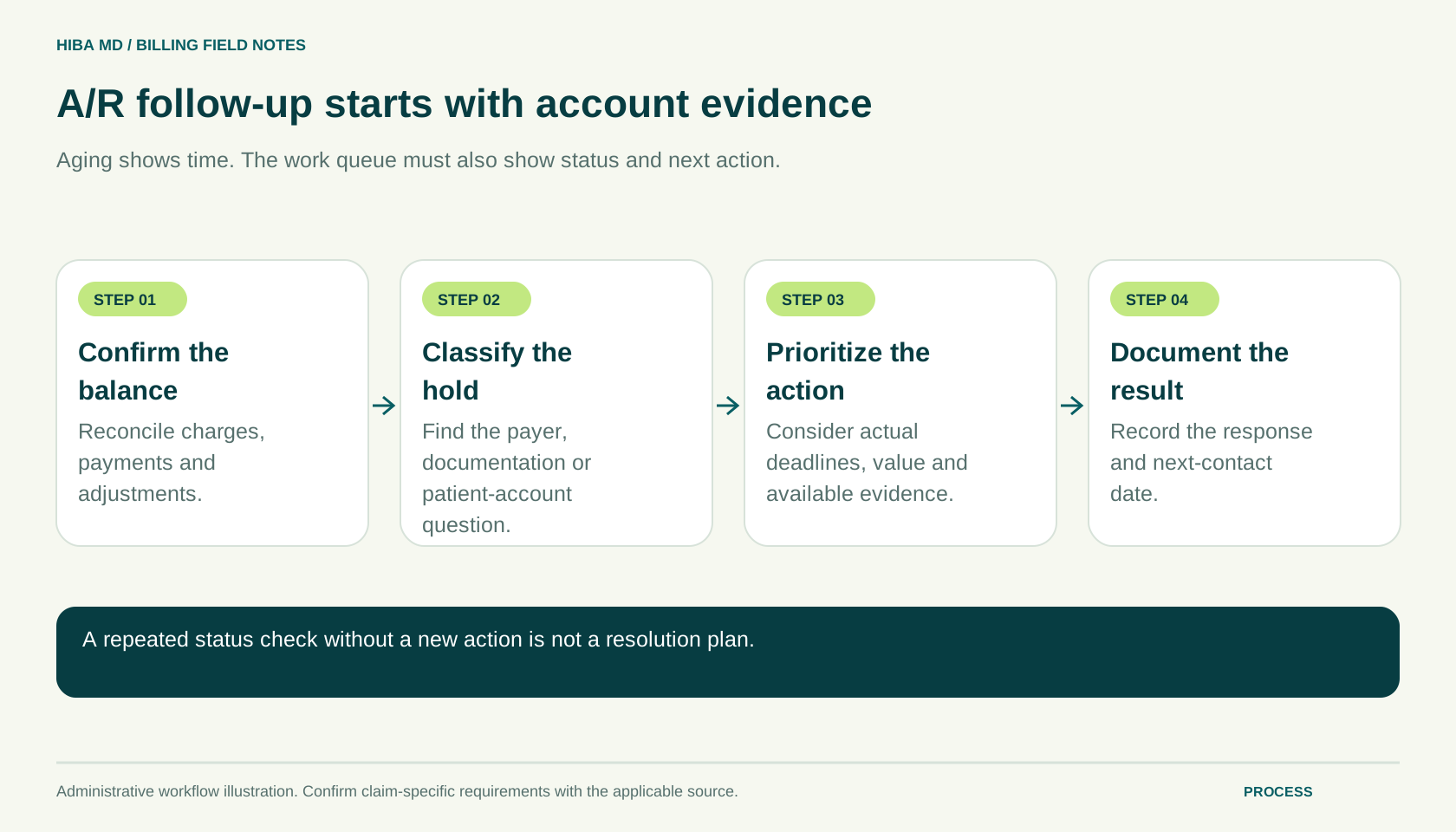
Medical accounts receivable is the amount recorded as outstanding for services, but an aging total alone does not explain what needs to happen next. Useful A/R management connects each balance with its payer status, underlying issue, supporting evidence, owner and next action. The aim is a supported resolution of the account, not simply a smaller number produced by unexplained adjustments.

Start with the practical question
This guide is for practice administrators who need to understand older balances, organize follow-up and evaluate reports from an internal team or billing partner. It uses invented figures to demonstrate arithmetic and queue design. They are not industry benchmarks, collection forecasts or Hiba MD results. The correct treatment of a particular account depends on the actual record, payer response, contract and applicable current requirements.
Establish what the A/R report includes
Before reviewing age buckets, define the balance being reported. Does the report include insurance and patient amounts, credit balances, unapplied payments, claims awaiting submission and balances assigned to another process? Is aging measured from the service date, first submission, statement date or another event? These choices materially affect what the report describes.
Ask the report owner to reproduce the total from a stated source and cutoff date. Keep an opening balance, activity during the period and closing balance where the system supports that reconciliation. Charges, payments, adjustments and transfers should explain the movement. If the closing balance cannot be connected to the source activity, investigate the reporting issue before deciding that follow-up performance is the cause.
A practice can appear to improve aging after a report setting changes even when no account changed status. That is why the definition belongs next to the dashboard, not in someone's memory. When a new billing partner or software system is introduced, compare like-for-like populations and explain any difference in scope. Otherwise, the first management meeting may become an argument about two totals that were never intended to match.
Read age as a signal to investigate
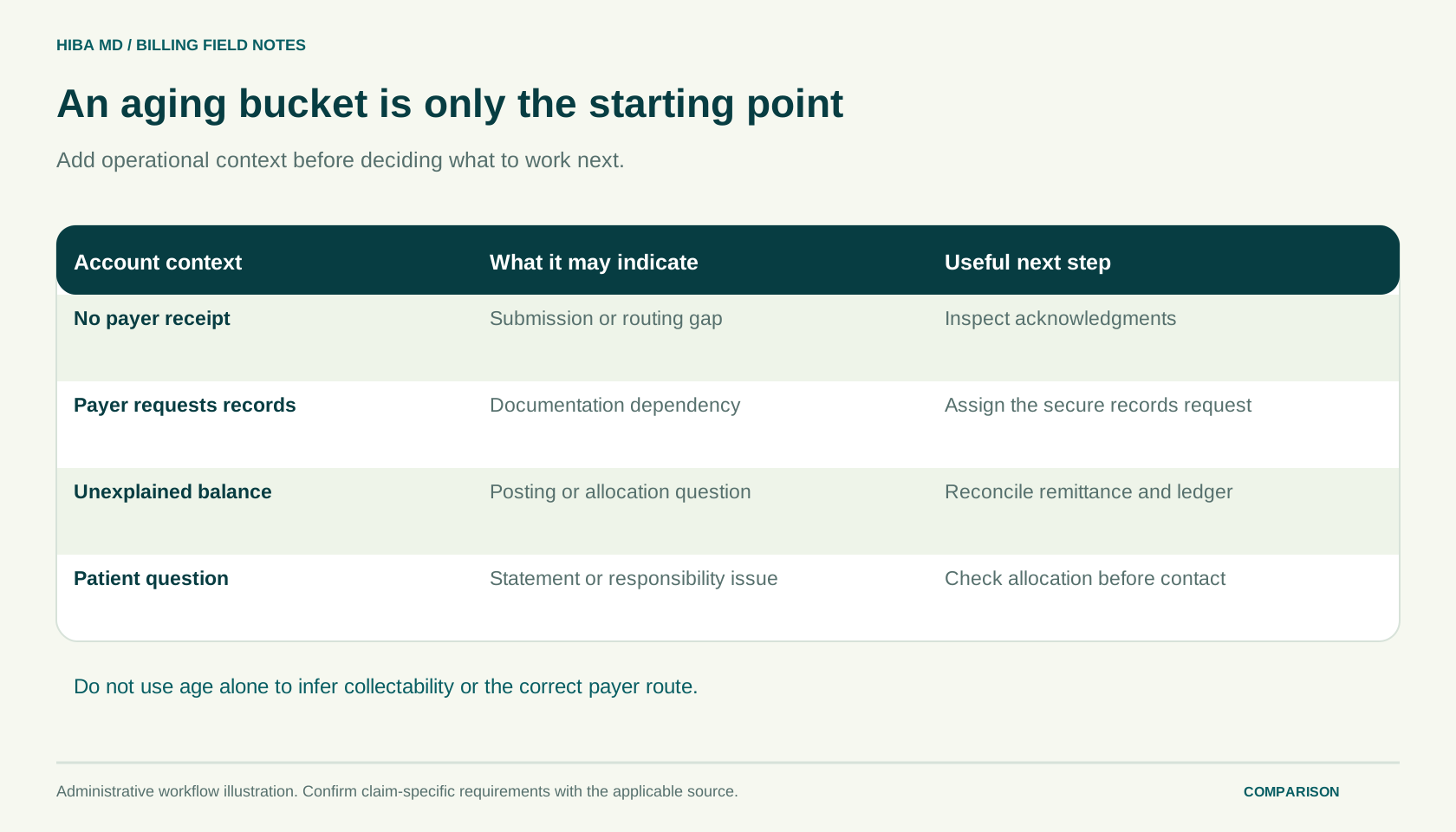
Age tells you that an item has remained open under the chosen definition. It does not establish that it is collectible, denied, overlooked or ready for patient billing. An older account could be waiting for a documented payer review, a missing remittance, a practice response or a correction. A newly created balance can also carry an urgent issue if a verified deadline is approaching.
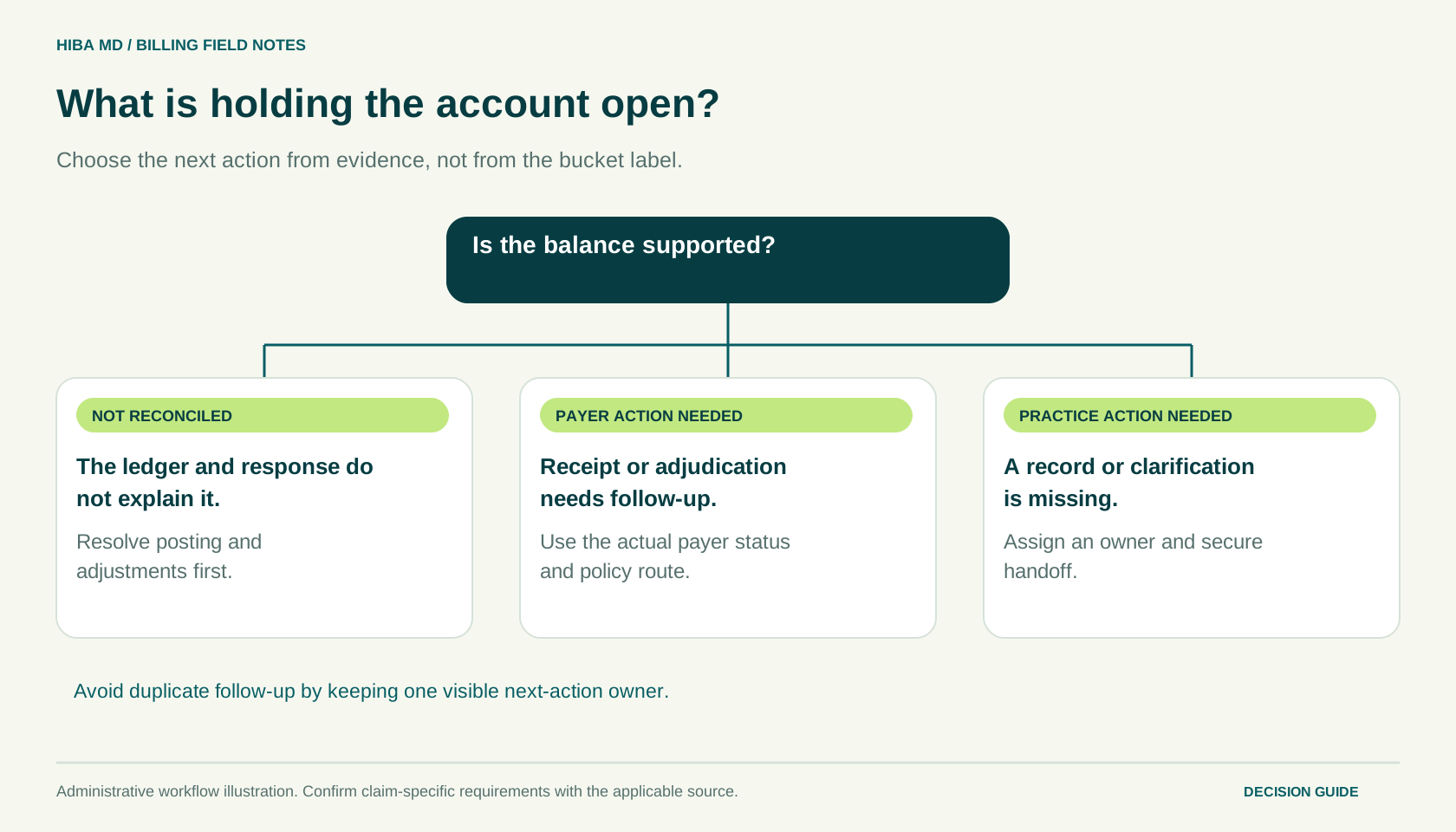
Use aging to choose where to look, then classify the reason. A useful review separates submitted and acknowledged claims from items that have not reached that stage. It also distinguishes payer amounts from patient amounts and identifies posting exceptions. Those categories help the manager understand whether the work belongs with registration, documentation, submission support, follow-up or payment reconciliation.
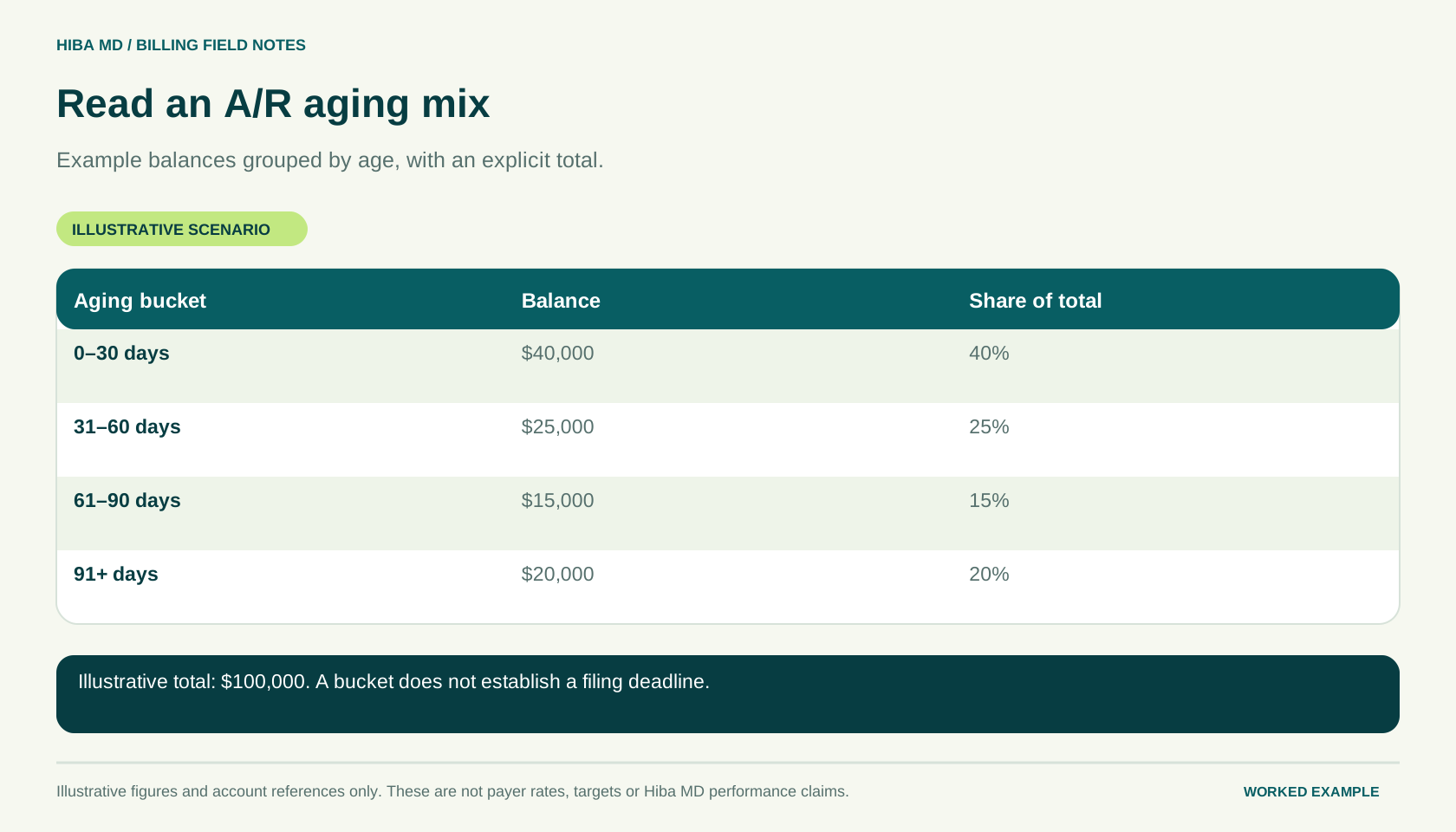
For example, an over-90-day bucket of $45,000 may include $20,000 under payer review, $10,000 awaiting documentation, $8,000 with unresolved posting questions and $7,000 in other categories. Those invented figures describe four different management problems. Asking staff to call on all $45,000 treats the age as the cause and can waste effort on accounts whose next action is somewhere else.
Build issue categories that lead to action
Keep the category list short enough for consistent use but specific enough to direct work. Possible categories include no acknowledgment, pending adjudication, returned submission, adverse determination, coverage clarification, authorization evidence, documentation query, payment variance, missing posting and patient-account review. Define each category in plain language and give staff examples of what belongs there.
Separate the cause from the current task. A provider participation issue might now require an enrollment-status confirmation, while a documentation issue might now require a payer review after the record was supplied. If the report only tracks the original cause, it may not reveal what the team is waiting for today. If it only tracks today's task, it may hide recurring upstream patterns.
Add an awaiting-practice-response status when appropriate. This is not a way to shift blame; it makes a dependency visible so it can be resolved. The note should identify the exact question, the person expected to respond and the next review date. A generic pending label does not give management enough information to remove a bottleneck or determine whether an escalation is justified.
Confirm claim status before contacting the wrong queue
Begin with the latest reliable response and the original submission evidence. Confirm whether the payer has the claim, what stage it has reached and whether a response or remittance is already available. CMS identifies the 276/277 as the electronic claim status inquiry and response standard. Your practice may use a supported electronic connection or the relevant payer interface, depending on its arrangements.
Record the status meaningfully. Claim received, pending information and adjudicated are different findings. A claim that was paid may need a remittance search or posting investigation rather than another payment-status call. A claim the payer cannot locate may need transmission evidence and intake investigation. The purpose of the contact is to resolve a defined question, not simply record an activity against the account.
Avoid sending a new submission just because the balance remains open. First determine what happened to the existing one and follow the appropriate current process. Repeated submissions can complicate the account history. Retaining acknowledgments and payer references gives staff a better starting point and makes it easier for a different team member to continue the work without repeating the same unsuccessful inquiry.
Prioritize with evidence, deadlines and dependencies
A practical priority model considers more than the largest balance or oldest date. Include verified filing or review deadlines, the amount under consideration, available evidence, current processing stage and the action required. A complete package with a clear next step can be worked immediately. A larger account missing a necessary practice record needs an escalation to obtain that record before another payer contact will help.
Use priority labels with clear definitions. Urgent should mean something specific, such as a verified time-sensitive requirement, rather than a general expression of concern. Keep the controlling source for any deadline in the approved system. An internal reminder is a management choice; a payer filing or appeal deadline is a separate requirement that must be identified from the applicable evidence.
Do not assume that every older dollar will become cash. A follow-up queue is not a forecast of recoverable revenue. Some accounts may resolve through supported payments, contractual treatment, corrections or another approved disposition. Management should understand the status and evidence behind each category rather than asking a team to promise a recovery percentage before the accounts have been reviewed.
Make every follow-up note useful to the next person
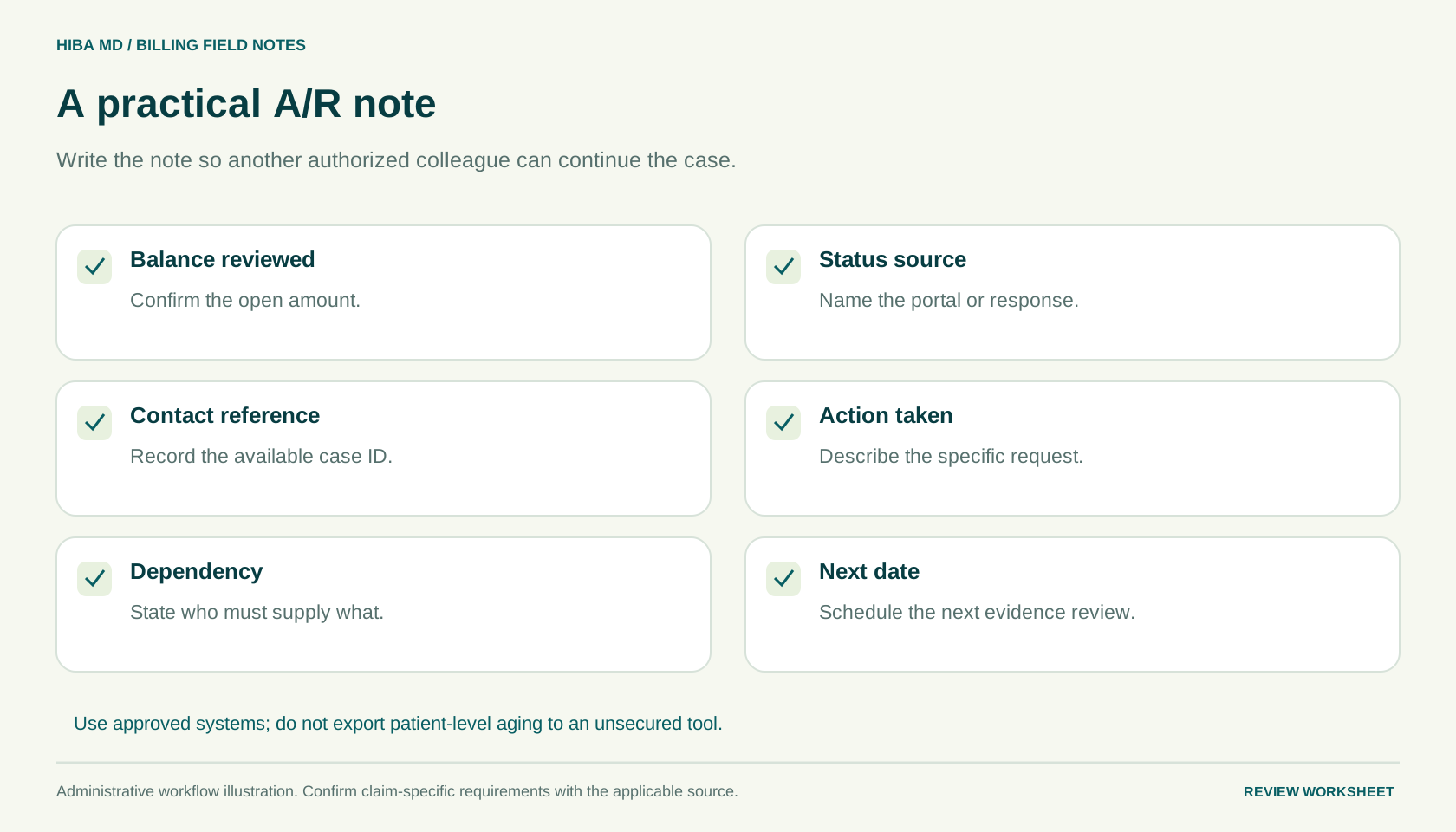
A good note answers four questions: what was checked, what was learned, what happens next and who owns it? Include the relevant payer or system reference and the date of the finding. Keep the note concise enough to scan, but specific enough that the next person does not have to repeat the same contact merely to understand the account.
Compare two invented notes. Called payer tells the reader only that an activity occurred. Confirmed claim received; payer requested the missing operative report; practice documentation owner will supply it through the approved route; review again on the agreed date describes the actual state of the work. The second note supports continuity without making an unsupported prediction about payment.
Keep patient information and credentials inside approved systems. Management summaries can use aggregate counts, dollars and issue categories. If an external billing partner participates, agree the record-sharing and access process before detailed work begins. The account note should refer to the evidence stored there rather than spreading copies of sensitive records through general email attachments or public website forms.
Investigate payment and posting exceptions separately
An unpaid-looking account may already have an adjudication or payment that has not been correctly connected to the ledger. Review remittance availability, deposit information, posting history and any unapplied amount before sending another request for payment. The A/R team and posting team need an explicit route for these questions so they do not work in parallel with contradictory assumptions.
CMS remittance resources explain that adjustments can occur at line, claim and provider levels. Read the full context rather than assuming that the difference between billed charges and the deposit is an underpayment. The expected amount itself needs an appropriate basis, such as the relevant contract or fee schedule, with the correct service and effective period.
For an invented example, a $600 balance might remain because a $400 payment was posted to another account and a $200 adjustment was not applied. That scenario needs source reconciliation, not necessarily a collection call. Another $600 balance may represent a genuine unresolved payer determination. Both appear in A/R, but they require different evidence and owners. A useful issue queue makes that difference visible.
Keep payer and patient responsibilities distinct
Do not transfer a balance to a patient simply because the payer portion is old. Review the actual adjudication, coverage arrangement, practice policy and applicable requirements before deciding the next responsible party. Patient-account work should have its own review process, with clear documentation of what was established and how questions will be handled.
When another payer may be involved, confirm the coordination-of-benefits route rather than treating a remaining amount as automatically patient due. CMS provides Medicare coordination resources, and state Medicaid programs and individual plans provide their own relevant administrative information. Use the actual service-date arrangement and keep the source reference with the account investigation.
Statements should be understandable and consistent with the approved ledger. If a patient asks about an amount, staff need a route to investigate it without simply repeating the statement total. A posting question, an unresolved secondary claim and a patient payment plan are different situations. Keeping those categories separate improves the quality of the conversation and reduces unnecessary back-and-forth between the front desk and billing.

Calculate days in A/R with a visible method
A common planning calculation divides a stated receivable balance by average daily charges over a selected period. For example, if included receivables are $90,000 and average daily charges are $3,000, the arithmetic result is 30 days. That result describes the selected inputs. It does not prove that every claim is paid in 30 days or that the practice meets an external performance standard.
Document how average daily charges were calculated, which days were included and what was excluded from receivables. A practice using a calendar-day denominator may produce a different result from one using business days. A recent volume change can also affect interpretation. Compare the method consistently over time and investigate the source before comparing the result with another organization.
Read days in A/R alongside aging and issue categories. An overall average can hide a concentrated older-payer problem or a large recent charge increase. The Hiba MD days-in-A/R calculator makes the arithmetic visible, while the aging analyzer helps organize balances by entered buckets. Both are browser-based planning aids; neither verifies payer status or determines the collectibility of a particular account.
Review queue movement, not just touches
Activity counts show effort: calls made, accounts reviewed or requests sent. They can help a manager understand capacity, but they do not establish that the underlying issue moved toward resolution. Add status movement to the review. How many items obtained the missing evidence, reached a confirmed payer decision, reconciled a posting question or completed an approved next step?
Use a defined beginning population when reviewing a cleanup project. Record the starting count and balance, additions, transfers, payments, adjustments and unresolved items. Explain the disposition of accounts rather than reporting a reduced total without context. If balances were moved to another queue, management should see that transfer separately from cash received or a resolved discrepancy.
An invented project might start with 100 accounts. After review, 25 receive a supported payment, 20 move to documented payer review, 15 await practice evidence, 10 require posting reconciliation and 30 remain under investigation. That description provides more operational insight than saying 70 accounts were touched. It also helps management identify which dependency to address before assigning more follow-up activity.
Organize older A/R during a billing transition
Changing staff or billing companies does not automatically transfer knowledge about existing accounts. Define the service dates, entities and task scope included in the handoff. Decide who retains responsibility for older balances and how the two teams will avoid duplicate submissions, duplicate payer contacts and inconsistent patient communications during the transition.
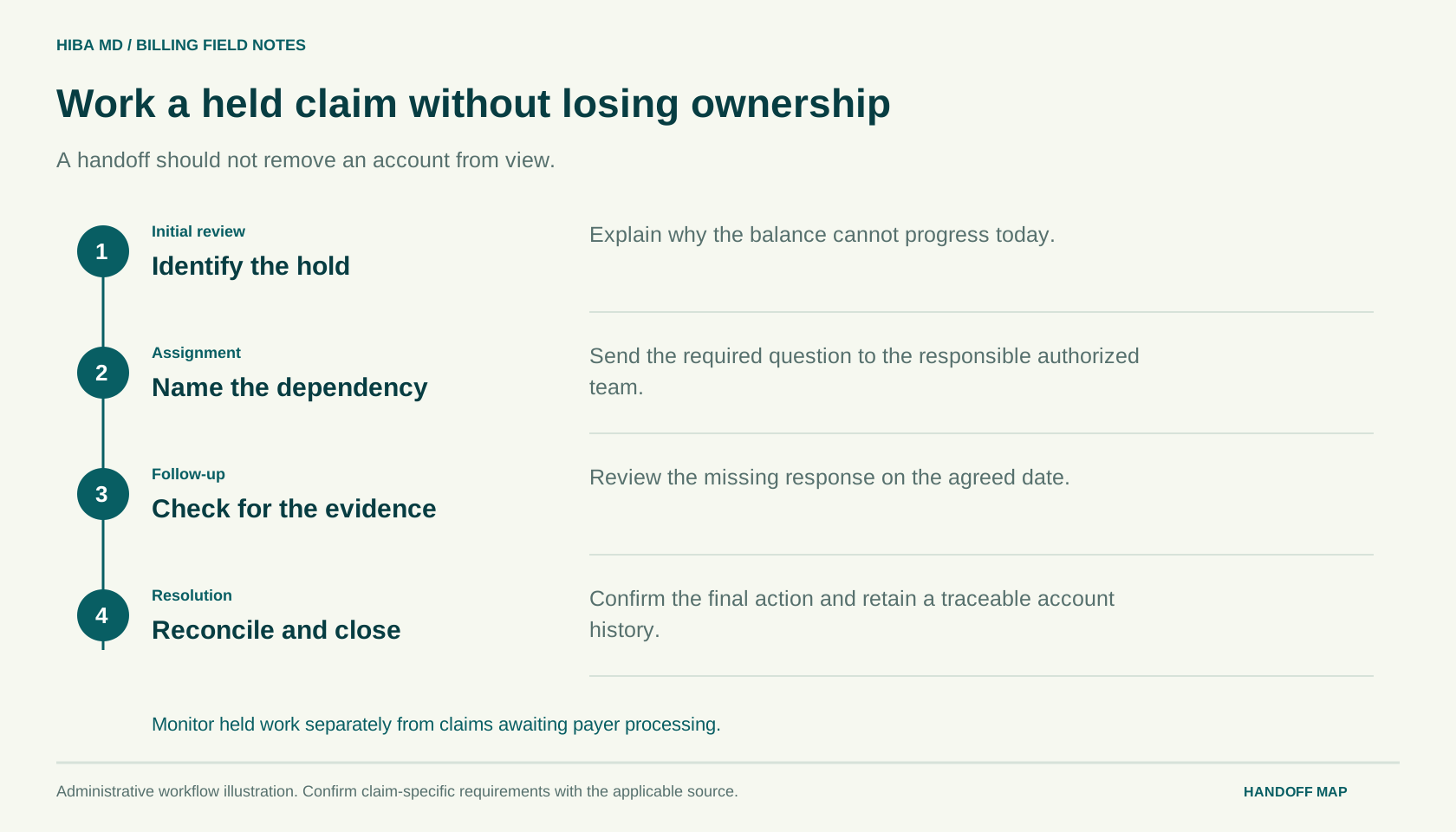
Transfer the account state, not just the balance. The receiving team needs the current issue, latest reliable response, outstanding evidence, deadline source where relevant, and next action. Confirm access to the approved records and establish how questions will be escalated. An export that shows only age and amount leaves the new team to reconstruct the investigation from the beginning.
Reconcile the opening A/R total and payment activity around the changeover date. Payments may arrive for earlier services after a new team starts work. Agree how remittances, deposits and postings will be handled so neither team assumes the other owns them. A clear transition plan is an administrative control; it should not be replaced by a promise that a new company will recover every old balance.
Use the findings to improve the earlier handoff
Older balances often reveal a recurring question elsewhere in the cycle. Group a defined sample by cause and look for a practical upstream change. Repeated missing subscriber details may call for a registration check. Repeated documentation waits may call for a readiness report. Repeated location questions may call for better provider and scheduling records. The final A/R queue is evidence for investigation, not proof of one universal cause.
Choose one change, assign an owner and review a later comparable population. Keep the original issue definition so the team can determine whether the change affected the intended problem. If the report or payer mix changed, explain that context. The value comes from a repeatable learning process rather than an unsupported claim that every workflow will improve by the same percentage.
Hiba MD offers a free audit discussion and one month of medical billing services free, with no conditions. For an A/R conversation, prepare an aggregate aging view, the main issue categories and the current ownership of new and older accounts. The first step is to understand the queue and agree the scope. Detailed records belong in the secure process established with the practice.
Reconcile an invented A/R cleanup population
Start a training worksheet with 50 accounts totaling $25,000 under a clearly stated cutoff and scope. During the exercise, record $4,000 of received and reconciled payments, $2,000 of supported adjustments and $1,000 transferred to a separately identified review queue. Before adding new activity, the remaining balance in the original queue is $18,000. The arithmetic helps staff see why payments, adjustments and transfers must be reported separately. Only one of those categories represents the same kind of cash event as the first.
Now introduce $3,000 of newly included activity and explain whether it belongs to the original cleanup cohort or the ongoing operational queue. Mixing the two without disclosure makes the project difficult to assess. A cohort review follows the starting population, while a current A/R report includes the balance at a point in time under its definition. Both are useful, but they answer different questions. Keep a separate movement column so management can trace how the original accounts changed without losing sight of the current workload.
Finish by assigning issue categories to the unresolved accounts. Some may await payer review, some may need practice evidence and others may need posting reconciliation. Ask which dependency management can remove this week. The exercise shifts the conversation from a vague instruction to collect more toward a specific decision about records, ownership or routing. It also prevents an unexplained reduction in the queue from being presented as a recovery outcome when the underlying disposition was actually a transfer or supported adjustment.
Design a follow-up cadence around the question
Do not assign every account the same repeat-contact interval merely because it is in the same age bucket. Begin with the last reliable finding and the next event the team needs to confirm. An account awaiting an identified practice document needs a practice follow-up. An account with a confirmed payer-review status needs the relevant status route and a reasonable review plan. A possible deadline requires verification of the source and appropriate escalation. The cadence should reflect the question, not replace the investigation.
Write a brief rationale for the next review date when the reason would not be obvious to another worker. If a promised record is due from a practice owner, identify that dependency. If the team is waiting for a response to a submitted package, retain the submission and receipt reference. Avoid turning an arbitrary reminder into a statement about the payer's processing requirements. Internal scheduling and external deadlines are different facts, and the notes should make it possible to distinguish them.
At the management review, identify accounts whose status has not changed across several contacts. Ask whether staff are using the wrong route, missing necessary evidence or waiting for a decision that needs escalation. Another identical call may not be the most useful next step. A well-designed cadence includes a point where someone reviews the investigative approach itself. That keeps follow-up from becoming a repetitive activity count and helps the practice direct effort toward a supported resolution of the actual account question.
Preserve a clear distinction between backlog and new work
An older-account project needs a defined boundary so the practice can assess both the inherited queue and ongoing operations. Record the service dates, entities and starting cutoff included in the project. Then identify how new accounts enter the ordinary follow-up process. Without that distinction, a team can reduce the original backlog while the displayed total remains unchanged because new work has arrived, or appear to improve because the report stopped including a category.
Use separate reporting views where practical. A cohort view follows the original accounts and explains their dispositions. An operational view shows current balances and dependencies. Review them together rather than forcing one to serve both purposes. The cohort view helps evaluate the cleanup work, while the current view helps management allocate capacity and identify a new upstream pattern before it becomes the next inherited backlog.
Assign an owner to transfers between the views. When an account moves into another review process, record why and who continues it. A transfer is not the same as a resolved balance, and management should be able to locate the continuing work. This makes the handoff reviewable and prevents an account from disappearing between teams simply because each report assumes the other one includes it. The principle is continuity of ownership, regardless of how the practice organizes its reporting categories.
Review inactive accounts with a clear decision boundary
Identify a defined group that has no recent meaningful status change under your internal review method. Do not assume that inactivity proves neglect or collectibility. Open the latest evidence and determine whether the item is awaiting a practice decision, an external response, a posting investigation or a different supported disposition. The purpose is to identify why the existing approach has stopped producing new information and who can decide the next appropriate step.
Give the reviewer access to the source history and a route for questions beyond routine follow-up authority. An account involving an unclear contract basis, a possible compliance concern or an ambiguous payer determination may need a different owner. Staff should not resolve uncertainty through repeated submissions, unsupported adjustments or an automatic transfer to the patient. A clear escalation is a valid next action when the evidence does not support a routine one.
Record the outcome of the review in the account and aggregate the recurring barriers for management. If several inactive items need the same practice record, management can address that dependency directly. If the source is missing, the task is to locate it or determine the appropriate documented next step. A list of old amounts becomes useful when it reveals those decisions; age alone cannot supply them.
Maintain the distinction between an internal review date and an external requirement throughout the exercise. The practice may choose to review inactivity at a certain interval, but that choice does not define a payer deadline or authorize an account disposition. Keep the applicable source and responsible reviewer visible so the final action rests on evidence rather than on the fact that the item has appeared on the report for a long time.
Frequently asked questions
Does an old balance always mean the billing team missed it?
No. Age does not establish cause. The account may be awaiting a documented payer review, missing practice evidence, pending posting reconciliation or another unresolved step. Review the actual response and history before assigning a cause. A useful report pairs age with issue, owner and next action.
Should we work the largest balances first?
Balance size is one factor, but verified deadlines, evidence readiness and dependencies also matter. A large account missing a required record may need a practice escalation before another payer contact will help. A smaller complete item may be ready for immediate action. Define the priority method so staff can apply it consistently.
Is days in A/R the same as average payment time?
No. Days in A/R is a ratio based on the receivable balance and an average daily charge amount under the selected method. It does not directly measure the elapsed time of every individual payment. Cohort-based payment-time analysis asks a different question and needs its own defined population and dates.
Can a free calculator tell us how much A/R is collectible?
No. A calculator can organize entered amounts or perform visible arithmetic. Collectibility requires investigation of the actual account, payer response, documentation, relevant arrangement and applicable requirements. Use the tool to frame questions, then use the approved practice records and appropriate professional review to resolve those questions.
What should a billing partner report about older A/R?
Ask for a reconciled starting population, movement during the period, current issue categories, evidence dependencies and clear next-action ownership. Distinguish payments, adjustments and transfers. A list of calls or a reduced balance without explained dispositions is not enough to understand what happened to the original accounts.
Sources and editorial notes
Written by the Hiba MD editorial team. Reviewed 2026-10-31. Worked examples use illustrative figures, not client results or performance benchmarks. This guide explains administrative workflows; check current payer requirements for claim-specific decisions.
