
Revenue cycle management connects the administrative work before a visit with the claim, payer response, payment and remaining account balance after it. A useful process gives every handoff an owner, keeps the evidence attached to the work and turns unresolved questions into visible next actions. It does not begin and end with submitting a claim.

Start with the practical question
For a practice administrator, the immediate question is usually more specific: why are completed visits waiting, why are balances growing, or why does the same payer issue keep returning? This guide follows an encounter through the cycle and shows how to investigate those questions without assuming that every delay has the same cause. The examples use invented operational figures to explain the method; they are not Hiba MD client results or industry benchmarks.
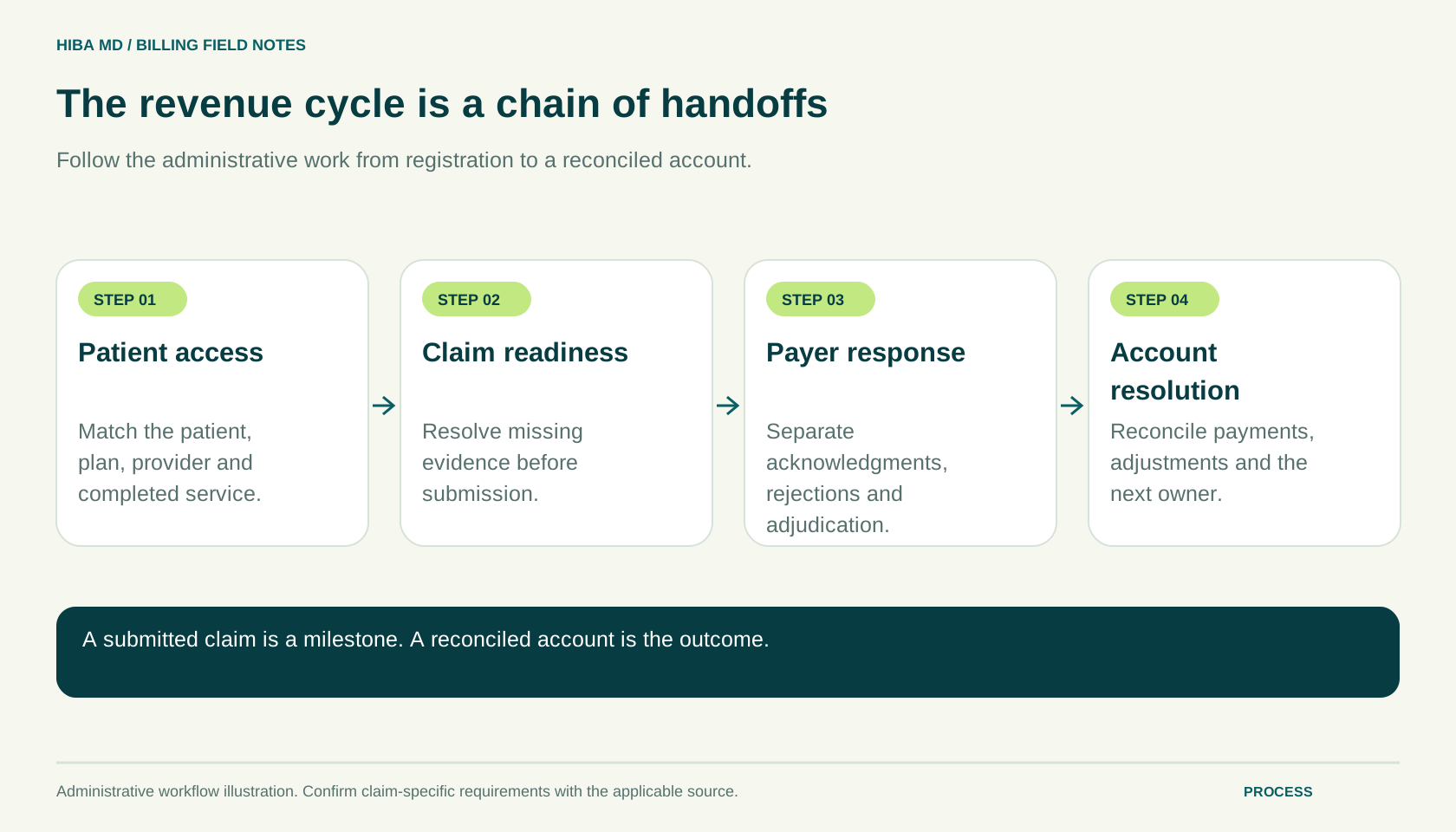
Use this guide to train a new billing team member
On day one, have the trainee trace a fictional visit through registration, coverage verification, the completed encounter and the charge. Ask them to write down the evidence that makes each stage ready for the next person. Give them a second case with a missing field and ask where they would hold it and whom they would contact.
For the next exercise, give the trainee a submission acknowledgment and a remittance from a fictional claim. Have them identify which document confirms intake and which contains the payer’s decision. Ask them to write a follow-up note with the claim reference, last verified status, next action and owner. Review their note before they work an actual queue.
Finish with a payment posting exercise. Give the trainee a deposit, an electronic remittance advice and a ledger entry, then ask them to match the records and flag any unexplained difference. Use the same exercise when someone changes roles. A colleague should be able to repeat the process from the records provided.
Draw the encounter-to-payment map
Start with a blank page and describe what actually happens at your practice. A patient schedules, registration information is collected, coverage questions are reviewed, a clinician completes an encounter, documentation reaches billing, and a claim is prepared. Submission produces acknowledgments. Adjudication produces a payer response. Payments, adjustments and remaining balances then need to be reconciled. Your local sequence may include referrals, authorizations, facility coordination or a separate laboratory handoff.
Write the output of each stage beside its owner. Scheduling might produce a booked appointment, while eligibility review produces a dated response for the relevant service. Those outputs are different. A completed appointment on the schedule also does not establish that all documentation needed for a claim is ready. Making these distinctions visible prevents the practice from measuring everything as one large billing queue.
The map should include exceptions. Show where a missing subscriber number waits, who resolves an unclear service record, and how a returned submission gets back to its owner. A map that only shows successful claims is a presentation. A map that explains the exceptions can become an operating tool for the team.
Identify the exact payer and provider arrangement
The payer logo on an insurance card is a starting point, not a complete routing instruction. Record the plan or product, the relevant service date, the billing entity, the rendering professional and the location. A practice with several clinicians or sites needs a reliable way to determine whether the arrangement being used matches the actual encounter. Do not assume that one provider's confirmed participation automatically establishes another provider's status.
For Original Medicare, use the current CMS provider and contractor resources to identify the appropriate administrative route. Medicaid information starts with the state program, but a particular managed-care arrangement may require a separate plan workflow. Keep the source and date checked with the practice's administrative reference so staff can distinguish a verified instruction from an old internal assumption.
Build the reference around decisions staff actually make: where to check eligibility, where to send a claim, where to obtain a response and where to ask a participation question. Avoid mixing those routes into one generic phone number. An authorization contact may not be the right contact for an already adjudicated claim, and a payer enrollment record is different from patient eligibility.
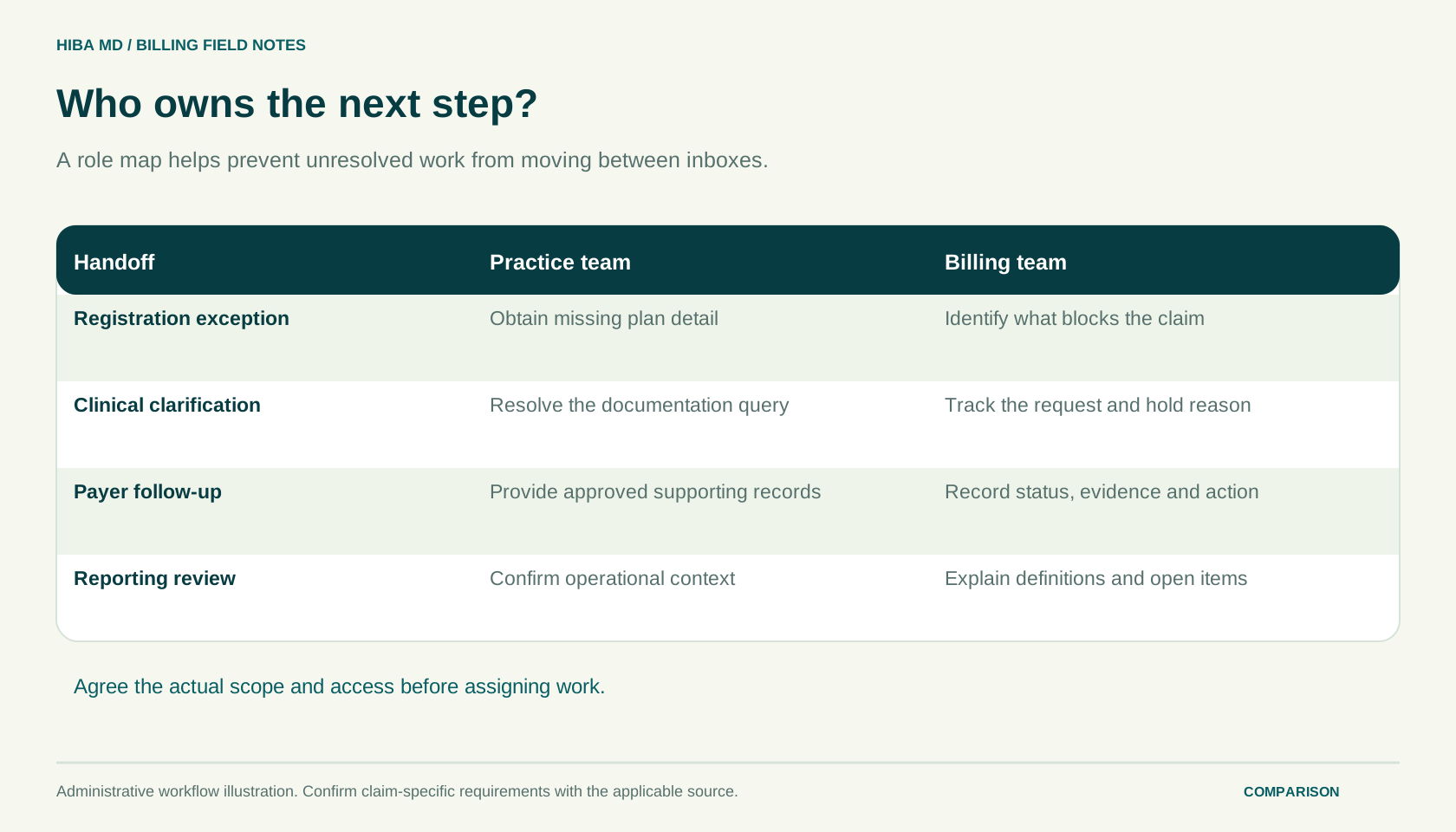
Review patient access before the encounter becomes a claim
Patient access work brings together registration, coverage, referral and authorization questions before they become downstream exceptions. Establish what information is collected when an appointment is made and what is rechecked near the service date. A card image, a patient's description and an electronic eligibility response can provide different pieces of information. The workflow should make it clear which source was used for each decision.
CMS describes the Medicare HETS system as an eligibility transaction system using 270 requests and 271 responses. That is a useful example of a defined electronic transaction; it is not a promise that a later claim will be paid. The eventual claim still depends on the service, documentation, applicable benefits and adjudication. Your process should keep eligibility evidence separate from authorization evidence and from the final payer decision.
Consider a therapy appointment with an authorization period recorded in one place and visits used recorded somewhere else. The practical risk is the disconnected handoff. Assign one owner to compare the planned appointment with the relevant dates and limits, then route any mismatch through the actual plan process. A calculator can count remaining units, but it cannot decide whether the payer's authorization covers a changed service.
Reconcile completed encounters with billing readiness
A completed-encounter list is a useful control because it asks a concrete question: which completed services have reached the next appropriate administrative stage? Reconcile that list with documentation status and charge preparation. Separate a genuinely unfinished record from a record that is complete but has not reached billing. The owners and corrective actions may be entirely different.
Use a small number of reason categories that staff can apply consistently. Examples include incomplete clinical documentation, unresolved provider attribution, missing administrative data and pending review. Give each category an escalation route. Avoid creating a catchall called coding problem when the underlying issue is a missing note or a registration mismatch; the label should point toward the person who can supply the evidence.
Suppose 120 visits were completed in a week. Of those, 105 reached claim preparation, nine await a completed record and six await a location clarification. The useful result is not simply that 15 visits remain unbilled. It is that two different owners have two distinct queues. Track those groups to resolution and check whether the same handoff causes recur in the following period.
Prepare claims from supported information
Claim preparation translates documented services and administrative information into the appropriate transaction. CMS provides separate educational resources for professional claims and the CMS-1500/837P workflow. Your practice needs an equivalent reference for its actual claim type and payer arrangement. Do not assume that an office professional claim and an institutional facility claim have the same data requirements.
A consistent pre-submission review can confirm that identifying information, service dates, provider details and the selected destination are present and compatible. Coding questions should go to the responsible qualified reviewer with the relevant record. Never fill a documentation gap by inventing a service, diagnosis or clinical explanation simply to move an account out of the queue.
Record the review outcome in a way that staff can reproduce. If an exception is released after clarification, retain the clarification through the approved practice process. If a claim remains on hold, record what is missing and who is expected to resolve it. This creates a usable trail when someone later asks why a claim was submitted on a particular date or why an account was still waiting.
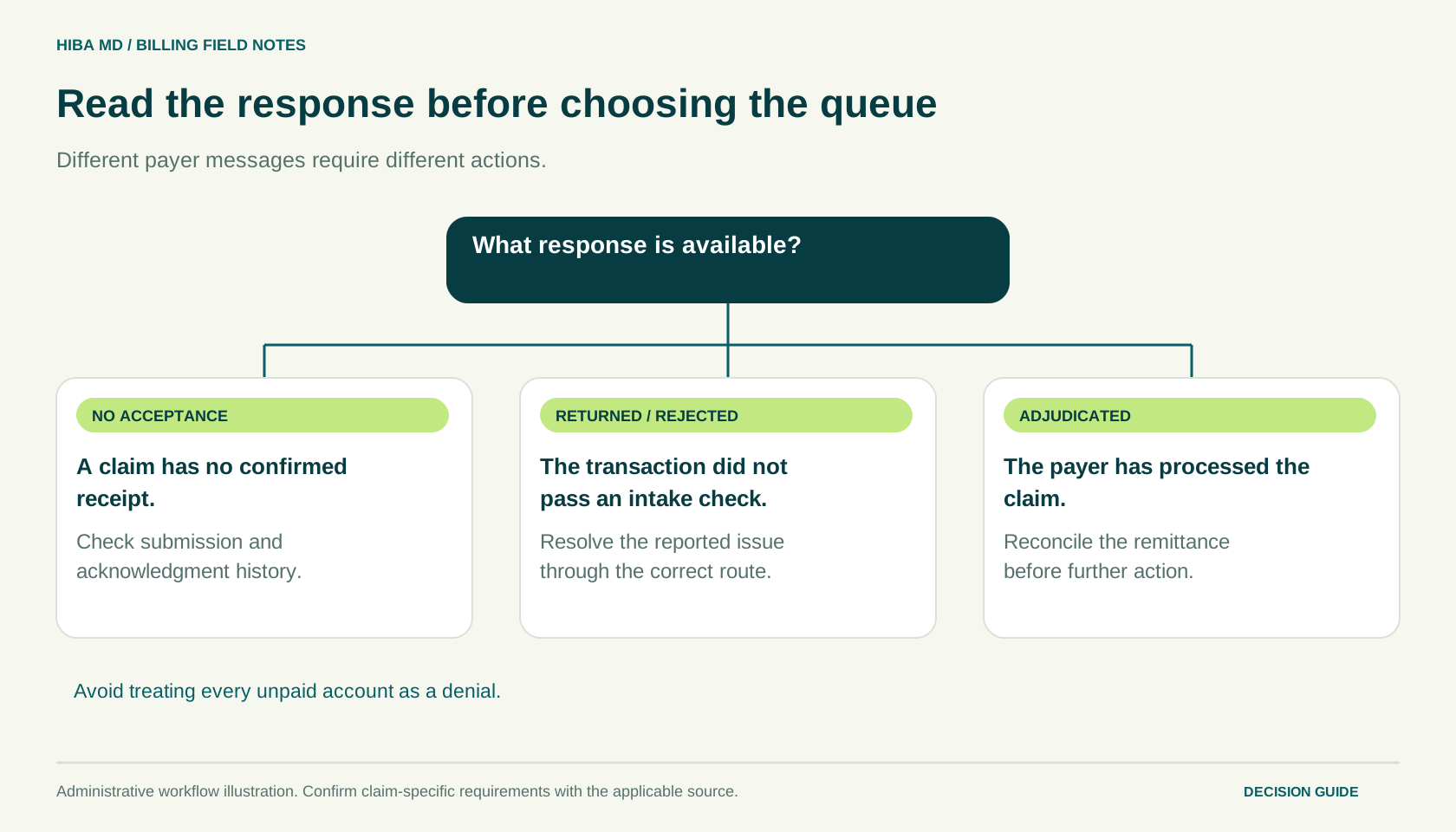
Follow acknowledgments through to a meaningful response
Submission is an event, not proof of payment or even proof of acceptance at every downstream stage. The workflow should explain which acknowledgment staff expect, where it appears and what they do when it is absent or negative. Keep file-level and claim-level messages distinct when the system provides both. A successful batch transmission can still contain individual exceptions.
Create a daily exception view for returned or unacknowledged items. The next action depends on the response. A data-format issue might require a transaction correction; a missing registration detail requires a practice inquiry; an accepted claim that remains unresolved may require a status check rather than another submission. Repeatedly resending an item without understanding the response can create additional confusion.
CMS identifies the 276/277 transaction as the health care claim status inquiry and response standard. In practice, staff may use an approved electronic connection or the relevant payer interface to obtain status. Whichever route is used, keep the resulting reference, status and next action together. A note that merely says followed up gives the next person very little information about what actually happened.
Separate denials, payment differences and pending items
An unresolved account is not automatically a denial. It might be awaiting adjudication, returned before processing, missing a payment posting, assigned to another payer or waiting for information. Begin with the actual response rather than the age of the balance. Then classify the issue according to the decision that needs to be made next.
For an adjudicated claim, read the complete remittance and any associated notice. CMS explains that remittance information can include adjustments at the line, claim and provider levels. A single reason label in an internal dashboard may leave out important context. Staff need enough detail to distinguish a contractual adjustment, a patient responsibility amount, a denial and a possible discrepancy requiring further review.
Build separate routes for corrections, inquiries and appeals. Verify the controlling requirements from the actual payer notice and current official resource rather than applying one universal deadline. The person responsible for an appeal needs the determination, supporting evidence, submission route and deadline source. The person responsible for missing documentation needs a different request. Clear routing makes the review more useful than a single undifferentiated denial list.

Reconcile payments before deciding what remains
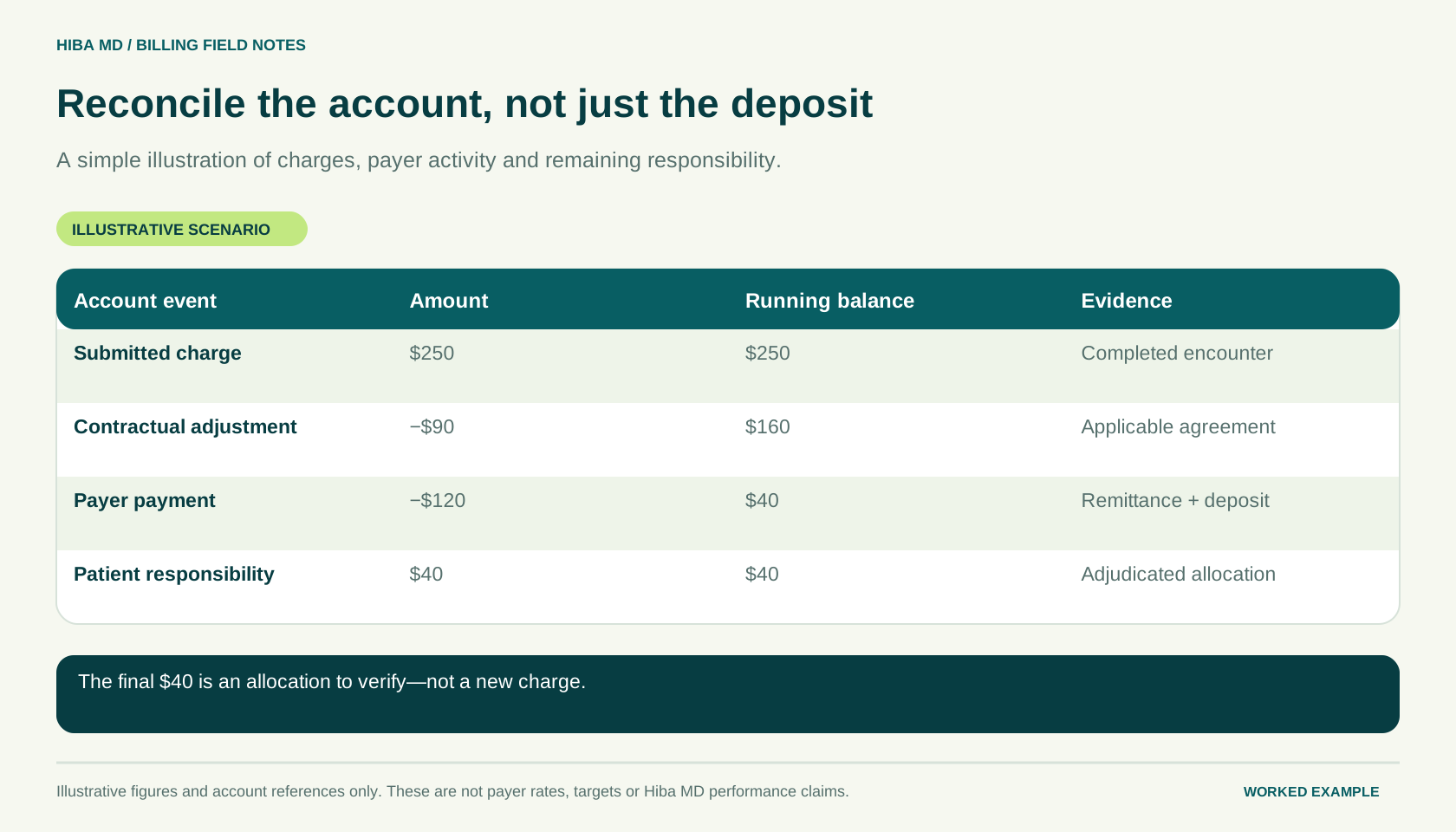
Payment posting should connect the payer's decision to the account and to the corresponding financial activity. An electronic remittance describes adjudication, while a deposit reflects money received. The two need to be connected, but they are not the same document. Establish who reconciles remittance totals, posting totals, deposits and any exception that prevents them from matching.
Use a clearly identified queue for unmatched remittances, unapplied receipts, provider-level adjustments and other differences. Do not force a reconciliation by applying an unexplained write-off. A balance can disappear from a report without the underlying question being resolved. The practice should know which adjustments are routine under its policy and which require review or approval.
For example, a deposit of $8,000 and a posted total of $7,800 leave a $200 difference to explain. The answer might be an unapplied amount, a posting error or another documented transaction. It is not automatically an underpayment. Trace the source records before labeling the discrepancy, assigning financial responsibility or contacting a patient about a remaining amount.
Give older accounts a reason and an owner
Aging tells you how long a balance has remained open under the report's definition. It does not tell you why the balance exists. Segment older accounts by payer status, issue category, evidence available and next action. A large account with a clear pending response may need a different cadence from a smaller account with a deadline approaching.
Make the work queue explicit: account reference in the approved system, current issue, amount under review, latest reliable response, next action, owner and target review date. Keep sensitive patient information inside the systems the practice has approved. Aggregate management summaries can show the number and value of accounts by issue without copying patient records into a general presentation or introductory email.
At review meetings, ask what changed since the last contact. If the note and status are identical after several cycles, decide whether the route is wrong, evidence is missing or escalation is needed. Measuring calls made can help understand effort, but it does not establish that an account has moved toward a supported resolution. Combine activity reporting with issue and outcome reporting.
Choose measures that answer operational questions
Select a small set of measures with written definitions. Charge lag can help identify delays between service and billing. Submission-exception counts show items that need attention at the transaction stage. Denial measures describe a defined adjudication population. Accounts receivable days and aging show different aspects of outstanding balances. Collection rates compare payments with a stated charge base and require consistent treatment of adjustments.
For a simple arithmetic example, $30,000 of receivables divided by $1,000 of average daily charges equals 30 days in A/R under that definition. Changing the charge period or excluding part of the balance changes the result. Write down the source, period and exclusions so someone else can reproduce the number. Do not compare the result with another practice unless the definitions and populations are compatible.
Use the number to select a question. If completed encounters are reaching billing later, examine the readiness queue. If an older-payer bucket grows, inspect the issues within it. A dashboard is most useful when each measure connects to an owner and a work queue. A rising percentage without a defined denominator is a signal to investigate the report before judging the team.
Run a short, evidence-led operating meeting
Set a repeatable agenda that begins with exceptions needing a decision. Review changes in unfinished encounters, returned submissions, payer-response issues, unreconciled amounts and older balances. For each topic, identify the relevant evidence and ask what action the practice or billing team must take next. This keeps the meeting focused on the work rather than a long recital of totals.
Use a decision log for matters that require practice input. A documentation query may need a clinical owner, a participation question may need enrollment support, and a payment variance may need a contract reference. Record the decision, responsible person and expected follow-up. If the answer is pending, identify the source being consulted and the date the team will review it again.
Reserve time for one upstream improvement. A recurring subscriber mismatch might justify changing a registration prompt. Repeated missing location details might require a better scheduling handoff. Review whether the change reduces that particular exception in a later comparable period. Treat a local process improvement as a test with evidence, not as a guaranteed collection result.
Plan support around a documented scope
Whether billing is handled by employees, an outside company or a combination, the practice needs a documented division of responsibilities. List the work included, what stays with the practice, which systems are used, how access is controlled and how exceptions are escalated. Outsourcing a task does not make the source documentation or management decisions disappear.
For a transition, separate new service activity from existing receivables and decide who owns each queue. Agree how both teams will avoid duplicate submissions and duplicate patient contacts. Establish the starting reports, payment reconciliation process and first review date before treating a change of personnel as a complete change of process. A clear handoff protects continuity when staff or systems change.
Hiba MD offers a free billing audit conversation and one month of medical billing services free, with no conditions. Use that conversation to describe your specialty, current systems and the part of the cycle that needs attention. The practical output should be an agreed starting scope and next steps. It should not depend on an unsupported promise about a payer outcome or a headline percentage that nobody can explain.
Build a one-page handoff worksheet
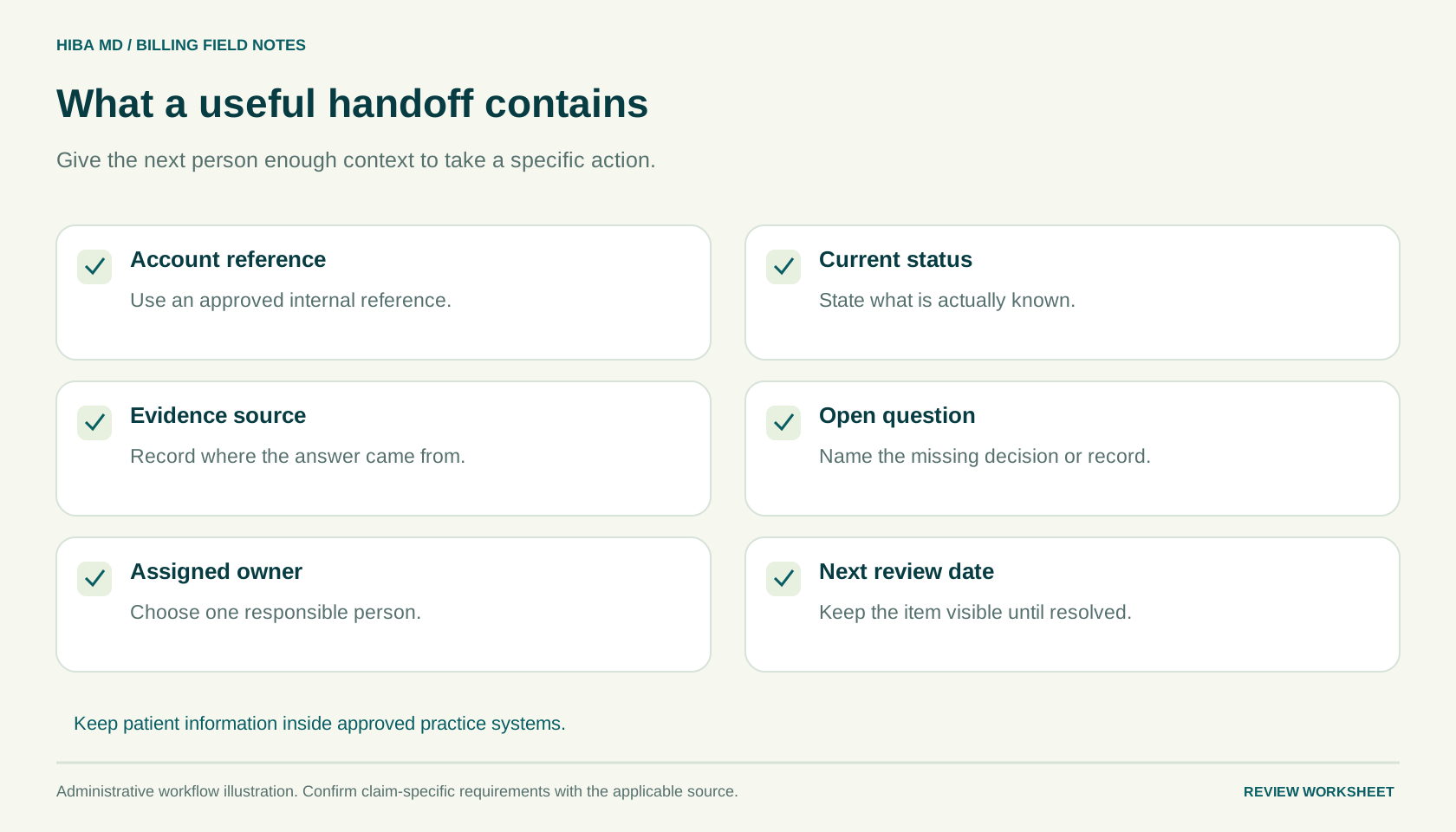
Create one row for each handoff in a sample encounter, with columns for starting evidence, receiving team, accepted output, exception route and completion evidence. For registration, the output might be a dated record with unresolved questions clearly marked. For documentation, it might be a record ready for the responsible review. For submission, it might be a recorded transaction with its expected acknowledgments. The worksheet should describe an observable output rather than a vague instruction to complete billing. That makes the process testable by someone who did not design it.
Next, add a responsibility column for decisions that belong elsewhere. A documentation question may require a clinician, a provider-record question may require an enrollment owner, and an unexplained payment may need a financial source review. The billing team can coordinate those questions without being able to supply every answer. Recording the boundary makes the worksheet more honest and useful. It also gives management a clear explanation when a queue is waiting for a practice response rather than an external payer response.
Use the worksheet on an invented encounter first. Ask a second staff member to follow it without additional verbal instructions. Note where they cannot identify the source, owner or completion evidence. Those gaps are design findings, not staff failures. Revise the wording until the handoff is understandable, then test the relevant part of the process on an appropriately selected real-work sample within the approved practice systems. Keep patient details out of the general training worksheet.
Test the cycle with a small reconciliation exercise
Use an invented group of 20 completed encounters. At the review cutoff, 14 have reached submission, three await documentation, two await registration clarification and one awaits provider attribution. The group still totals 20. That simple reconciliation forces the process to account for every encounter instead of allowing missing work to vanish between reports. Next, review the 14 submitted items by their actual response stage. Keep any returned or unacknowledged items visible rather than treating the submitted total as the end of the process.
Now introduce a payment-posting question in the exercise. One submitted account has a remittance available but no connected posting. Ask which queue receives the exception and how it is removed from inappropriate payer-follow-up work while the source is investigated. The exercise demonstrates why account state matters: an apparently unpaid balance can need a posting action rather than another submission. It also tests whether the team can explain the transition between claim status, adjudication evidence and ledger activity.
Finish with a brief decision review. Which exceptions can staff resolve through the established process, which need practice input and which need a current payer or official reference? Assign a next action to each. A practice does not need a complicated simulation platform to learn from this exercise. It needs a complete population, consistent statuses and a way to explain every item at the cutoff. Repeating the same method after a process change gives management a useful comparison grounded in observable work.
Decide what belongs in the management summary
Keep the management summary separate from the detailed operational record. The summary can show the count and value of work by stage, the main dependencies and the decisions needed. The approved account system holds the detailed evidence. This separation helps a meeting stay focused without circulating unnecessary patient-level information. It also prevents a general spreadsheet from becoming an unofficial second ledger that gradually diverges from the source system and creates another reconciliation problem.
For every summary category, identify the action it could trigger. Completed encounters waiting for records may require a documentation discussion. Unacknowledged submissions may require a technical investigation. Unreconciled amounts may require source matching. A category that consistently produces no useful question may need a different definition or may not belong in the main review. The purpose is to help decision-makers see the next meaningful intervention rather than present every data field the software can export.
Keep the summary date and scope visible, especially when it is shared after a meeting. A snapshot can become misleading if readers assume it is a live queue. Identify the owner who can provide the current position and record decisions in the appropriate working process. This makes the report useful as a dated management reference while preserving the actual system as the place where staff continue the account work and maintain the evidence behind later changes.
Design the backup handoff before it is needed
Ask a backup staff member to take over an invented exception using the ordinary records and instructions. They should be able to identify the issue, locate the source, understand the last finding and choose the next authorized step. If the process requires an undocumented conversation with the original owner, record that gap and improve the working note or reference. This is a practical continuity check for absences and transitions, not an assessment of whether an individual has memorized every account.
Define which decisions a backup may make and which require escalation. Routine status investigation, source matching and a request for missing information may involve different authority from a coding decision, an adjustment approval or a formal dispute. The backup process should preserve those boundaries. A queue moves more responsibly when staff know how to obtain the correct review than when they feel pressure to close an unfamiliar item without adequate evidence.
Finally, confirm how management learns that the primary owner is unavailable and who monitors the affected queue. A backup named on paper is insufficient if they lack appropriate access or do not know work has been assigned. Test the notification and access path using approved systems. Then review whether the next person can continue the cycle accurately, with the source history intact and no need to duplicate a submission or request simply because ownership changed.
Frequently asked questions
Is revenue cycle management the same as medical billing?
Medical billing is an important part of the revenue cycle, particularly claim preparation, submission, response handling and account follow-up. Revenue cycle management also connects those tasks with earlier registration and coverage work, documentation handoffs, payment reconciliation and practice reporting. The exact scope of a service arrangement should be written down rather than inferred from the label.
Which revenue cycle problem should a small practice address first?
Start with an observable issue that affects a defined queue, such as completed encounters waiting for documentation or repeatedly returned submissions. Confirm the source and owner, then review a manageable sample. This is more actionable than attempting to improve every metric at once without understanding which handoff creates the work.
Can an eligibility check guarantee that a claim will be paid?
No. Eligibility information is one input to the administrative review. A later claim depends on the actual service, documentation, benefits, provider arrangement and payer adjudication. Keep eligibility, authorization and payment decisions separate so staff do not turn a useful preliminary response into a broader promise it does not establish.
How often should the practice review its billing workflow?
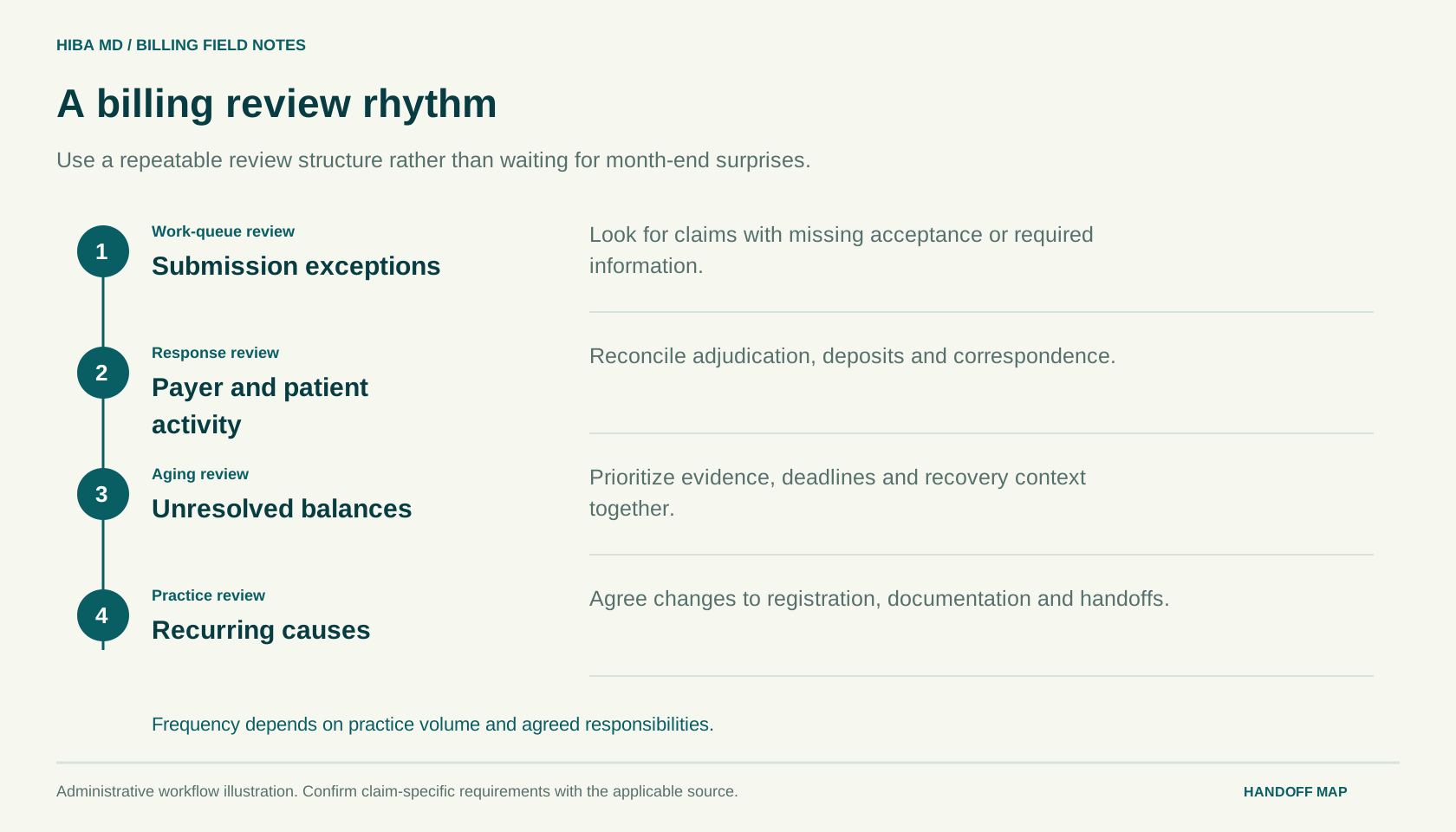
Choose a cadence that fits the volume and decision needs of your practice. Daily exception handling and a regular management review serve different purposes. The important point is that unresolved items have owners and next-action dates, and that the team reviews recurring causes rather than waiting for a monthly total to reveal a growing backlog.
What should we prepare for a Hiba MD billing audit discussion?
Bring the business question you want to answer, your specialty and system context, and aggregate information about the affected work queue. Do not send patient records through a public form. The initial conversation can establish scope and a secure process for any later record-level work, while coordinating the free first month of billing services.
Sources and editorial notes
Written by the Hiba MD editorial team. Reviewed 2026-11-12. Worked examples use illustrative figures, not client results or performance benchmarks. This guide explains administrative workflows; check current payer requirements for claim-specific decisions.
