
Match the completed scan to the signed interpretation. Verify who furnished each part, whether the code supports separate components, and which setting and location fields apply to the claim. Release a professional, technical or global charge only when the actual records and current Original Medicare rules support it.
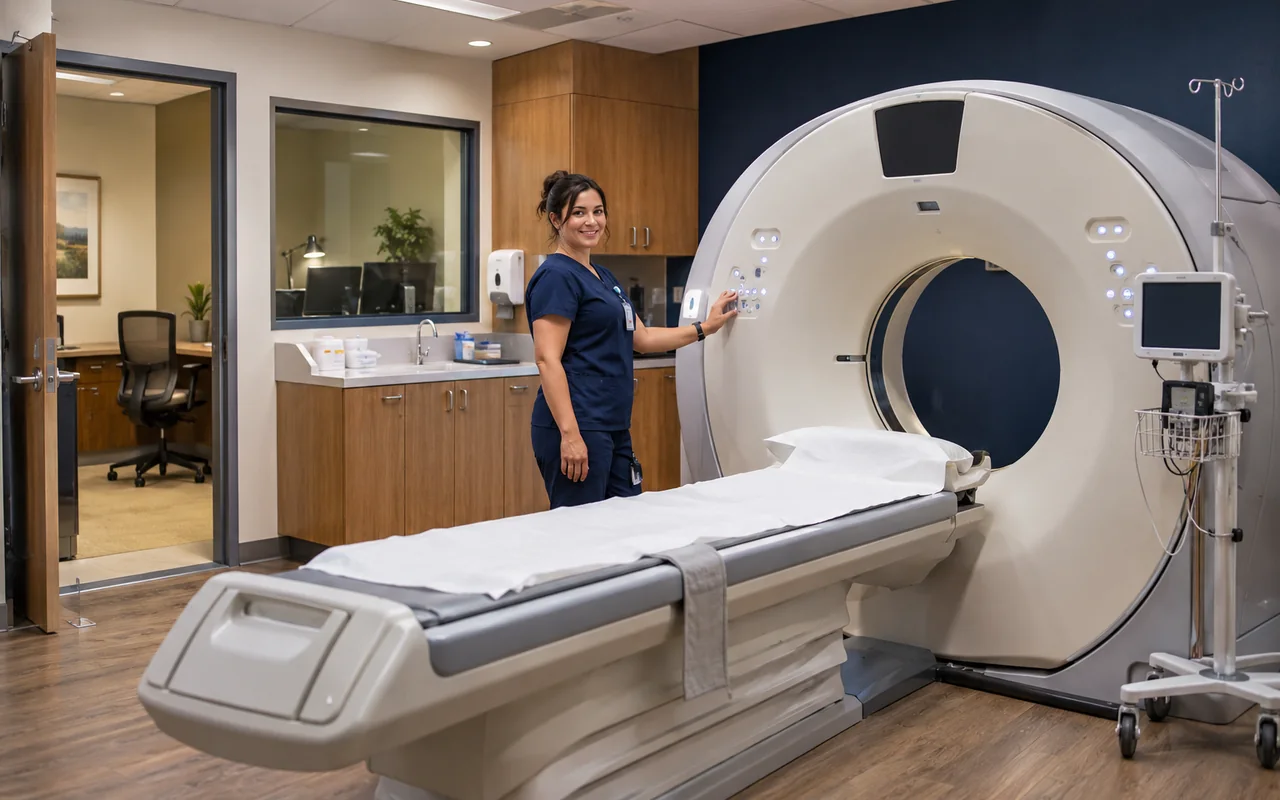
Start the claim review with the study record
A hospital sends a completed imaging study to a radiology group on Friday. The images are read Saturday, the final report reaches the group Monday, and the charge arrives in the billing queue with the group's office location filled in automatically. Before sending it, the biller needs to know what that location field represents. The place where a radiologist opens the study may differ from the setting where the patient received the scan. The software may have filled both fields from one address.
Build the review around the actual study. Open the imaging record and confirm the accession or other identifier the practice uses to match a study to its report. Find the date and setting of acquisition, the entity that furnished the scan, the interpreting clinician and the signed report. Link the draft charge to those records using approved systems. Two exams on the same day can have similar descriptions, and an order may have changed before the exam was performed. The completed record tells the biller what belongs in the review.
Put unresolved fields into a work queue with a specific owner. An imaging supervisor can verify where the equipment and staff furnished the scan. A coding reviewer can check the completed procedure and whether the code supports component billing. A credentialing specialist can confirm the billing relationship for the reader and group. Give each person a question they can answer and a date to return it. For a recurring hospital feed, record which fields come from the interface and which require a human check.
Route Illinois Medicare claims by payer and product
CMS lists National Government Services as the A/B Medicare Administrative Contractor for Jurisdiction 6, which includes Illinois. For Original Medicare professional claims in that jurisdiction, use the relevant CMS manuals and the contractor's current provider instructions. Confirm the correct contractor and submission route for the actual claim, especially if the reading and acquisition sites span jurisdictions. This guide focuses on diagnostic radiology operations for Original Medicare professional claims and uses fictional cases for training.
A Medicare Advantage member may show a Medicare identifier in a demographic record. Confirm active coverage and the responsible plan for the date in question before relying on that identifier. For a Medicaid or commercial product, obtain the applicable billing instructions from the program or plan. Give your payer matrix a source date and an owner. If the front desk finds a plan change, route it to the charge team and record when coverage was checked. A payer name printed on an old worklist leaves the biller without enough information to choose the route.
Compare the payer identifier in the outbound claim with the route in the payer matrix. After a clearinghouse transition, check that the new payer crosswalk points to the intended destination and supports the transactions the group needs. Keep an example response from the first batch in the approved workspace. If the claim goes to a different product than the one the team verified, put the submission on hold and review the route with the responsible payer or clearinghouse. Save any correction to the payer mapping so the next study does not repeat the problem.
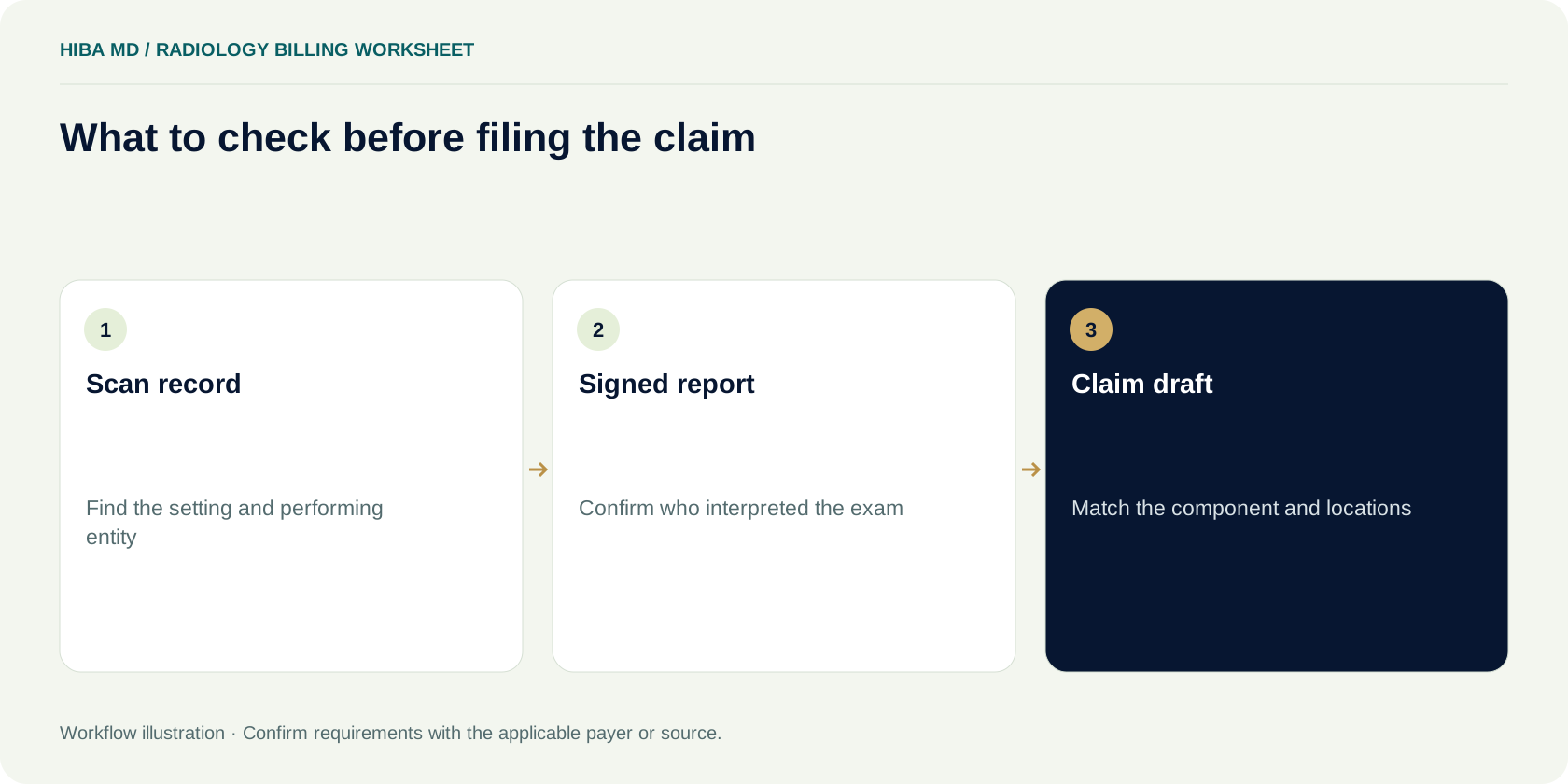
Determine which component your practice furnished
The technical component describes the performance side of a diagnostic service, including the equipment and personnel used to furnish it. The professional component covers the interpretation and report when those services qualify for separate professional billing. CMS's radiology chapter explains the payment conditions for each component. The underlying study and the report belong together in the audit trail even when different entities bill for their parts. Use the signed report to identify the interpretation and its author. Find the acquisition record separately to determine who furnished the scan.
In a fictional example, a community hospital furnishes an outpatient scan and a contracted radiology group interprets it. The hospital and group each confirm their billing responsibilities under the applicable rules and arrangement. The group keeps a reference to the study and reviews whether its professional claim is supported. A charge template that normally bills the entire service at the group's freestanding center would need review before the hospital case could be released.
A practice working with several partner sites can maintain a table that identifies the entity responsible for the scan, the group responsible for the interpretation and the person who owns any unusual case. Record the date the arrangement began and who last verified it. Treat that table as a starting point. A locum coverage change, a new scanner or an amended contract can change the facts the table assumes. Compare the claim to the actual arrangement on the relevant date before relying on a template, and direct billing questions back to the people who can verify the arrangement.
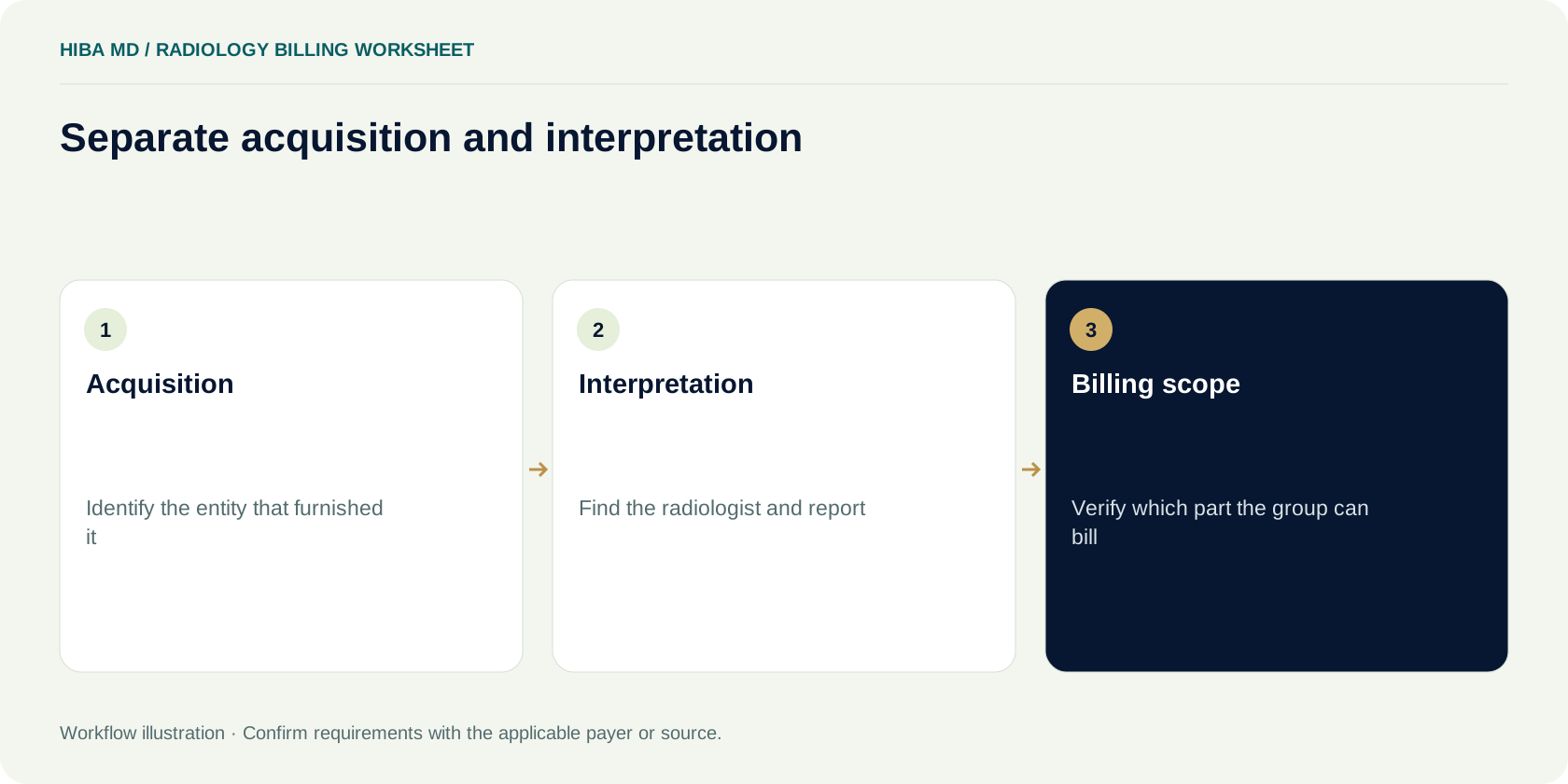
Check the code before selecting a modifier
For Original Medicare, the Physician Fee Schedule's professional and technical component indicator helps you determine which codes allow modifiers 26 and TC. CMS's Claims Processing Manual describes the indicators and includes categories for services already defined as professional only, technical only or global only. A split-capable code can have a different billing path from a code that already describes an individual component. Check the exact code and effective policy rather than adding a modifier because the study came from a hospital feed.
Compare the charge with the signed report and completed study details. For example, the interface may carry the original order description after the exam was changed. Coding can confirm the supported code using the performed service and final report. Send both source records to the coder. “The charge imported from the original order. The technologist's completed study record and the final report describe a different exam” is a useful note. Include a reference to both records and prevent automatic release while the discrepancy is open.
A prebill edit can catch some errors if the system has a maintained reference for the code and payer. Configure the edit to show which rule it applied and when that rule was last updated. Send unfamiliar cases to the reviewer instead of allowing the edit to substitute a modifier on its own. After a schedule or code update, test a few representative studies across sites. Use one example the system should release and another it should hold, then compare those results with the coding review. This helps the team spot a template that quietly changed behavior.
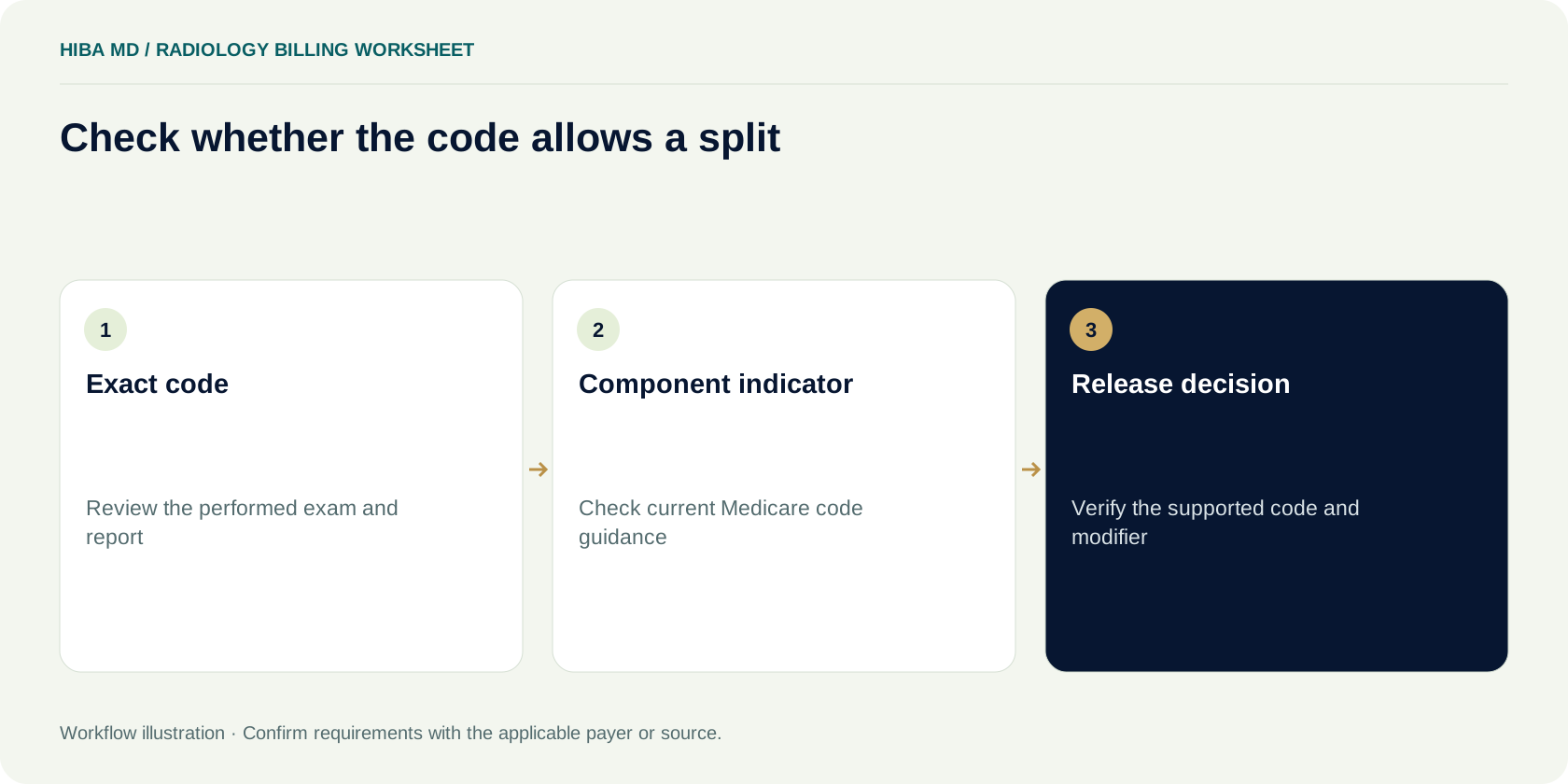
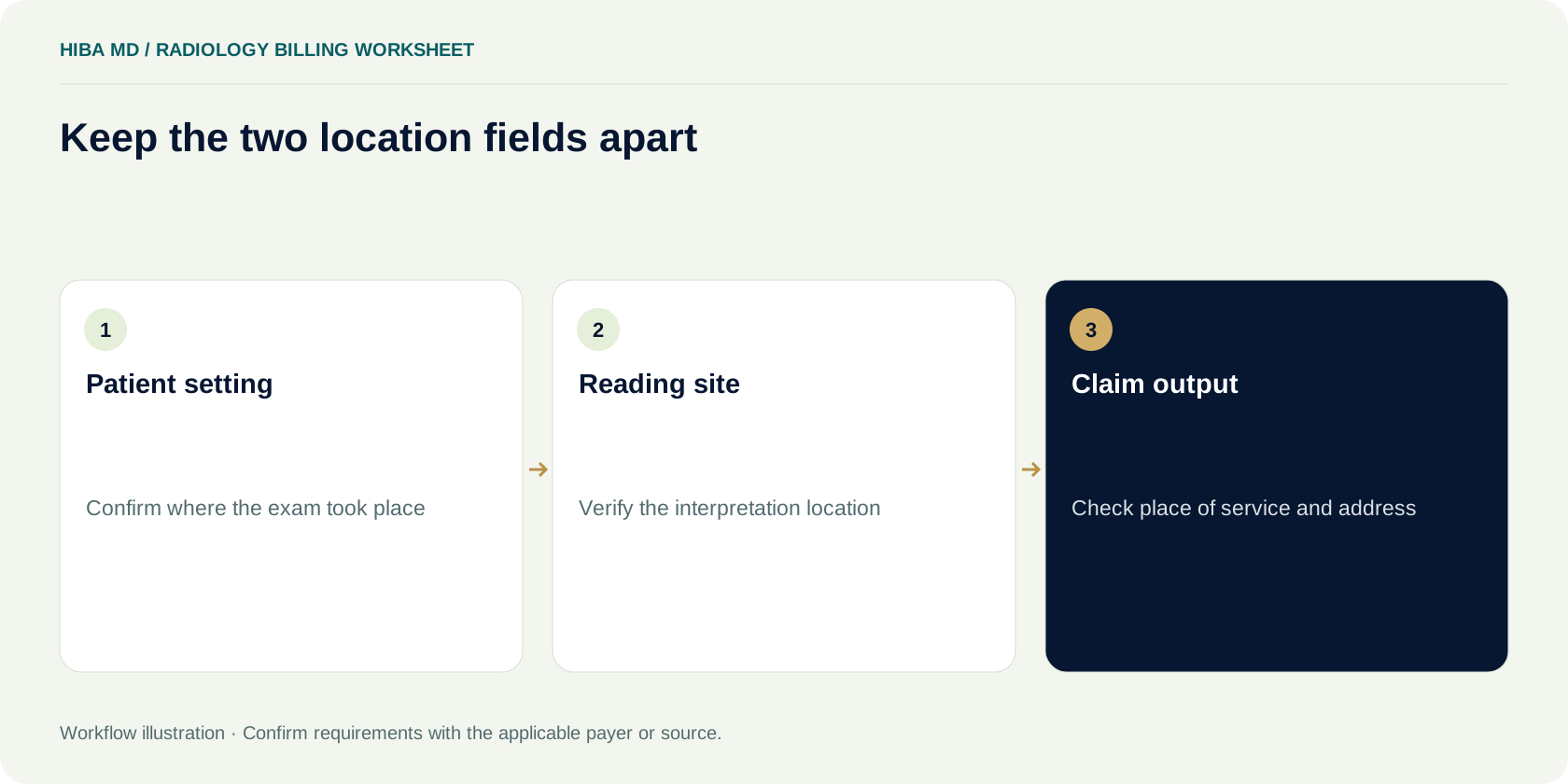
Keep patient setting and reading location in separate fields
CMS's professional claim instructions discuss how to select place of service when a diagnostic interpretation and scan occur in different locations. For the usual separately billed interpretation, look to the setting of the patient-facing technical service and check the applicable exceptions. The interpreting location may still matter for the service facility information and pricing locality. Verify those claim fields independently. An address alone does not establish the patient's setting or distinguish a hospital outpatient department from a freestanding center.
Consider a fictional Chicago-area study. The patient receives the exam as an outpatient at a hospital, and the radiologist reviews the images later from a group office. The billing team verifies the actual outpatient setting for place of service, using CMS instructions for the professional component. It then checks what address and ZIP information the professional claim requires for the reading site. Copying the reader's office setting into the place-of-service field would describe the wrong patient setting in this scenario. Copying the hospital address into every location field could create a separate problem.
Ask the imaging partner for a reliable setting field and a way to distinguish on-campus and off-campus hospital outpatient departments when relevant. Record a source the group can verify for each site mapping. If the feed returns only the city or a department nickname, give the case to a reviewer who can verify the setting before submitting. Test the electronic claim output as well as the billing screen. A software interface can preserve two separate fields in its work queue but map them to the wrong places when it generates the claim.
Review global billing before releasing it
A global charge can represent both the professional and technical portions of an eligible service. Under CMS's diagnostic test instructions, global billing for split components has conditions involving the furnishing entity and Medicare payment locality. Review the current manual for the case, including applicable site and enrollment requirements. The fact that both portions appear under the same order number cannot establish that one entity can bill them together. Compare the actual acquisition and interpretation records with the group's billing arrangement.
Suppose an Illinois freestanding imaging center furnishes a scan and an outside group performs the interpretation. Both receive the same accession number because it identifies the same study. The center's biller should check which component the center may bill and whether the code supports that billing. The reading group should separately verify its professional claim. A reviewer can reconcile those decisions in the study record, with a reference to the agreement and the current instructions. If either side's role is unclear, stop the automatic global charge and resolve the ownership question with the parties responsible for the arrangement.
For a center with in-house readers and outside coverage, tie the release rule to the case rather than the building. A standing rule that makes every study at the same address global will miss a substitute reading arrangement. Capture the interpreting group when the report arrives. Compare it to the entity the billing template expects, and send discrepancies to the person who can verify the coverage schedule and billing relationship. Save the decision and effective dates so staff can apply it to the right studies without changing older claims retrospectively.

Work an example with an off-site interpretation
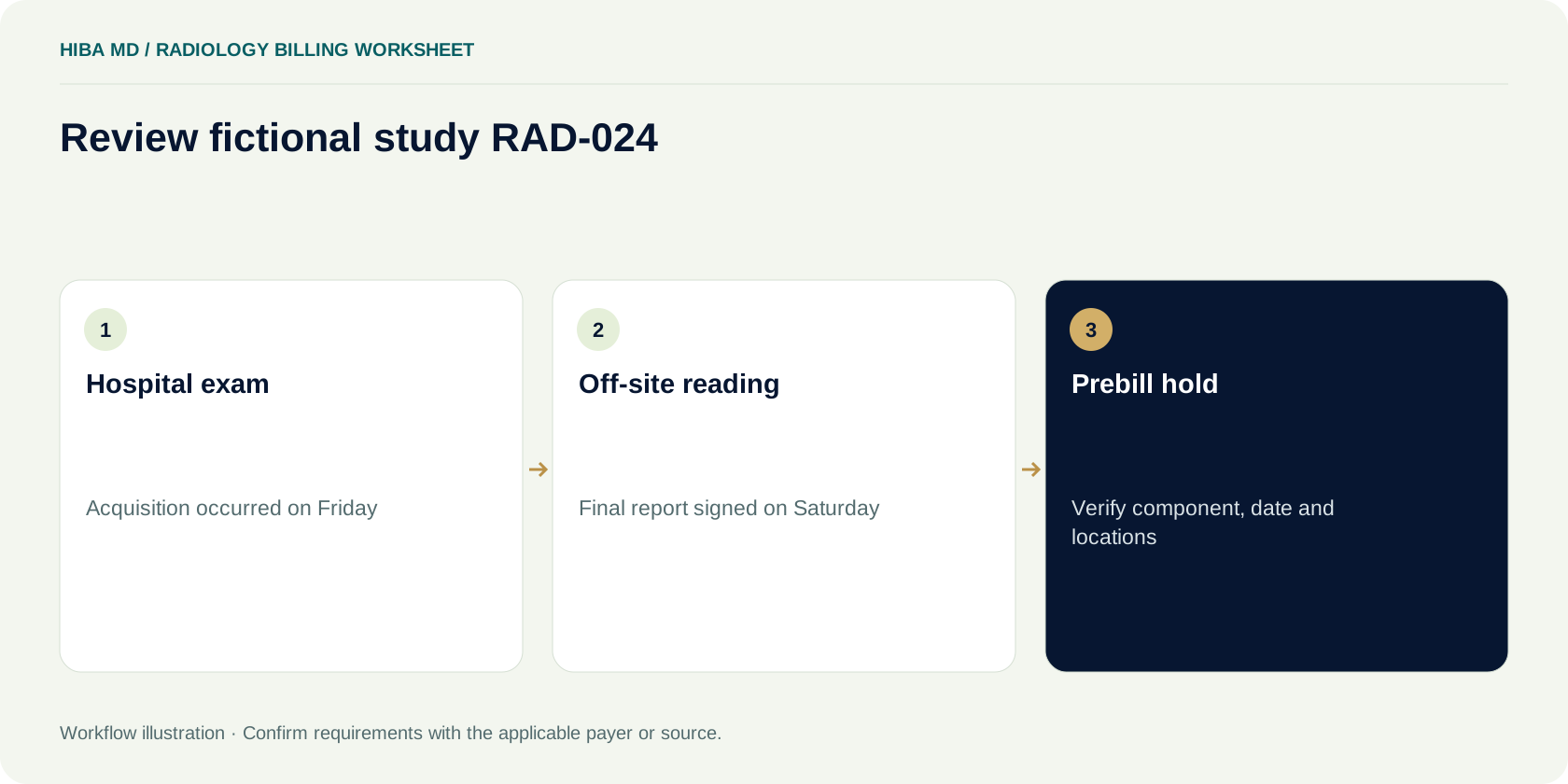
Use this fictional worksheet for training. Study RAD-024 was performed at a hospital outpatient site on a Friday. The final interpretation was signed Saturday by the radiologist assigned to the group. The imported draft charge used a freestanding template, included a global line and populated all dates from the acquisition feed. The biller holds it and asks for the report, confirms who furnished each component, and verifies the code and modifier combination with the coding reviewer. The reviewer also checks the place of service and the reading location under the professional claim instructions.
Keep acquisition and interpretation dates available as separate data points. When the dates differ, confirm which date to report for the billed component under current payer and contractor instructions. A charge posting timestamp or the time a report reached the billing queue is not adequate evidence of when a service took place. If the case record has conflicting timestamps, confirm what each source field measures before changing the claim. Record the source the reviewer used and any clarification from the contractor in the approved case notes.
The finished worksheet shows the accession reference, patient setting, acquisition site, reading location, performing and interpreting entities, claim component, proposed code and modifier, dates reviewed and the source for the release decision. Add the name of the reviewer and the date of review. Those fields let a second biller repeat the check after a response arrives. Use invented references in training versions. Keep any real report or image in the practice's approved clinical and billing systems.
Try a second worksheet row for RAD-025, an exam performed the same afternoon at the group’s freestanding site. The performing entity and patient setting differ from RAD-024. Its final report also shows a different interpreting arrangement. Open the two records together and check that each row retains its own site, reader and evidence. Ask a colleague to explain why the same payer and exam family could still produce different claim fields. If both drafts show the same values after the review, compare the output to each worksheet before concluding the values are correct. This is a useful test for a release rule that inherited fields from the previous claim.
Check the final electronic claim against the worksheet
Review the claim output before release when an interface or template has just changed. Compare the rendering provider, billing provider, payer route, service location, service date, place of service, procedure code and modifiers with the approved worksheet. Verify the appropriate authorization reference if the plan requires one. Use the source requirements for the specific payer and service. If the authorization belongs to the acquisition site, check how the payer handles the interpretation under the applicable product. Capture the result rather than assuming it follows the scan.
Start with a single claim from the new feed and place its output beside the source fields. Ask the analyst to display the outbound value beside the source value for the first few studies from each new location. For a location field, include the identifier and address or code that actually went out, not just the name the scheduler sees. When the values differ, document why. Some fields are deliberately translated to fit claim requirements. A translation without a recorded basis is hard to distinguish from a mapping error later.
Set a rule for who can release a claim after an exception. If a question concerns coding, have an authorized coding reviewer approve the resolution. If it concerns the billing entity, have the person who maintains the arrangement confirm it. A reviewer reopening the case needs the release decision. Save what was changed, who reviewed it, and which evidence supported the change. When the same exception affects many studies, verify the corrected mapping with a sample before releasing the rest of the affected batch.
Close the loop with claim acknowledgments
After transmission, save the batch reference and match the downstream acknowledgments to the submitted claims. Medicare's electronic filing guidance distinguishes intake validation from claim-level acknowledgment and subsequent adjudication. A payer acceptance records progress through intake. Keep watching for the adjudication result. When the clearinghouse report shows acceptance but a payer response is still missing, use the appropriate claim status process and preserve the last confirmed event. Work from the actual responses available for the transaction.
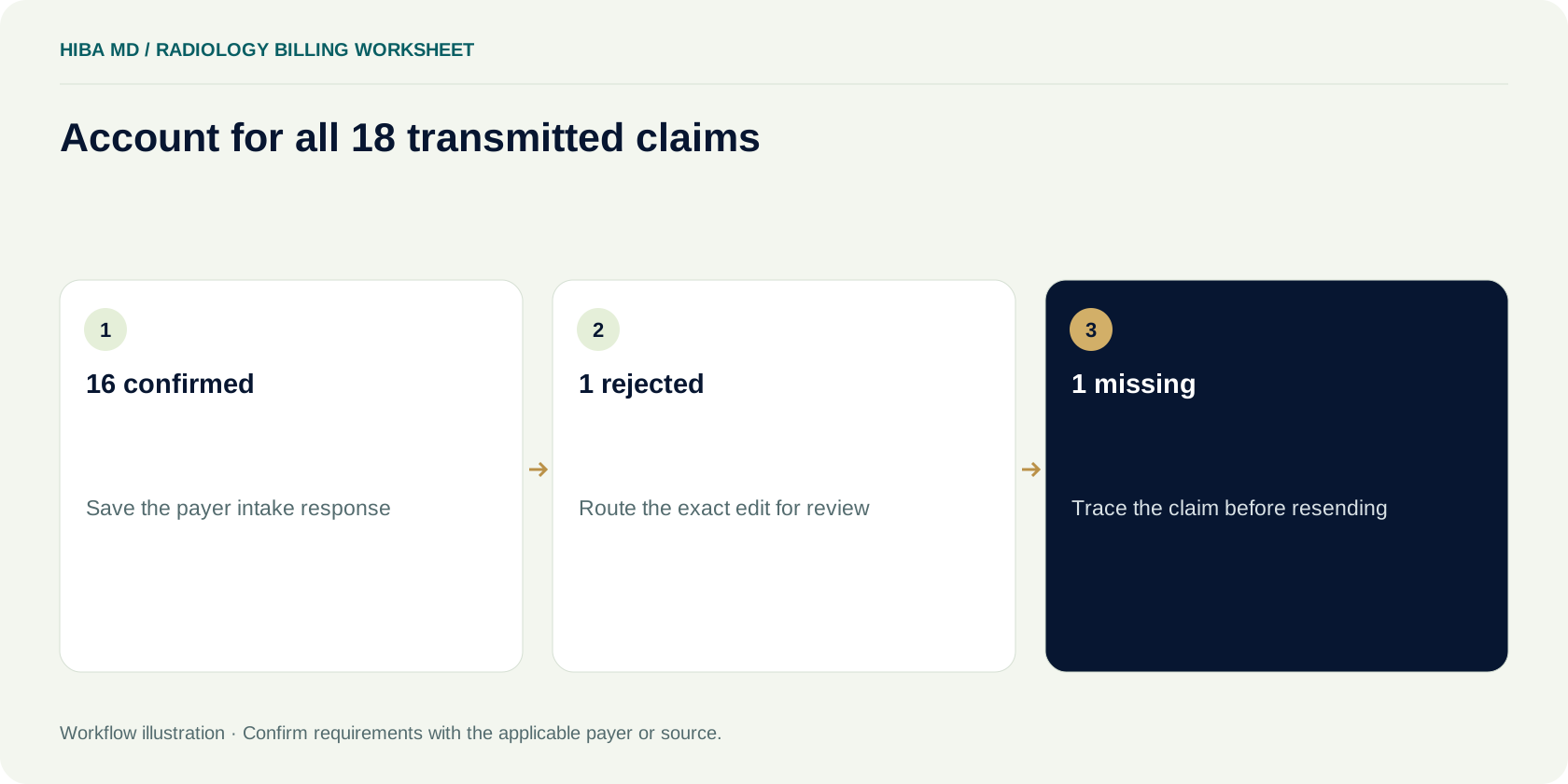
In a fictional batch of 18 professional claims, the practice confirms 16 reached payer intake and one was rejected. The final claim has no matching response. Give the rejected claim to the owner who can address the exact edit and verify whether correction and resubmission are appropriate. Research the missing response before sending a duplicate. After correction, link the replacement transmission and its acknowledgment to the original work item. A submission count without a claim-level match would make the two unresolved claims disappear in a daily report.
Once remittance arrives, compare the returned service line and response to the submitted record. If a case was accepted and later denied, follow the payer's current process for an adjudicated determination. If a recurring edit or denial points to a site or component mapping, return the case to the person who owns that mapping. The poster can flag the pattern, but the analyst needs the raw outbound claim field, the source record and the exact reply to reproduce it. Keep the case history intact so the team can check whether a change fixed the next batch.
For the missing acknowledgment in the practice example, record what you actually have. The clearinghouse accepted the file at 3 p.m. and its batch report lists the claim, but the latest payer response has no matching entry. Ask the clearinghouse or contractor to trace the transmission under its current process. If it provides a payer claim control number, save that number and check the claim status through the applicable route. If staff later correct and send the claim, retain both timestamps. The next person should be able to tell which submission was traced and which is awaiting a response.
Build a small exception review around repeated patterns
Choose a weekly sample of hospital and freestanding studies. Include at least one remote interpretation, a case from a new site if there is one, and a claim the team held before release. For each, ask a colleague to identify who furnished the scan, who signed the interpretation and why the claim shows the chosen component and setting. Have them compare the approved record to the actual transmission and payer response. Record where they had to open an extra system or call a colleague to find a missing field.
Track mapping corrections separately from claim outcomes. If five claims were held because a location was blank and two were rejected after submission, count the events in the appropriate queues. A hold tells the manager where work stalled. A rejection shows that a defect reached transmission. Name the denominator when reporting a rate, and use the same definition over time. A review across two weeks is easier to interpret when the team can tell whether the counts represent studies, transmitted claims or service lines.
Give the most common exception a specific next step. If the imaging partner's feed lacks patient setting for one department, ask the interface owner to identify a reliable source. If the group misses signed reports on weekends, ask the charge team to document how it verifies the report before release. Test the change on a few examples and keep a record of the result. Share de-identified examples and aggregate counts in meetings that do not require access to the underlying clinical record.
Test the first studies after a site changes hands
Suppose a practice moves imaging from a hospital department to a freestanding location and the first schedule uses the same exam names as before. Have the billing team record the effective date and confirm which studies were furnished on each side of the move. A scheduled appointment may have been rescheduled at the former site. Check the actual acquisition record before assigning a location or applying the new billing arrangement. If both sites continue in parallel for a week, let the actual completed study drive the selection.
Build a first-week review list before the first claims leave. Include an exam performed and read at the new site, an exam sent to an outside reader and a late report for a study from the former site. Compare each case with the approved entity and payer setup. Have a biller inspect the transmitted file and record what happened when the payer responded. If one case fails, look for other cases that share the relevant facts. An error limited to outside reads calls for a narrower review than an incorrect address on every new site claim.
Keep the older mapping available for cases already performed. A late charge should be reviewed with the facts that applied to that service, even if the application now defaults to the new location. If the software does not let the biller select the historical arrangement, define a documented exception route. When the transition ends, record when the old rule stopped applying and how the team can still find it when a remittance or audit question arrives.
Frequently asked questions
Who processes Original Medicare professional claims for Illinois?
CMS lists National Government Services as the A/B Medicare contractor for Jurisdiction 6, which includes Illinois. Verify the actual contractor and route if the scan and reading sites span jurisdictions.
Can a radiology biller use modifier 26 or TC with every imaging code?
Check the code and the applicable Medicare professional and technical component indicator. Some codes already describe an individual component or a global service and may not support those modifiers.
What place of service should I check for an off-site interpretation?
Use the current CMS instructions for diagnostic tests to confirm the patient setting that applies to the professional claim. Verify separately what reading location and ZIP information the claim requires.
Does sharing one accession number make global billing appropriate?
The accession number identifies the study. Verify the code and the actual furnishing and billing arrangements, including the applicable locality requirements, before releasing a global charge.
What if a scan and report have different dates?
Keep the actual acquisition and interpretation dates available. Check the current payer and contractor instructions for the date to report for the billed component.
Does a payer acknowledgment mean an imaging claim was paid?
Use the acknowledgment to document the intake result. Track the adjudication separately and match the remittance to the claim and service line.
Sources and editorial notes
Written by the Hiba MD editorial team. Reviewed 2026-11-10. Worked examples use illustrative figures, not client results or performance benchmarks. This guide explains administrative workflows; check current payer requirements for claim-specific decisions.
