
Billing priorities for neurosurgery
Start with the encounter and check how the practice handles complex operative records, multiple providers and care-setting transitions. For related support, see medical coding support.
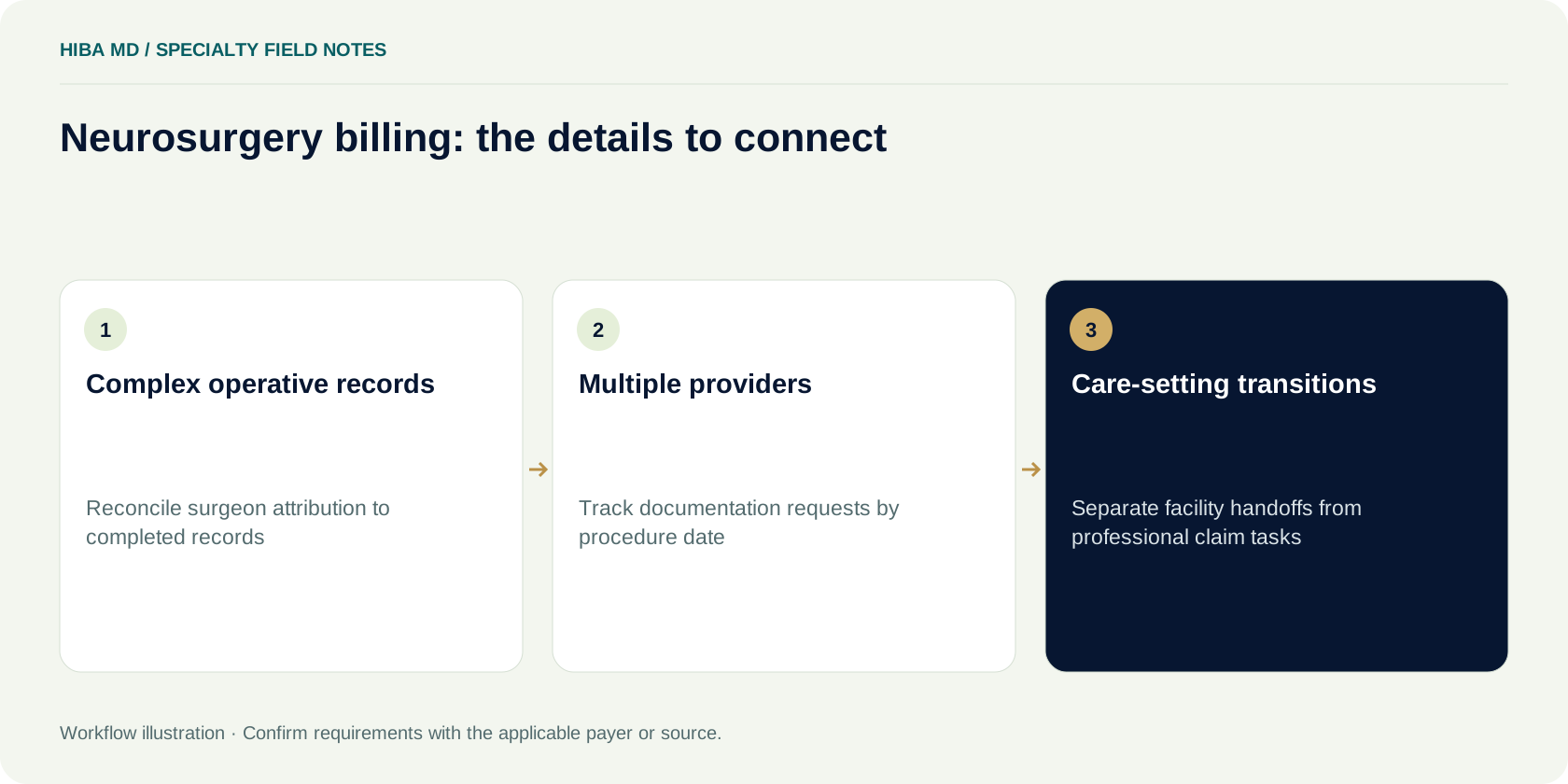
Complex operative records
Reconcile surgeon attribution to completed records.
Multiple providers
Track documentation requests by procedure date.
Care-setting transitions
Separate facility handoffs from professional claim tasks.
From encounter to claim follow-up
Keep the specialty detail connected through each handoff. Use these four stages to see where the work is ready—and where it needs a closer look.
Eligibility & handoff
Identify the relevant provider, service location and payer route for neurosurgery encounters. Keep outstanding coverage or authorization questions visible before they move into the claim queue.
Documentation & review
Reconcile surgeon attribution to completed records. Track documentation requests by procedure date. Coordinate any missing evidence through your approved practice process.
Follow-up & reconciliation
Separate facility handoffs from professional claim tasks. Distinguish a returned submission, an adjudicated denial and an unexplained payment difference before choosing the next action.
Patterns & ownership
Separate operative-documentation holds from payer follow-up, and preserve care-setting responsibilities. Give unresolved items an owner, an evidence source and a next-contact date.
Does the completed procedure match the documentation and administrative records?
Your neurosurgery
billing review checklist.
- Reconcile surgeon attribution to completed records
Record the source, the responsible person and the next action in your practice workflow.
- Track documentation requests by procedure date
Record the source, the responsible person and the next action in your practice workflow.
- Separate facility handoffs from professional claim tasks
Record the source, the responsible person and the next action in your practice workflow.
These checkpoints organize an administrative review. They do not select codes or establish coverage. Keep patient-level examples inside approved practice systems.
Tools for this workflow.
Plan, check and organize the next step. Free to use, without an email signup.
Claim readiness checklist
Review administrative claim details before submission.
Denial follow-up planner
Generate a focused administrative next-step checklist for a denial category.
Appeal date planner
Plan a follow-up date using the appeal window in the payer notice.
Neurosurgery billing questions
What should we review first for neurosurgery?
Start with complex operative records and one example of how it moves through your current workflow. Then review multiple providers and care-setting transitions, using the actual practice records and payer responses in your approved systems.
What is included in the specialty checklist?
The free download contains the three focused workflow checkpoints shown on this page, plus prompts for provider arrangements, payer routing, documentation sources and next-action ownership. It is a review aid you can take into a billing discussion.
Can you support a multi-location or multi-specialty practice?
Discuss the actual mix of providers, locations, systems and payer arrangements in the audit. A shared practice name does not automatically mean every service uses the same documentation or billing route.
Does this page determine codes, coverage or payer rules?
No. These are administrative workflow guides. Use current authoritative references, the actual payer response and appropriate professional review for claim-specific decisions.
Is the first month free for this specialty?
Yes. Hiba MD provides one month of medical billing services free, with no conditions. Contact us to coordinate the starting date and practice workflow.
Related practice guides.
Explore surgical specialtiesOfficial reference points.
Hiba MD specialty workflow guide · Reviewed 2026-10-31. General administrative information; use the relevant current references for claim-specific coding, legal or reimbursement questions.
