
Specialty medical billing works best when the administrative process reflects the actual services, documentation, providers and care settings involved. A therapy visit, a diagnostic interpretation and a surgical episode do not create identical handoffs. The consistent foundation is evidence and ownership; the details that need review vary with the encounter and payer arrangement.

Start with the practical question
This guide helps practice administrators compare those workflow differences and choose useful questions for a billing review. It does not provide code selection, coverage decisions or a universal set of specialty billing rules. Use current authoritative resources and qualified review for a particular claim. The examples are invented administrative scenarios, not clinical recommendations, payer instructions or Hiba MD client results. They show how to organize the investigation rather than predict the outcome.
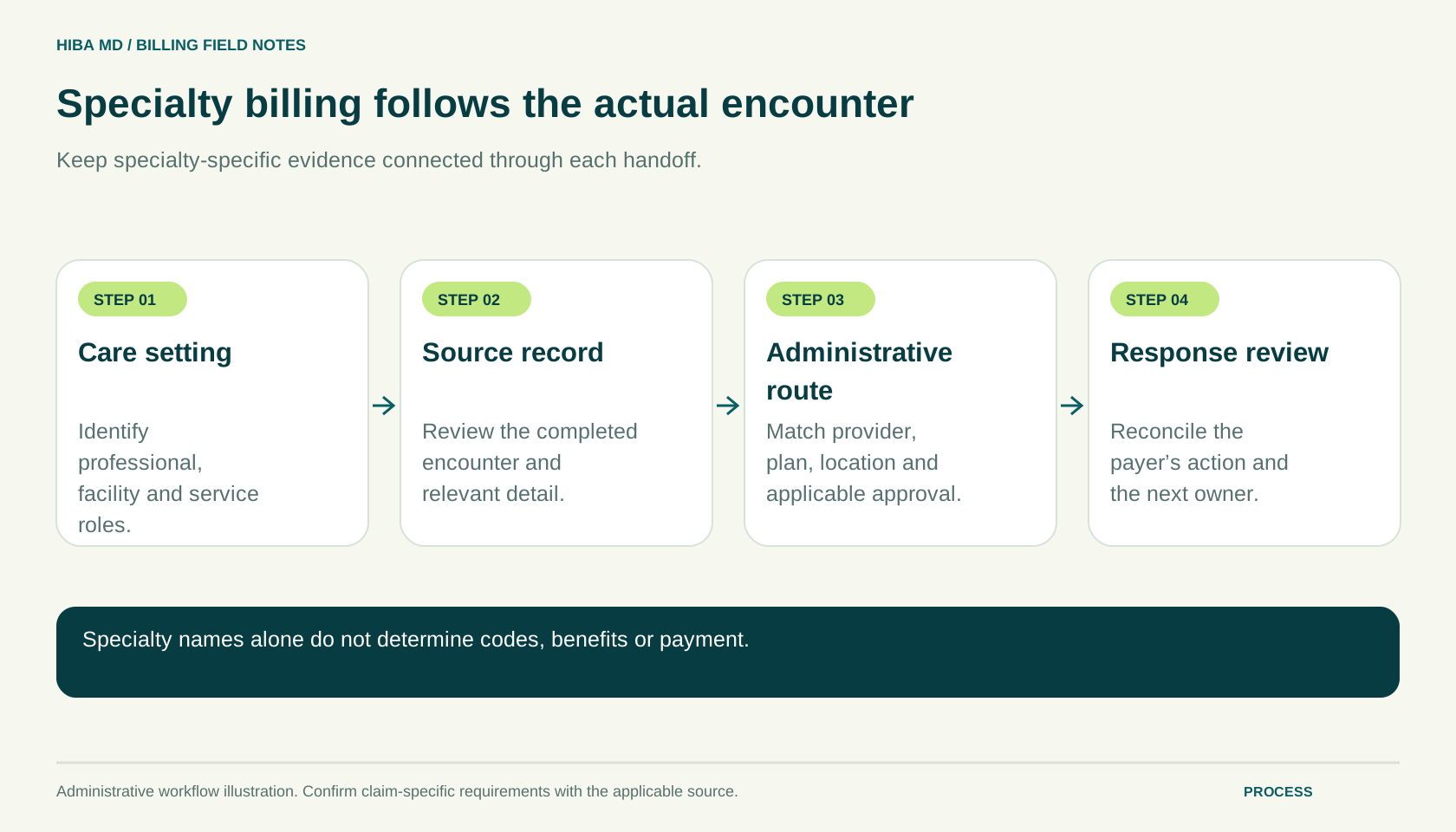
Begin with services and settings, not the specialty label alone
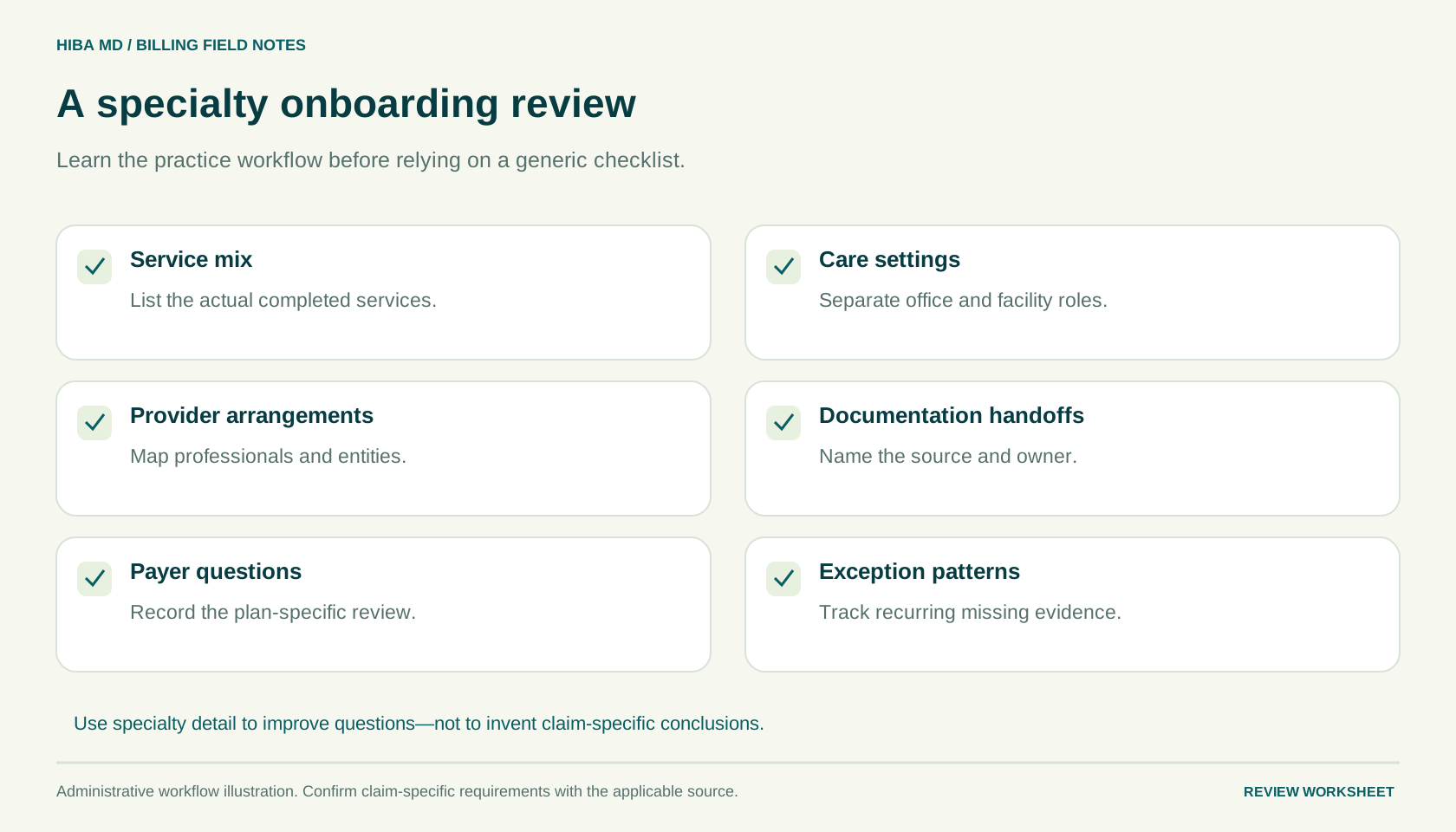
A specialty name is a useful starting point, but it does not describe every service a practice performs. Identify office visits, procedures, diagnostic studies, therapy sessions, facility work and other actual activities relevant to the practice. Then identify who provides, documents, interprets and bills each part. This creates a more useful map than assuming every encounter follows the same route.
Separate the professional, entity and location details. A clinician may work in more than one setting, and an organization may have several service lines. The billing process should preserve the arrangement relevant to the encounter rather than applying one broad practice-level status. Use the actual provider and payer records to confirm administrative questions when the arrangement changes.
For an illustrative multispecialty group, office visits may use one readiness handoff while a diagnostic service requires an interpretation record from another workflow. A surgical service may depend on facility coordination. The manager's task is to identify those dependencies and assign owners. Calling all three medical billing does not remove the different evidence each one needs before a claim can be prepared responsibly.
Use a consistent core with specialty-specific branches
Every workflow benefits from a clear registration source, relevant service-date coverage information, completed documentation, supported claim preparation and response follow-up. Those shared controls help staff understand the overall cycle. Specialty-specific branches then identify the additional questions that matter to the actual encounter rather than replacing the core process entirely.
Keep each branch practical. Name the evidence, the person who supplies it and the point where billing needs it. A branch might ask about authorized units, component responsibility, an operative record or a recurring service period. It should not simply add a specialty heading above the same generic paragraph. The question must change what the team checks or how it routes an exception.
Review the branch when services change. A new procedure, location, professional arrangement or system can create a different administrative dependency. Give the reference an owner and link it to current sources. A well-maintained short guide is more useful than a long specialty list that nobody can connect to the practice's actual documentation and claim-preparation work.
Primary care: connect varied visits with documentation readiness
Primary care can include different types of encounters and longitudinal relationships. The administrative review should identify what service was actually completed and where the relevant documentation reaches billing. A schedule label may help organize the day, but it should not replace the encounter record or qualified review of what is supportable for the claim.
Pay attention to changing coverage information, subscriber details and records needed from outside the practice. A recurring patient relationship can make old information feel familiar even when the service-date arrangement has changed. Use a defined registration and coverage handoff so staff know which evidence is current and which questions still need clarification.
An illustrative readiness report might separate completed visits awaiting a finalized record from completed records awaiting an administrative correction. Those groups need different owners. A generic unbilled-visit count hides the distinction. The practical improvement is a queue that identifies why each encounter is waiting and what evidence will allow the next appropriate step, without encouraging staff to infer clinical details from the appointment type.
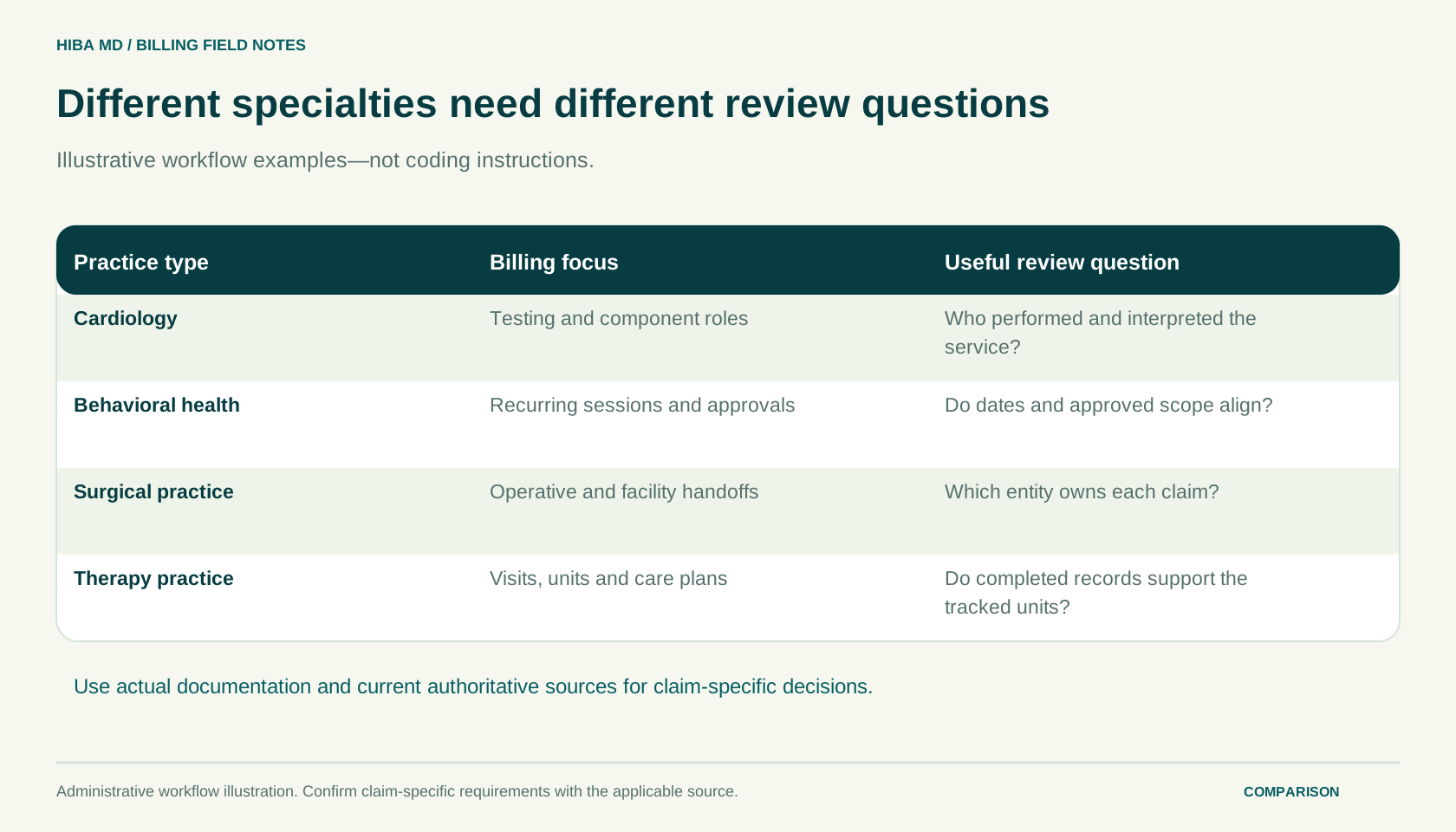
Behavioral health: keep recurring sessions and participation connected
Behavioral-health workflows may involve recurring visits, different professional types and arrangements that require careful administrative coordination. Identify the actual provider, service setting and plan route for each relevant encounter. A general practice label should not substitute for confirming the arrangement that applies to the professional delivering the service.
Keep session documentation and any relevant authorization or benefit questions connected with the completed visit. Where the actual process involves dates, periods or limits, record the source response and compare it with the service record. Do not treat a recurring appointment series as proof that every later encounter has identical administrative circumstances.
For an invented counseling example, a professional changes location while continuing to see established patients. The scheduling relationship may look continuous, but the administrative team still needs to determine whether the provider and location record used by billing remains accurate. The workflow should identify that question before staff apply an old participation assumption to new encounters or discover the mismatch only after a payer response.
Therapy and rehabilitation: reconcile periods, visits and units
Therapy and rehabilitation administration often requires different records to remain connected: the plan of care or relevant service documentation, completed visits, treatment-time information where applicable, and the actual payer response for any relevant authorization. The precise requirements depend on the service and arrangement, so use the current source rather than a universal therapy rule.
An authorization tracker can organize entered dates and quantities, but the original response determines what the numbers mean. Keep approved, used and remaining amounts distinguishable and confirm the underlying records. A visit count, a unit count and a service period are not automatically interchangeable. Staff should know which measure the actual response uses and who reviews any mismatch.
Using invented arithmetic, 20 entered approved units minus 14 entered used units leaves six. That result is an organizing aid, not a decision that a planned visit is covered. Compare the relevant service, date and documentation with the source evidence. If the encounter changes, route the question through the actual process rather than assuming that a positive remaining number resolves every administrative condition.
Diagnostic services: clarify completion and component responsibility
Diagnostic workflows can involve separate ordering, performance, interpretation and reporting steps. Identify which records establish that the relevant work is complete and who is responsible for each handoff. The administrative process should distinguish a performed study from an interpretation still awaiting completion when that distinction matters to claim preparation.
Clarify the actual billing arrangement for professional and technical responsibilities where relevant. Do not infer it solely from the specialty name or the fact that a study occurred in a particular building. The responsible reviewer needs the actual service, provider, location and arrangement. Current payer and official resources should guide claim-specific questions through the practice's qualified review process.
An illustrative imaging queue might contain completed studies awaiting an interpretation record and completed records awaiting provider attribution clarification. Those issues require different owners. A useful dashboard separates them rather than calling both missing charges. The same principle can apply to laboratory and pathology handoffs: identify the actual source record and the administrative question before deciding which team should act.
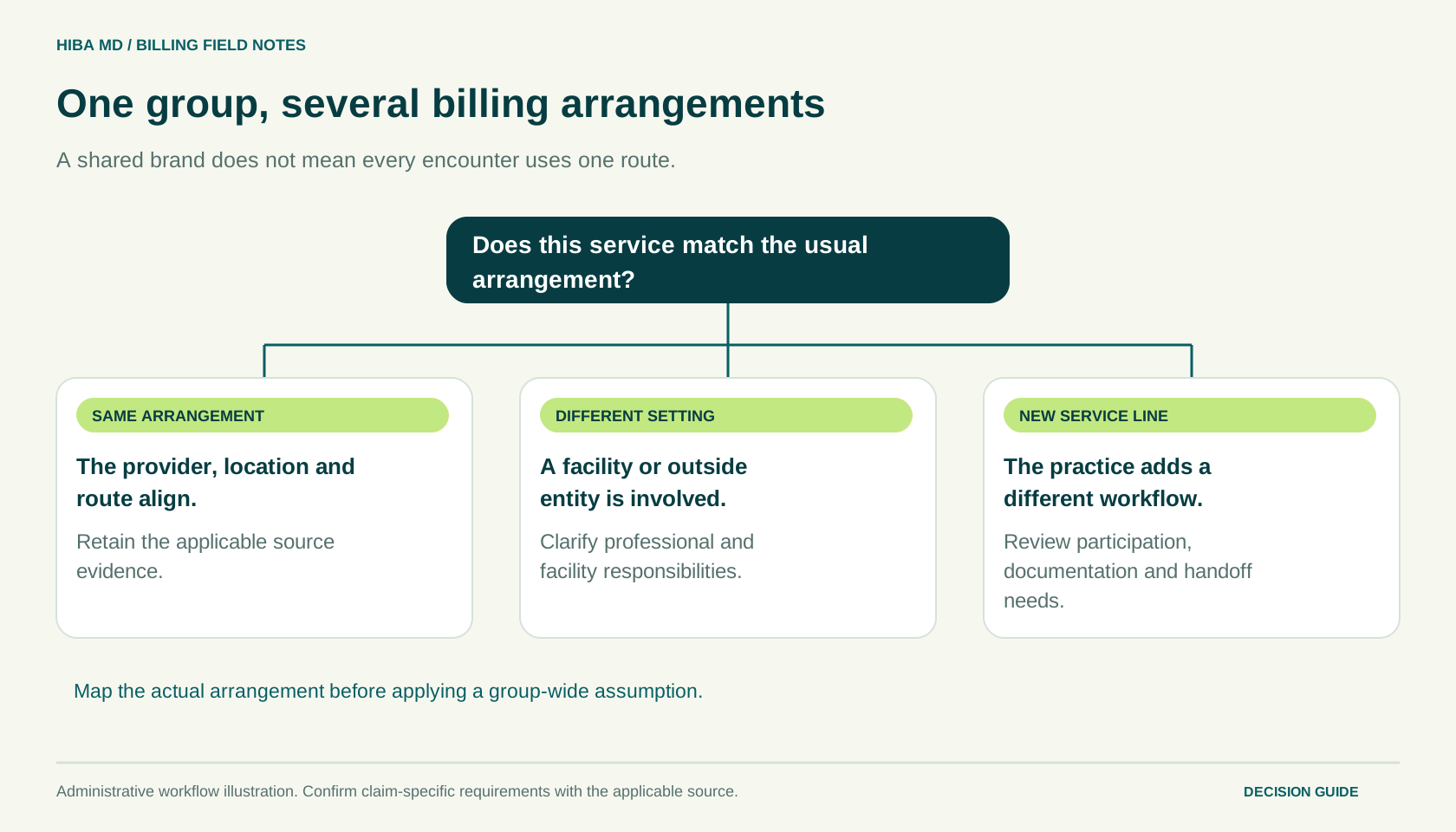
Surgical specialties: connect the episode without flattening it
Surgical administration may involve an office evaluation, facility coordination, an operative record and later follow-up. Map the actual services and responsibilities rather than treating the episode as one undifferentiated claim event. The professional and facility records may reach billing through different routes, and a missing handoff can appear much later as an unresolved account.
Use the completed record for qualified coding and administrative review. Laterality, location, service details and other relevant facts must come from the actual documentation. A scheduling description or authorization request does not replace the operative record. If the documented service differs from what was planned, identify the change and consult the appropriate current process rather than forcing the claim to match an earlier assumption.
For an invented orthopedic example, a procedure is completed at a different facility from the original schedule. The administrative team needs to compare the current provider and location details, relevant response evidence and completed record. The purpose is to identify the exact question and owner. It is not to declare a universal correction rule or select a modifier without the necessary qualified review.
Women's and children's care: preserve the relevant patient context
Administrative workflows for children's care may require careful attention to patient, guardian and subscriber information. The person attending the appointment may not be the subscriber recorded in the coverage arrangement. Confirm the relevant identifiers and service-date information through the practice's approved process rather than relying on a familiar family relationship or a previous appointment record.
For services delivered across a care period, identify which records and transitions matter to the actual arrangement. The practice should know where completed services, changes in provider or location and supporting documentation reach billing. Use current authoritative and payer resources for specific coding, coverage or period-based questions; a general website guide cannot determine those matters for an individual encounter.
An illustrative pediatric specialty referral may arrive with incomplete subscriber information while the clinical appointment is already planned. The immediate administrative task is to identify the missing evidence and its owner. A separate clinical decision remains with the responsible clinician. Clear separation of those roles lets the team coordinate without turning an administrative checklist into an unsupported medical or coverage determination.

Procedures, infusions and recurring treatment: connect the records
Some specialty workflows combine a visit, a procedure, medication-related records and repeated treatment dates. Identify which source records support each part and how the team knows they are ready for review. Do not assume that one completed note establishes every administrative fact associated with the encounter or that a recurring schedule eliminates the need to review changes.
Where the actual arrangement includes authorization dates or limits, keep those responses connected with completed activity. Where multiple professionals or settings participate, clarify attribution and location information. If a discrepancy appears, route it to the appropriate documentation, coding or payer-review owner. The next action should follow the evidence rather than a generic instruction to resubmit everything.
For an invented recurring-treatment example, a service date changes and a supporting record arrives later than the encounter summary. The practice needs a readiness process that distinguishes completed clinical activity from claim-preparation readiness. A visible hold reason and owner are more useful than leaving the item in an unexplained pending list. The goal is continuity of supported information through the handoff.
Community and facility-based care: identify the actual claim pathway
Community health centers, home health, long-term care and other settings can involve administrative routes different from an ordinary office professional claim. Begin with the actual provider or supplier type, service setting and program arrangement. CMS manuals and enrollment resources provide official starting points, but the responsible team must identify the current instructions relevant to the specific work.
Avoid applying an office checklist unchanged to every setting. Service periods, ordered services, facility census information or professional handoffs may create different dependencies. The practice should map how the source record reaches the person preparing the actual claim type. A broad facility label is not enough to establish the correct transaction, payer route or documentation readiness standard.
An illustrative home-based service workflow may require reconciling completed visits with the relevant orders and period records. A facility-based professional workflow may require accurate census and attribution information. These examples share the need for evidence and ownership, but their source records differ. The administrative design should preserve those differences so a missing item goes to the person who can actually resolve it.
Telehealth and multisite work: keep location questions visible
When services involve different locations or remote delivery, identify the actual facts relevant to the arrangement. Patient location, provider location, service format and plan context can create administrative questions. Use the current authoritative and payer sources for the service date; do not rely on an old general statement that remote services are handled the same way everywhere.
Keep clinical, licensure, enrollment, coding and coverage questions with the appropriate qualified owners. A billing guide can help identify that a location question exists, but it cannot decide all those matters. Record the source consulted and what it establishes. If an answer remains pending, make that uncertainty visible to the practice rather than treating a virtual appointment label as proof of readiness.
For an invented multisite example, a clinician's schedule changes between two offices and a remote session. The administrative reference should help staff identify which provider and location arrangement applies to each encounter. The purpose is not to create unnecessary complexity; it is to prevent a single default value from concealing real differences that affect the later claim review.
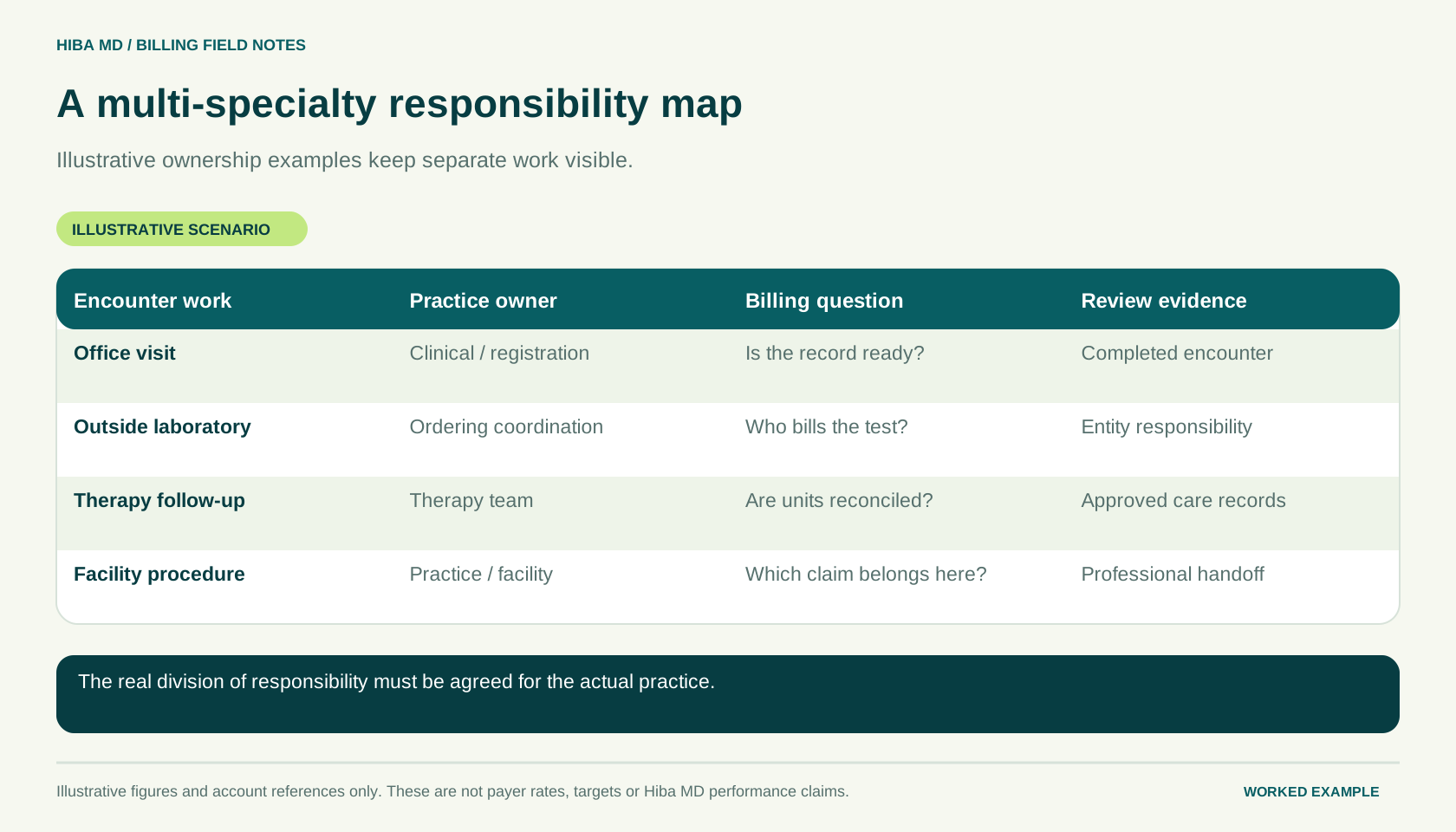
Use specialty details to investigate payer responses
When an account returns or receives an adverse determination, identify the actual response stage and affected service. Then use the specialty workflow map to locate the relevant evidence. A diagnostic component question, a therapy-period question and a surgical documentation question may all appear in a general denial list, but the owners and source records differ.
Separate the cause from the immediate action. A missing interpretation record may now be available, while a payer review remains pending. An authorization mismatch may require clarification of the actual response. A provider record may need enrollment investigation. The work queue should show both the underlying issue and the next task so management can understand current dependencies and recurring patterns.
Use a focused review sample when a pattern appears. Compare the service record, administrative evidence, submission and response. Do not assume that every account in a specialty has the same cause. A well-designed investigation identifies what the evidence supports, what remains unknown and which upstream handoff could be tested for improvement in a later comparable group.
Build a specialty-aware review with practical tools
Choose tools that match the administrative question. An authorization tracker can organize entered dates and quantities. An A/R analyzer can show the distribution of entered balances. A clean-claim checklist can organize readiness questions. A billing audit scorecard can help structure a conversation about the process. None of those tools selects codes, retrieves payer status or determines coverage for a particular encounter.
Combine the tool result with the source and owner. If a calculation flags a question, identify what evidence will answer it. If a checklist reveals a missing handoff, name the person who can supply the record. A tool becomes useful when it leads to a supported next step; it is less useful when it creates another score that nobody can connect to the actual practice workflow.
Hiba MD provides 109 specialty and practice-type guides, free tools, a free audit conversation and one month of medical billing services free, with no conditions. Start with the services and settings your practice actually uses, then discuss the handoffs that need attention. Share aggregate information first and agree a secure process for any later detailed review of patient-level records or claim evidence.
Build a service-line evidence map
Choose three actual service lines in your practice and create a row for the record each one needs before claim preparation. Identify who creates the record, where it becomes available, who confirms readiness and how an exception is routed. Keep the map administrative. It should point to the actual documentation and qualified review rather than attempt to select codes or tell a clinician what facts to record.
Compare the rows. Some controls will be shared, such as reliable registration and provider information. Others will differ, such as interpretation completion, therapy-period evidence or an operative record. Use those differences to decide where a specialty branch is necessary. A branch is justified when it changes the evidence question or owner, not merely because the service has a different name on the practice website.
Test the map using invented examples first. Ask a staff member from another team to identify the source and next action for each exception. If they cannot do so, clarify the handoff before adding more detail. A map that only its author understands will not help during an absence, transition or volume increase. Maintain the reference when the practice adds a service, provider arrangement or location.
Compare three invented specialty exceptions
Create a therapy item with a date-and-quantity question, a diagnostic item awaiting an interpretation record and a surgical item with a location discrepancy. All three may be waiting before submission, but they should not share one generic next action. Ask the team to identify the exact evidence needed and the person who can supply or review it. The exercise makes the specialty differences concrete without using any patient information.
For the therapy item, compare entered activity with the actual relevant response and route the interpretation question appropriately. For the diagnostic item, locate the source responsible for the interpretation handoff. For the surgical item, compare the completed record with the actual provider and location arrangement. None should be resolved by inventing a clinical fact or changing a default field merely to release the claim.
Then identify the shared control: every item needs a source, owner and next review date. The practice can use one queue structure while preserving different issue categories and evidence routes. This is the advantage of a consistent core with specialty-aware branches. Staff learn a common method of investigation without being encouraged to assume that every care setting produces the same documentation or administrative requirements.
Design a multispecialty management review
Organize the review by the decisions management needs rather than by a long list of specialty names. Show readiness dependencies, response issues and reconciliation questions with enough service-line context to identify the owner. A shared registration issue may affect several specialties and justify one upstream change. A missing interpretation handoff may be specific to a diagnostic workflow. The report should help the team see both patterns.
Use compatible definitions when comparing service lines. Different claim types, service periods and work units can make a simple rate comparison misleading. A therapy unit, diagnostic study and office encounter are not automatically equivalent workload measures. State the population and question for each measure. If the purpose is capacity planning, describe the actual task mix rather than assuming that equal claim counts imply equal effort.
Reserve part of the review for a cross-team handoff. Ask whether a record became available where the next team expected it and whether the source was understandable. A specialty-aware process improves when the people supplying and receiving information discuss a specific example. That conversation can reveal a practical change more effectively than a broad request for better communication or a headline assertion that the team supports every specialty.
Keep the guide useful as the practice changes
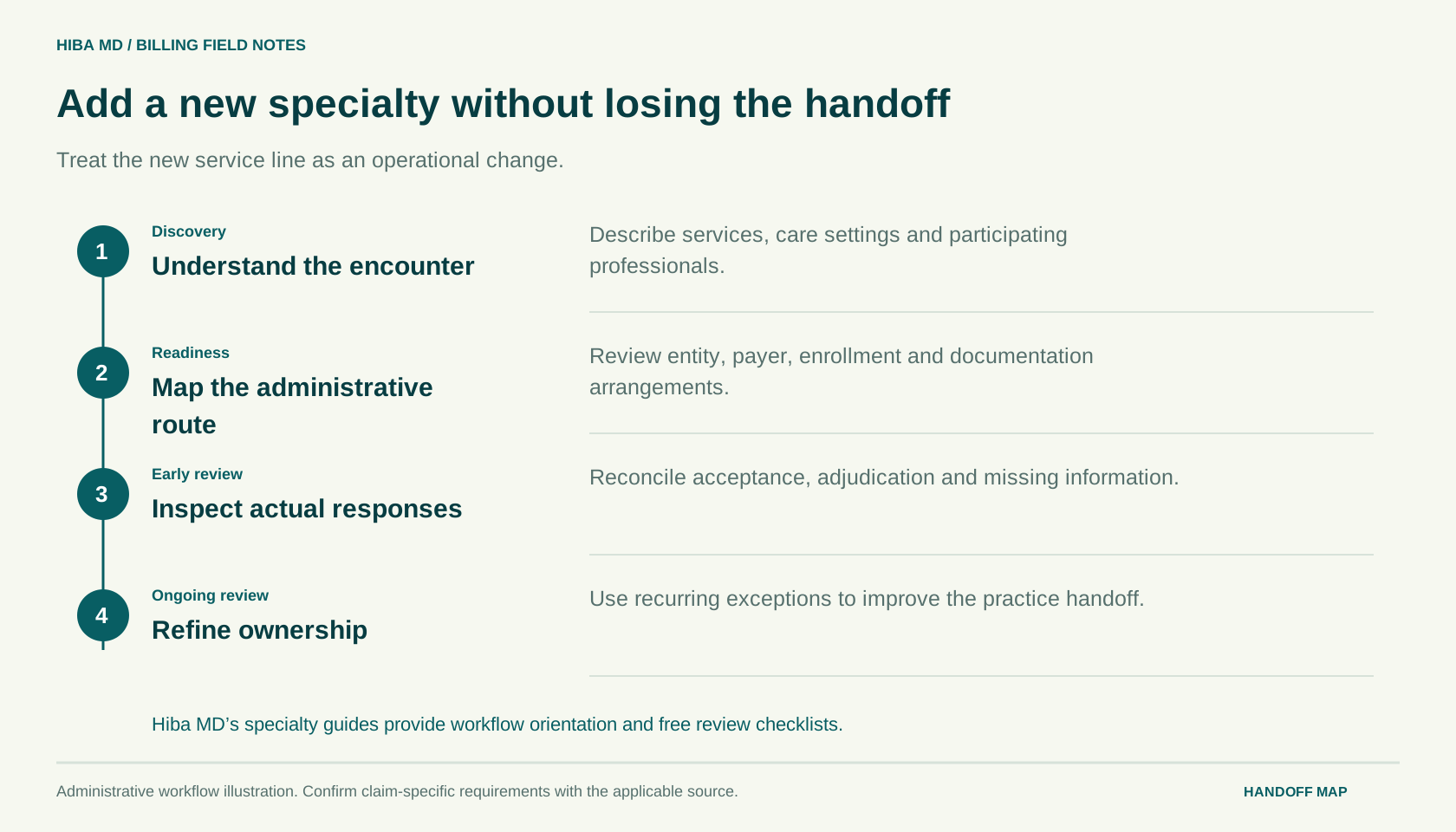
Add a review trigger for new services, new professionals, new locations and changes in the systems used to record or transmit information. The practice does not need to rewrite the entire process each time. It needs to identify which evidence map, source reference and exception route are affected. A small controlled update is more maintainable than allowing informal workarounds to accumulate in personal notes.
Use the first relevant encounters after a change as a deliberate handoff review. Confirm that the administrative team can locate the actual source records and identify unresolved questions. If a payer response raises an issue, investigate its specific content rather than assuming the new service is responsible for every problem. The goal is to learn where the process needs clarification while preserving accurate records and appropriate professional decision boundaries.
Record the change and communicate the action to the people affected. A new guide is useful only if scheduling, documentation, billing and management know which step changed and who owns it. Review a later comparable sample to see whether the intended handoff became clearer. That gives the practice a repeatable improvement method across specialties without relying on unsupported promises about universal payment outcomes or ranking claims.
Keep a way for staff to request a new branch when the actual work does not fit an existing one. Ask them to describe the service, source record and unresolved administrative question, then route the request to the appropriate reviewer. Do not create a new branch merely to add another label to the directory. A useful addition changes the evidence question, owner or next action. This keeps the specialty library grounded in practice operations and makes it easier for a new team member to find the right path without reading a large collection of nearly identical instructions.
Frequently asked questions
Does every specialty need a completely different billing process?
No. Registration, supported documentation, claim preparation, response review and reconciliation provide a shared foundation. Specialty-specific branches identify the evidence and handoffs that differ. The goal is a consistent core with practical questions for the actual services and settings, rather than either one generic checklist or unrelated processes for every label.
Can a specialty guide tell us which code to bill?
No. These guides organize administrative review questions. Code selection and claim-specific interpretation require the actual record, current authoritative sources and appropriate qualified review. A specialty name, scheduling description or calculator result cannot substitute for the completed encounter documentation or establish that a payer covers a particular service.
Why do provider and location details matter in multispecialty groups?
A group can include different professionals, entities, locations and payer arrangements. A broad practice-level status may conceal an unresolved question for a particular encounter. Record the actual arrangement and retain the relevant source confirmation so scheduling and billing do not infer more than the evidence establishes.
What is a useful specialty billing audit question?
Ask where an important source record becomes disconnected from the claim workflow. Examples include therapy authorization periods, diagnostic interpretations, operative records or recurring-session participation details. Identify the evidence, owner and next action. That question is more actionable than asking whether a team knows every specialty in general.
How can we begin with Hiba MD?
Describe your specialty mix, care settings, systems and the administrative handoff that needs attention. Aggregate examples are enough for the initial free audit conversation. Hiba MD offers one month of medical billing services free, with no conditions. Agree a secure process before any later patient-level document or account review.
Sources and editorial notes
Written by the Hiba MD editorial team. Reviewed 2026-10-31. Worked examples use illustrative figures, not client results or performance benchmarks. This guide explains administrative workflows; check current payer requirements for claim-specific decisions.
