
Verify which payer covers the physical therapy visit on its service date. Read the actual approval for its date range, services and quantity. Track visits and billed units in separate fields, and review the renewal before either the dates or the approved quantity run out. For Texas Medicaid fee-for-service, use the TMHP therapy handbook. For managed care, confirm the member’s plan instructions.

Start with the plan that covers the treatment date
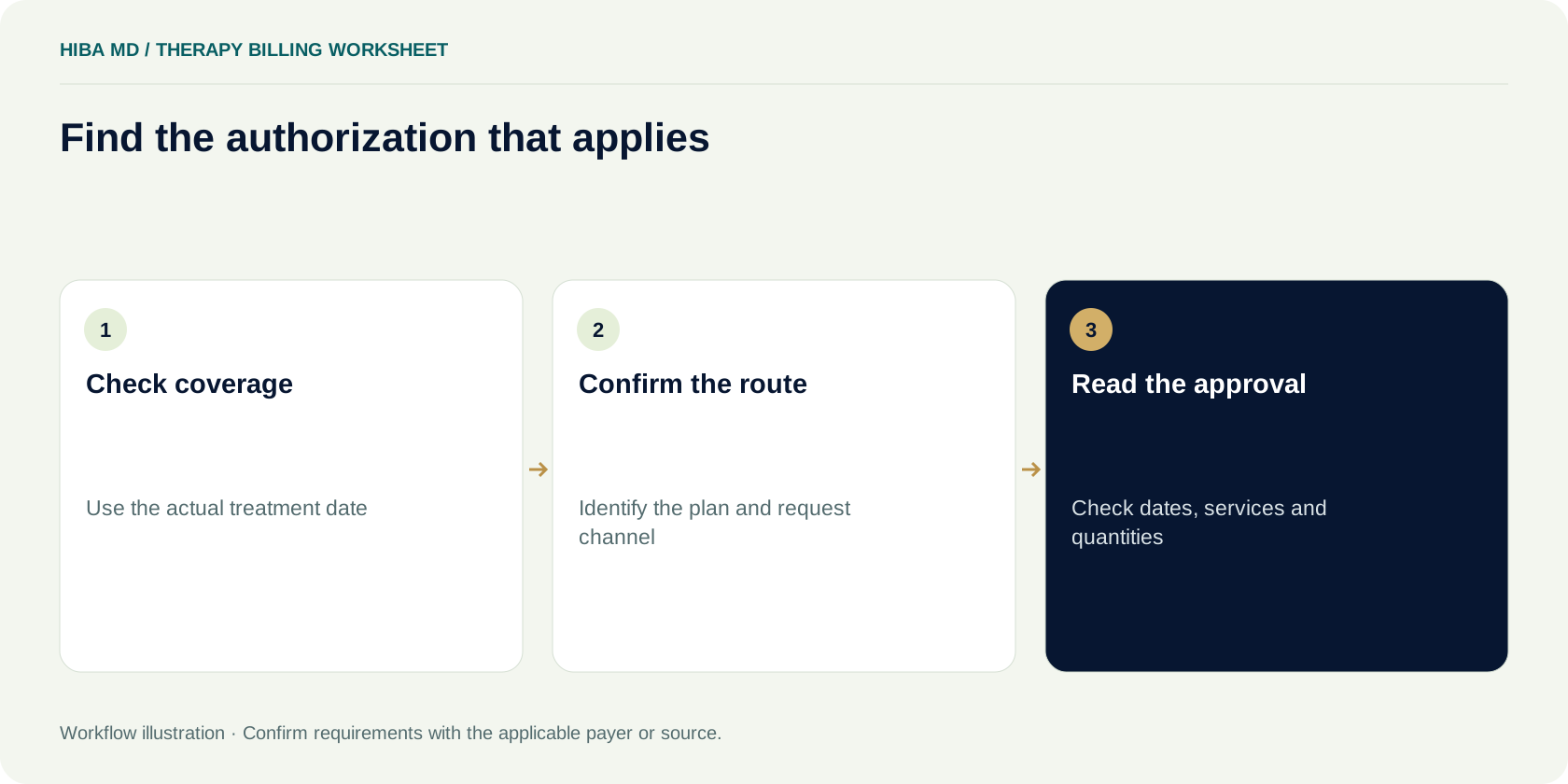
A parent calls to book three more sessions. The scheduling screen shows four visits left, but the clinic has an older approval from a different plan in the chart. Check coverage for the proposed treatment date before confirming the appointment. Confirm which plan is responsible, who handles its physical therapy requests and whether the approval on file applies to that date, location and rendering provider. If coverage changed, verify the approval with the plan responsible for the new visit.
For Texas Medicaid fee-for-service, start with the Texas Medicaid & Healthcare Partnership (TMHP) provider manual. Its therapy handbook separates children's services from adult acute therapy. Read the section that matches the patient and setting. The handbook describes prior authorization for treatment following the initial evaluation in those sections. For managed care, find the member's specific plan and use that plan's submission instructions. TMHP says administrative procedures can differ between traditional Medicaid and managed care organizations, and between plans. Ask which entity actually receives the request when the plan delegates authorization.
Have the scheduler record the coverage check date, the effective period the response shows, and where the answer came from. Give the authorization coordinator the exact product name if it is available. A response that says only “Medicaid active” leaves the coordinator to do the same work again. When an appointment is booked well ahead, set a second check close to the treatment date. Pay special attention to a series that crosses a month boundary or follows notice of a coverage change. A repeat check takes less time than working through a whole batch sent to the wrong plan.
Keep the evaluation and the treatment request separate
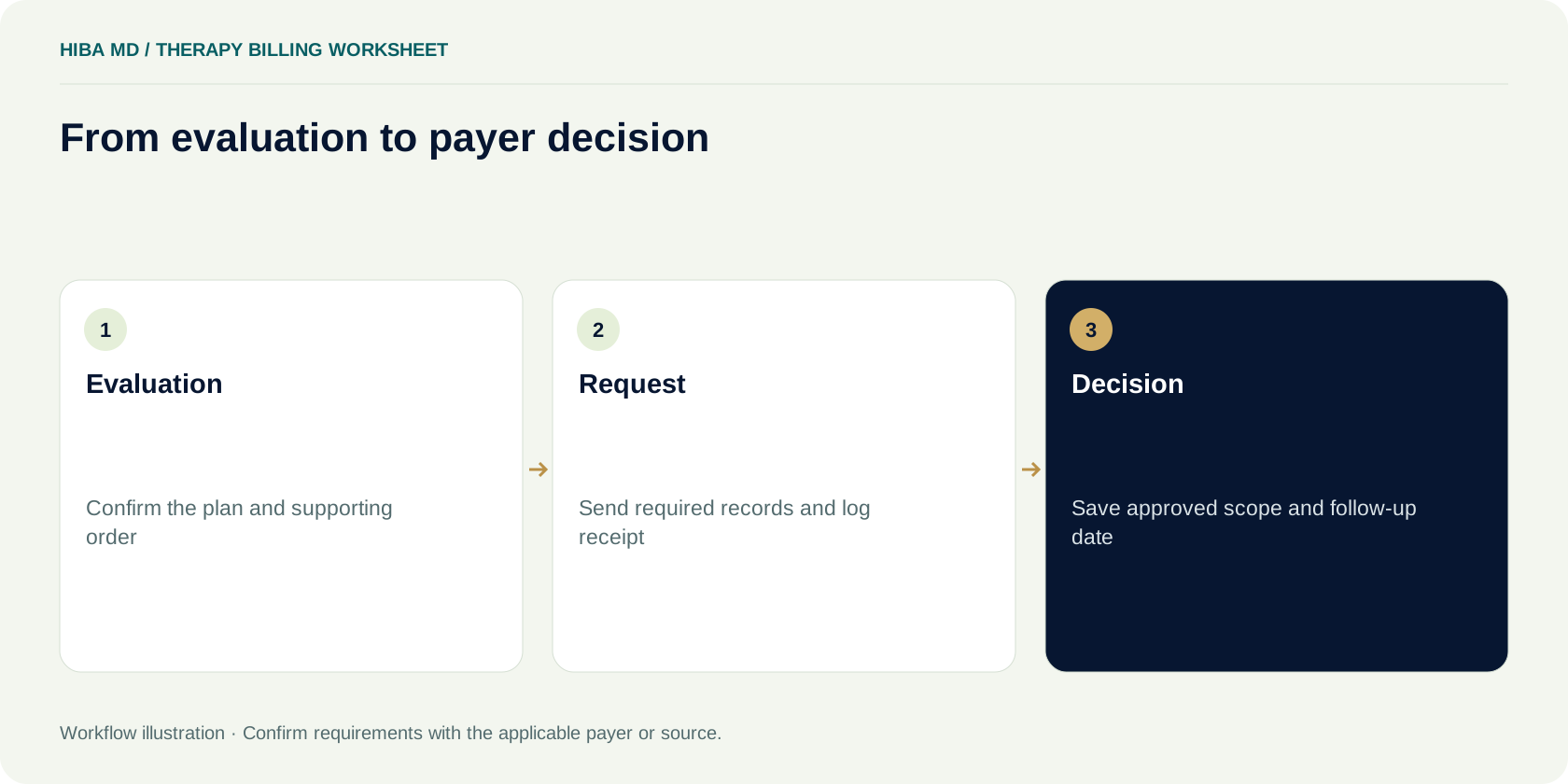
The evaluation gives the clinician the information needed to make a treatment plan. At intake, check whether the plan has an evaluation requirement, which discipline and setting it applies to, and what documentation the clinic needs. After the evaluation, open a separate treatment request in the work queue if the applicable policy calls for one. A completed evaluation or a referral in the chart should never automatically turn the treatment status green in the scheduling system.
For the initial requests covered by the children's and adult acute sections of TMHP's handbook, the handbook describes a five-business-day receipt window measured from the start of treatment after the evaluation. It also describes the effect of a late request on earlier dates of service. Read the relevant section for the exact scope and documentation. A practice can choose to prepare the request earlier and set its own earlier follow-up date. Keep the policy deadline and the clinic's target in different fields. If the plan is managed care, confirm its instructions directly before using any deadline in a work queue.
A useful intake handoff takes one sentence. “Evaluation complete on Monday, treatment requested for the following week, therapist signature received, prescribing documentation pending.” Now the person opening the queue knows what is missing and whom to contact. Put a date beside the missing item. If treatment is already booked, let the treating clinician and scheduler see the unresolved status so they can review the schedule and explain the next step to the patient. Clinical decisions belong with the clinician. The billing team can give them a clear picture of coverage and what has actually been submitted.
Build a request packet someone else can finish
The authorization coordinator should be able to open the case and see the requested discipline, setting, services and date range without reading through every note. Keep a short cover record in the approved system, then attach the clinical documentation that the payer asks for. For TMHP fee-for-service, check the current therapy handbook and the current PT, OT and ST authorization form. The handbook describes signatures and supporting orders, including how a qualifying order may accompany a request when the prescribing provider has not signed the form. Give the person assembling the packet the actual rule and the source to check.
Ask the clinician to review the services requested against the treatment plan. Billing staff can spot a blank field or a mismatch between the requested frequency and the attached plan. They should send questions about goals, clinical rationale or the treatment approach back to the clinician. For example, “The request shows two sessions per week and the signed plan shows one. Please confirm the intended frequency before we submit.” Save the clinician’s response with the request so the next reviewer can see which frequency was confirmed.
After submission, save the acknowledgement or transaction reference alongside the original request. A successful upload may show that the packet reached a portal. Record the payer's decision when it arrives, with a separate status and the date of that decision. When the payer asks for an attachment, log what it asked for, who will supply it and when the coordinator will check the case again. This also helps when the person who submitted the first request is out on Friday. Their backup can see the last response and pick up the case without submitting a second packet.
Read the approval before anyone uses its balance
Copy the approval from the payer's response into the clinic record. Preserve the original response so a second person can check the transcription. Record the authorization number as shown, the date window, the named service or discipline and the quantity. Give the quantity an explicit label. “12 visits,” “24 units,” and “24 units tied to a procedure” describe different limits. If the response leaves the unit of measure unclear, send that question back to the payer and record the answer before relying on the balance.
Check for a narrower scope in the response than the one the clinic requested. For example, a clinic asks for two months and receives one, or asks for two services and sees just one on the determination. Compare the approval with the request line by line. Where a payer ties an approval to a provider, location or service code, capture that restriction in a field the scheduler and biller can see. If the proposed treatment changes, ask how the payer handles amendments or a new request. Keep the earlier decision linked to the visits it covered.
In a fictional example, an approval covers eight visits from November 2 through November 27 at the original site. Four completed visits have consumed four visits under the example plan's counting rules. The patient asks for an appointment on November 30. The scheduler still sees four remaining, but the proposed appointment falls outside the window. The coordinator should confirm the applicable process for additional dates and flag the appointment for review. Carrying the balance into December would conceal the actual problem. The team needs both a date check and a quantity check.

Count visits, treatment minutes and claim units in separate fields
A clinic calendar tells you that a patient attended an appointment. The treatment note records what happened during that appointment, including the time the clinician documented for applicable services. The claim contains the units calculated under the payer's instructions. If the team stores all three in a column labeled “used,” staff can arrive at different answers while each is reading the same sheet correctly.
The TMHP therapy handbook describes how to handle services paid in 15-minute increments. The CMS outpatient rehabilitation documentation fact sheet and Medicare Claims Processing Manual describe how Original Medicare determines units for timed therapy codes, including encounters with more than one timed service. Use the method for the payer and service at hand. Keep the actual treatment minutes available so a reviewer can check the math. A unit calculation from a different plan or a default copied from another patient's template can create a mismatch even where the clinician's note is complete.
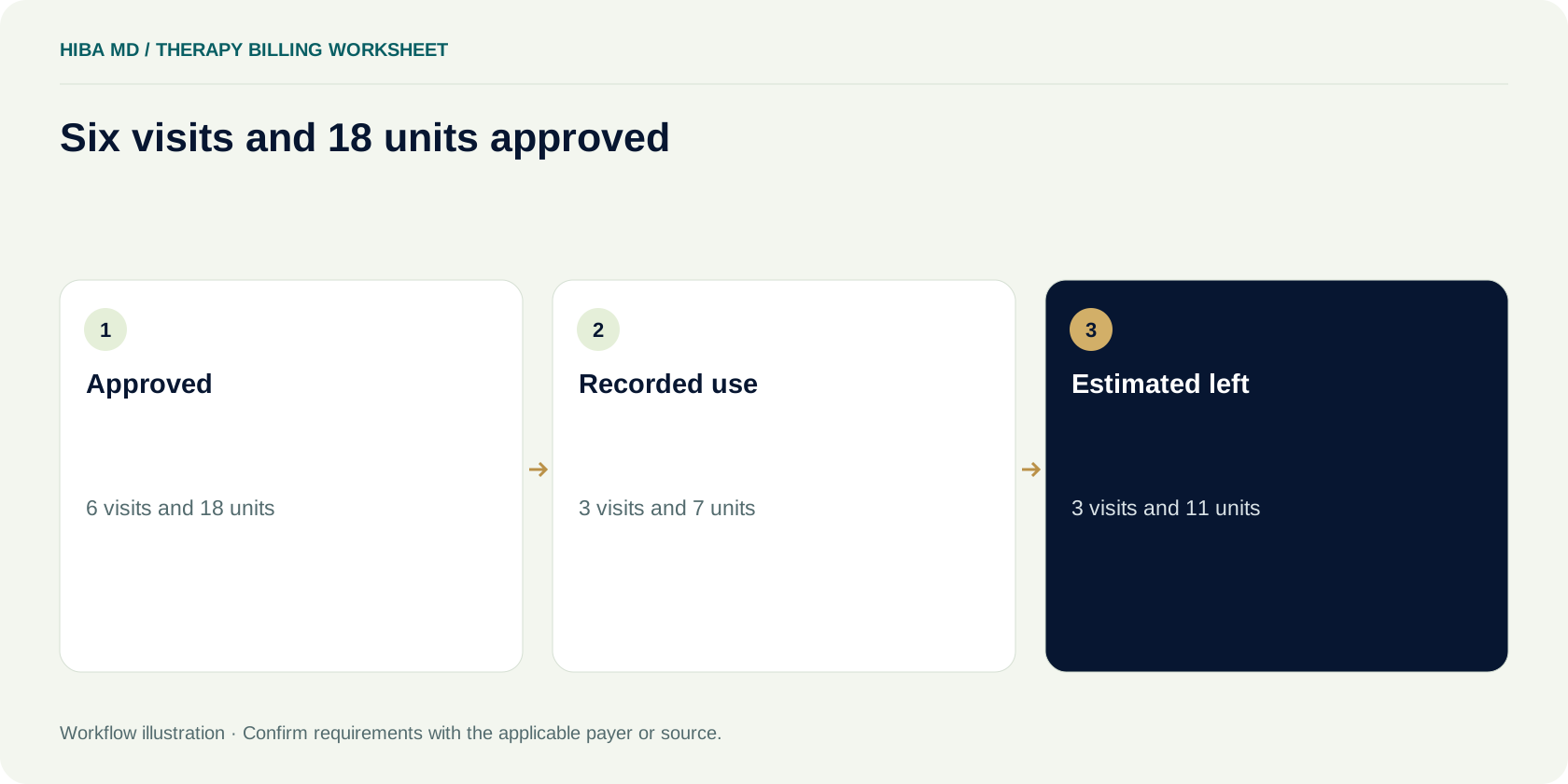
Try this fictional example for an internal training sheet. A plan approves six visits and separately allows up to 18 units for a named service. After three completed visits, the reviewed units for that service are two, three and two. Assuming all three visits and those seven units count against this approval, the clinic estimates three visits and 11 units left. Keep the estimate beside the last payer-confirmed balance and the date that balance was checked. Both limits apply in this example. An authorization showing 11 units left does not tell the scheduler how many dates remain on the calendar or how much treatment is clinically appropriate.
Use a ledger that keeps pending work visible
Build one row per service date in the clinic's approved system, with a separate line if the team needs to track two code-specific balances. Include an internal case reference, the planned and actual service date, the status of the appointment, the authorization reference and the amount to charge against each applicable limit. Add fields for the claim reference, submission state and payer response date. The scheduler should be able to see a concise status while the billing team can open the underlying record. Use fictional entries if the sheet is being circulated for training.
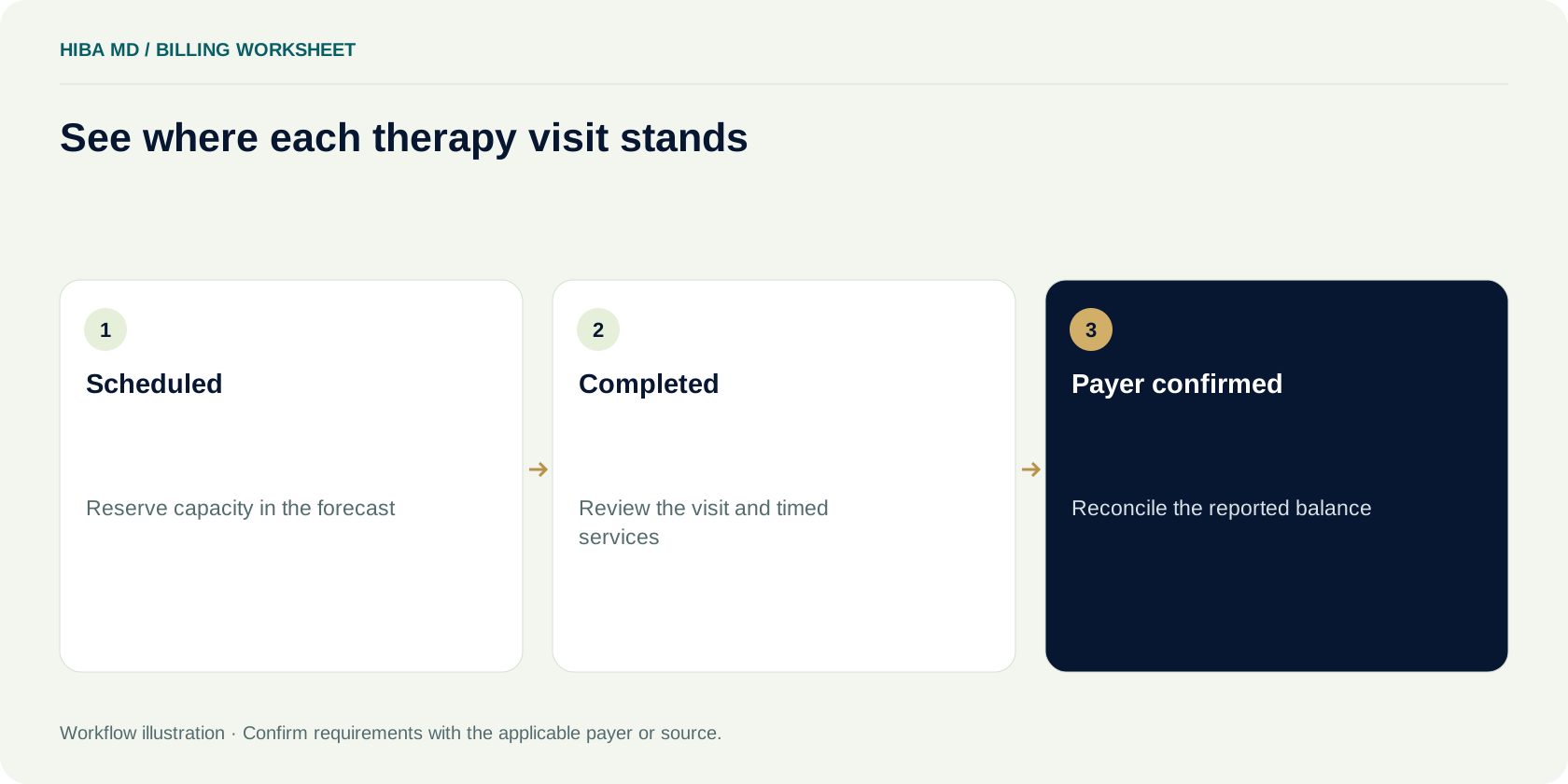
Separate visits reserved on the schedule from visits completed. A reservation can show that the clinic expects to use the balance next week. A completed visit reflects the service that actually happened. Cancellations and no-shows need their own state so they can be removed from the forecast while preserving what happened in the schedule. Check the plan's counting rules before subtracting any encounter. If the payer's portal updates later than the clinic's records, keep a separate field for your estimate and one for the latest reported amount. Save the date and source of the reported value.
The simplest review is a short list of cases where the records disagree. Perhaps a completed visit has no released charge, a claim response is still outstanding, or a payer balance dropped after the team expected it to stay the same. Send each case to the person who can verify the evidence. For an unsigned treatment note, that person is usually the clinician. For a balance that changes after a payer response, the poster or biller can compare the claim and the remittance to the ledger before anyone edits the count.
Here is a sample ledger entry for a training case. Case PT-017 has a service date of November 10, authorization reference DEMO-42, and an appointment marked completed. The reviewed charge uses one visit and two units for the covered service. The coordinator recorded those amounts as estimated use on November 10. The payer balance was last checked November 9. The claim is awaiting a payer response, and the biller will check on November 13. Use a later row to record the next visit and update the reference only when a different determination applies. This structure lets a second reviewer explain both the estimate and why the payer balance may still look higher.
Plan the renewal from the earlier of two limits
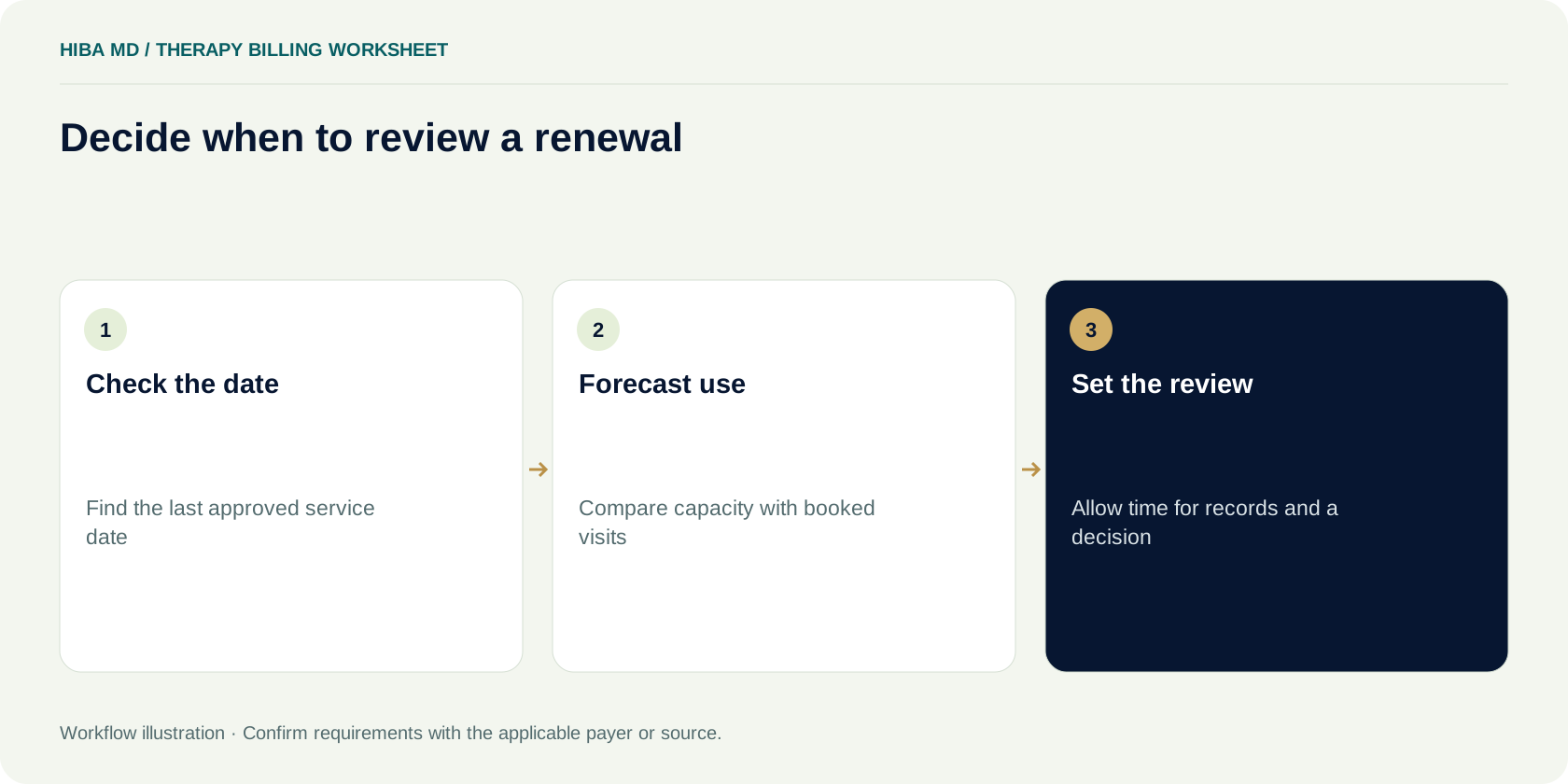
A renewal queue works better when it watches both the end date and expected use. Take a fictional clinic with five approved visits left and a schedule of two visits per week. At that pace, the quantity may run out before the last approved date. For a patient with a single visit next week and an authorization that ends tomorrow, the date window arrives first. In both cases, the coordinator can see the problem before the patient turns up.
Choose an internal review point that leaves time to obtain the necessary documents, submit the request and check the response. Base it on the clinic's actual handoff times and the payer's published requirements. If your plan calls the process recertification, check what it asks for under that heading. The TMHP therapy handbook discusses progress documentation and prior authorization materials for recertification and has specific guidance on reevaluation. Use the section that fits the patient. Have the clinician decide when an updated evaluation or plan is clinically appropriate and verify how it should be handled administratively.
A practical calendar entry might say “Check decision Thursday morning, submitted Monday, proposed first service date next Tuesday, therapist to answer documentation questions.” That is more helpful than a reminder titled “Renew.” If the payer approves fewer visits or a different date range than requested, revise the forecast and inform the scheduler. Keep the older approval in the record. Claims from last week may still need it while the patient is already being scheduled under the new period.
Resolve plan, location and provider changes before releasing claims
Treat a transfer between sites as a new eligibility and authorization check if it affects the information on the original approval. For instance, a family moves within Texas and asks to continue care at another clinic location. The appointment may look identical on the calendar, but the responsible plan or authorized rendering details can change. The coordinator should compare the new site and rendering information against the determination and confirm how the payer wants the change handled. The office should keep both responses when the plan issues a replacement or amendment.
When coverage shifts from a managed care plan to fee-for-service, read the relevant TMHP transition guidance and confirm what to submit for the services at issue. Record the effective change date and review the treatment dates on either side. Send claims according to the payer responsible for each date, using that payer's instructions. Keep the old determination and the new determination accessible. The team should be able to explain why two consecutive visits followed different routes without guessing from the patient's current plan card.
A clinician departure can create the same kind of administrative gap. The care team may have arranged a handoff and the scheduler may see a free appointment. Have billing check whether the approval, enrollment and plan records support the new rendering arrangement before relying on the old authorization. Ask the payer what evidence it will need and whether a change takes effect on a particular date. When the office can answer those questions, it can give the patient a specific update about the appointment and give billing a defensible release decision.
Audit the first claim under each approval
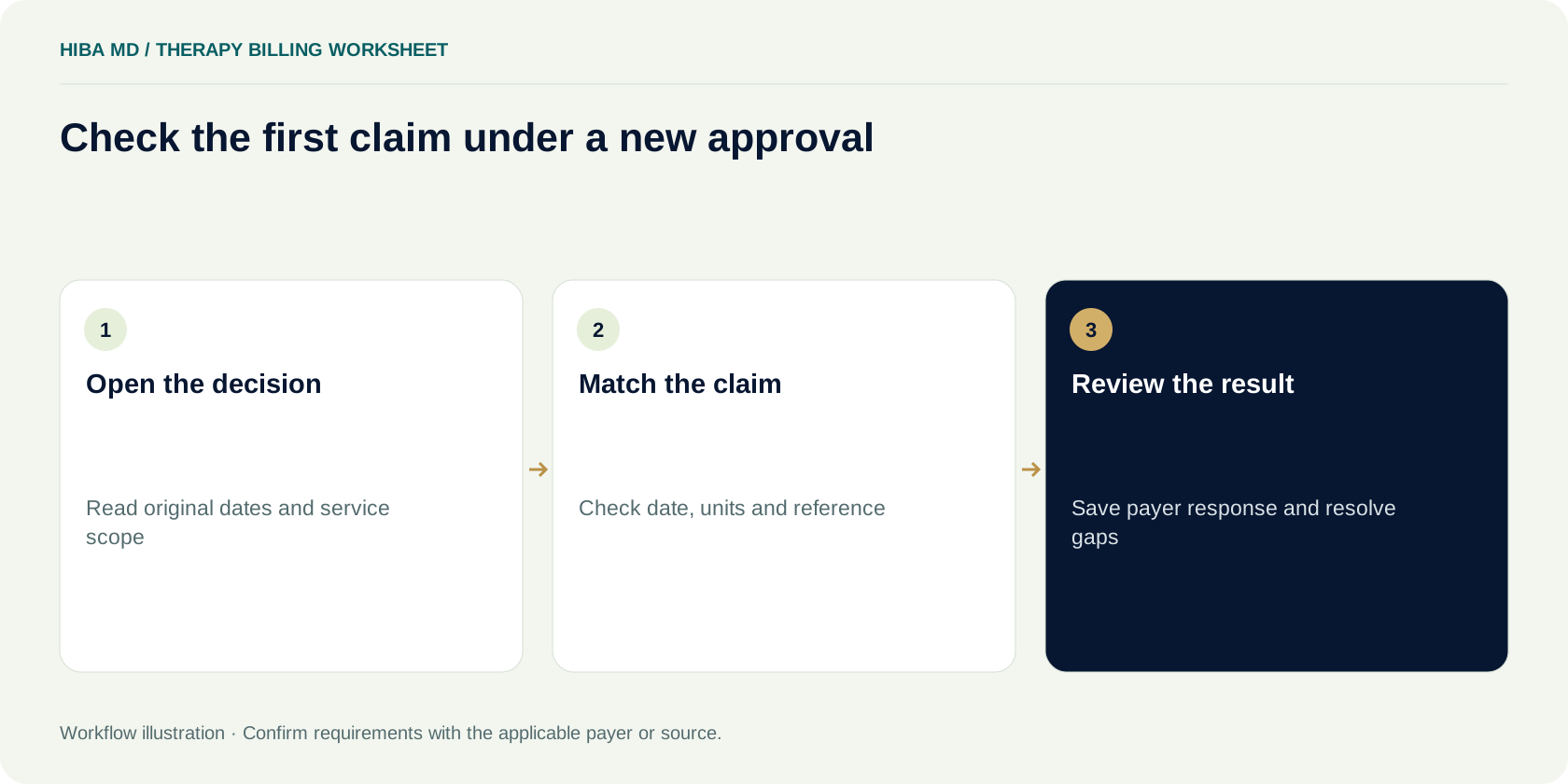
The first claim under a new approval is worth reading before it goes out. Compare the approved service and window to the actual treatment date, location, rendering details and documented units. Check the authorization reference where the payer expects it. Confirm that the payer on the claim matches the coverage verified for that date. The coordinator and the biller should each know which fields they own. An exception should go back with the specific discrepancy and a next action, so it spends less time in a generic hold queue.
Suppose a claim draft has a therapy line on November 11 and the payer determination starts November 12. Open the treatment note and the original approval to verify both dates. If the claim was entered with an incorrect date, correct the data using the record and document the change. If the encounter truly occurred on November 11, follow the payer's instructions to determine what options are available. Keep the documented service date accurate. An internal hold should include an owner and a deadline review so the claim is not forgotten while staff seek clarification.
Then look for evidence that the claim arrived and was processed. A clearinghouse acknowledgement, payer acceptance and a remittance report different stages. The first response that confirms transmission is a good time to record the tracking reference. On remittance, compare the payer response with the charge and your authorization record. TMHP's fee-for-service prior authorization chapter explains that approval alone does not guarantee reimbursement. Checking the first result can reveal an issue while the team still has time to review the rest of the series.
Work authorization denials from the evidence on the claim
When a remittance points to authorization, pull the response, the submitted claim and the original determination together. Start with the exact service line. Verify that the response applies to the right claim version and date. The biller can then tell whether the claim lacked a required reference, the payer had a different effective date, the service was outside the approved scope, or the payer's system shows a different balance. Keep the payer's stated reason separate from the clinic's diagnosis until there is enough evidence to connect them.
Use the route the payer specifies for the problem. A submission rejected before adjudication may need correction and resubmission. A claim denied after adjudication may have a correction, reconsideration or appeal process, depending on what the payer found. Record the applicable deadline, the source for that deadline, any required attachments and the confirmation when the next action is sent. Assign one person to track that next action. Repeated uploads without a case reference make it harder to know which response belongs to which submission.
Close the loop with the scheduling team if the issue can affect upcoming appointments. In a fictional example, a line denies because the payer says the approved quantity is exhausted. The clinic's ledger still shows two units. The poster checks whether a recently adjudicated claim used the units, the coordinator asks the payer for the relevant balance detail, and the scheduler flags the upcoming appointment for review. When the team resolves the mismatch, update the ledger with the evidence and explain how the next appointment was handled. In the closure note, identify the claim or payer response that explained the discrepancy.
Review a short exception list each week
A weekly review can start with authorizations nearing expiration, appointments at risk of exceeding a balance and claims waiting for an authorization decision. Sort by the next date when action matters. Put a service later this week near the top when a decision is outstanding. Give a filing deadline approaching in two days the same visibility, even if the appointment happened months ago. Each item should name the owner and the specific thing they need to verify. Keep completed cases in the history and clear them from the active queue.
Use totals with a defined denominator when you report patterns. For example, count authorization-related denials among adjudicated physical therapy claim lines for the same payer and period, with a consistent rule for replacement claims. If you start with encounters instead of claim lines, label the measure accordingly and use it consistently. Add a separate count of upcoming visits awaiting a decision. That scheduling measure answers a different question and gives the practice a way to see where patients may need a call. An authorization issue that holds up the first visit may never appear in last month's denial rate.
For the first month, choose one recurring discrepancy to investigate. If several approvals were used past the end date, walk through how the date gets from the portal to the schedule. If the balance is wrong, check where completed visits and remittance updates enter the ledger. A manager can review a small sample after the change and see whether a colleague opening the case can answer four questions without help. Which payer owns the date? What did it approve? What has the clinic used? Who is taking the next action? Bring aggregate counts and workflow questions to any outside billing review, and keep identifiable records inside the clinic's approved systems.
Frequently asked questions
Where do I check Texas Medicaid physical therapy authorization requirements?
For fee-for-service, use the current TMHP provider manual and the therapy handbook section that applies to the patient and setting. For managed care, confirm the member’s plan, its authorization instructions and any delegated submission channel.
Does a referral cover the treatment visits after the evaluation?
Check treatment authorization separately. The TMHP handbook describes prior authorization for post-evaluation treatment in its children’s and adult acute therapy sections. Keep the referral or supporting order with the request and record the payer’s actual determination when it arrives.
How should a clinic record an approval that lists both visits and units?
Keep one balance for visits and another for units, including any code-specific restrictions. Record what has been reserved, what the clinic estimates it has used and what the payer last confirmed, with dates for each balance check.
What if approved visits remain after the expiration date?
Check the dates on the determination and ask the payer about renewal or additional dates. Flag the planned appointment for review. The remaining quantity alone does not extend the approval period.
What should I check if the payer denies a line for missing authorization?
Compare the exact service line, the submitted claim and the original approval. Confirm the payer, date, service, quantity and authorization reference. Use the payer’s process for the issue you find and record the deadline and submission confirmation.
Can I calculate Texas Medicaid therapy units using Original Medicare rules?
Apply the instructions for the payer and service you are billing. The TMHP therapy handbook addresses Texas Medicaid units, while the CMS rehabilitation documentation fact sheet addresses Medicare. Keep the actual timed treatment minutes for review.
Sources and editorial notes
Written by the Hiba MD editorial team. Reviewed 2026-11-08. Worked examples use illustrative figures, not client results or performance benchmarks. This guide explains administrative workflows; check current payer requirements for claim-specific decisions.
